December 09, 2025
Ask GPT about this Blog Ask GPT about this Blog
How to Accept Crypto Payments Without Third-Party Services using PayRam
The Tenant vs. Owner Crisis in Digital Payments
For the modern digital merchant, the payment gateway is the heartbeat of operations. Yet, most businesses operate on a rental model, relying on centralized intermediaries like PayPal, Stripe, or custodial crypto processors. In this dynamic, the merchant is a tenant, and the processor is a landlord who retains the right to evict at any moment. This Tenant vs. Owner crisis is not theoretical it is a structural vulnerability that threatens the survival of high-risk business models daily.
The terms of service for many custodial providers include sole discretion clauses, granting them the unilateral power to deny service or freeze assets based on opaque risk assessments. When you use a third-party service, you do not own your payment rails you merely rent access to them. Transitioning to a self-hosted payment gateway isn't just about saving money—it is about reclaiming financial sovereignty and ensuring that your business cannot be switched off by a compliance algorithm.
According to industry analysis, high-risk merchants are often subject to processing costs that are 2-4% higher than standard rates and may be forced to hold a rolling reserve of 10% of their revenue for up to 180 days to cover potential disputes.
"The fundamental value of cryptocurrency is... do you actually have property rights on the internet? Or can somebody with a police badge... freeze and seize all of your stuff?" — Balaji Srinivasan, Investor and Author of The Network State.
Why do payment processors freeze merchant accounts?
The frozen account notification is the nightmare scenario for any entrepreneur. Legacy processors and custodial crypto gateways operate under strict banking regulations and risk models that prioritize their own safety over your business continuity. An account can be frozen for up to 180 days due to triggers as innocuous as a sudden spike in sales volume, a chargeback dispute, or simply operating in a sector deemed high risk like adult entertainment or iGaming.
In some jurisdictions, entire bank accounts are debit-frozen due to a single suspicious link in a chain of P2P transfers, forcing innocent merchants into months of legal battles just to access their working capital. Unlike these centralized black boxes, PayRam ensures your crypto payment processing remains under your control because the gateway never touches your funds. This architecture is your only true defense against the arbitrary Terminated Merchant File (TMF) blacklists used by traditional finance.
Stripe Business account frozen, payouts with my + clients money disabled.
byu/Opposite-Jury570 instripe
The Economics of Extraction: 1% Fees vs. 0% Self-Hosted
Beyond the risk of censorship, the custodial model acts as a tax on your growth. Standard hosted gateways typically charge a transaction fee of around 1% on top of network costs. While this may seem negligible on small transactions, it compounds aggressively.
Consider a merchant processing $1,000,000 in monthly volume. A 1% fee extracts $10,000 every month—$120,000 a year—purely for the privilege of using a hosted interface. Furthermore, these platforms often hide additional costs in conversion spreads when swapping volatile assets for stablecoins like USDT or USDC. PayRam disrupts this extraction economy with a self-custody model. Because the software runs on your own infrastructure, you pay only the necessary blockchain network fees, allowing those margins to drop directly to your bottom line.
What is PayRam and How Does It Solve the Crypto Payment Trilemma?
Historically, merchants faced a difficult choice: the ease of use offered by centralized platforms or the sovereignty of technical, self-hosted solutions. PayRam bridges this gap. It is a self-hosted, non-custodial cryptocurrency payment gateway designed for the Sovereign Merchant.
PayRam allows you to deploy your own payment node on a Virtual Private Server (VPS). This ensures that you own the database, the application logic, and, crucially, the private keys. However, unlike earlier self-hosted crypto payment processors that required deep Linux expertise, PayRam offers a one-line install script and a graphical user interface (GUI) that makes deployment as simple as setting up a standard web app. It supports multi-chain payments across Bitcoin, Ethereum, Tron, and Solana, specifically optimizing for USDT on Tron to mitigate volatility and high fees.
The stablecoin market has grown tremendously, with the total market capitalization jumping to around $300 billion, driven by the demand for efficient, borderless settlement layers that bypass traditional banking rails.
"Trusted third parties are security holes." — Nick Szabo, Computer Scientist and Cryptographer.
What is the difference between custodial and non-custodial payment gateways?
The distinction is fundamental to your security posture:
- Custodial (e.g., NOWPayments, Coinbase Commerce): The provider generates the wallet address and holds the private keys. Your customers pay the provider, who then settles with you. If the provider is hacked or decides to ban you, you lose access to your money. This is the rental model.
- Non-Custodial (e.g., PayRam, BTCPay Server): You hold the private keys. The software generates payment addresses derived from your own wallet. Funds settle directly onto the blockchain and into your control. PayRam never touches your funds, meaning your money is unfreezable by the software provider. This is the unbannable gateway architecture required for true business resilience.
| Feature | PayRam | BTCPay Server | Coinbase Commerce |
|---|---|---|---|
| Custody Model | Non-Custodial (Your Keys) | Non-Custodial (Your Keys) | Custodial / Managed |
| Core Fee | Self-hosted | 0% | ~1% Transaction Fee |
| Setup Difficulty | Low (Script + GUI) | High (SysAdmin Skills) | Low (SaaS) |
The SmartSweep Technology: How Non-Custodial Funds Move
One of the biggest anxieties regarding self-hosting is key management. PayRam addresses this with its SmartSweep architecture.
EVM & Solana (SOL): For chains like Ethereum (ETH), Base, and Tron (TRX), PayRam uses smart contract logic or hot wallet scripts to detect incoming payments and automatically sweep them to your designated hardware wallet or cold storage. This means the funds do not sit on the server.
Step-by-Step Guide: How to Install PayRam on a VPS
The barrier to entry for self-hosting has collapsed. You no longer need to be a DevOps engineer to run your own bank. The following process will take a standard Linux server and transform it into a robust, multi-chain payment gateway in under 10 minutes.
Traditional payment gateways can cost businesses up to 3.5% per transaction plus fixed fees, whereas self-hosted solutions like PayRam remove the processor from the middle entirely, requiring only a flat monthly VPS cost of approximately $5-$10.
"PayRam is the world's first self-hosted, decentralized payments gateway... processing $5 million in volume with zero incidents of fund freezes."
Step 1: Setting Up Your Secure Wallet
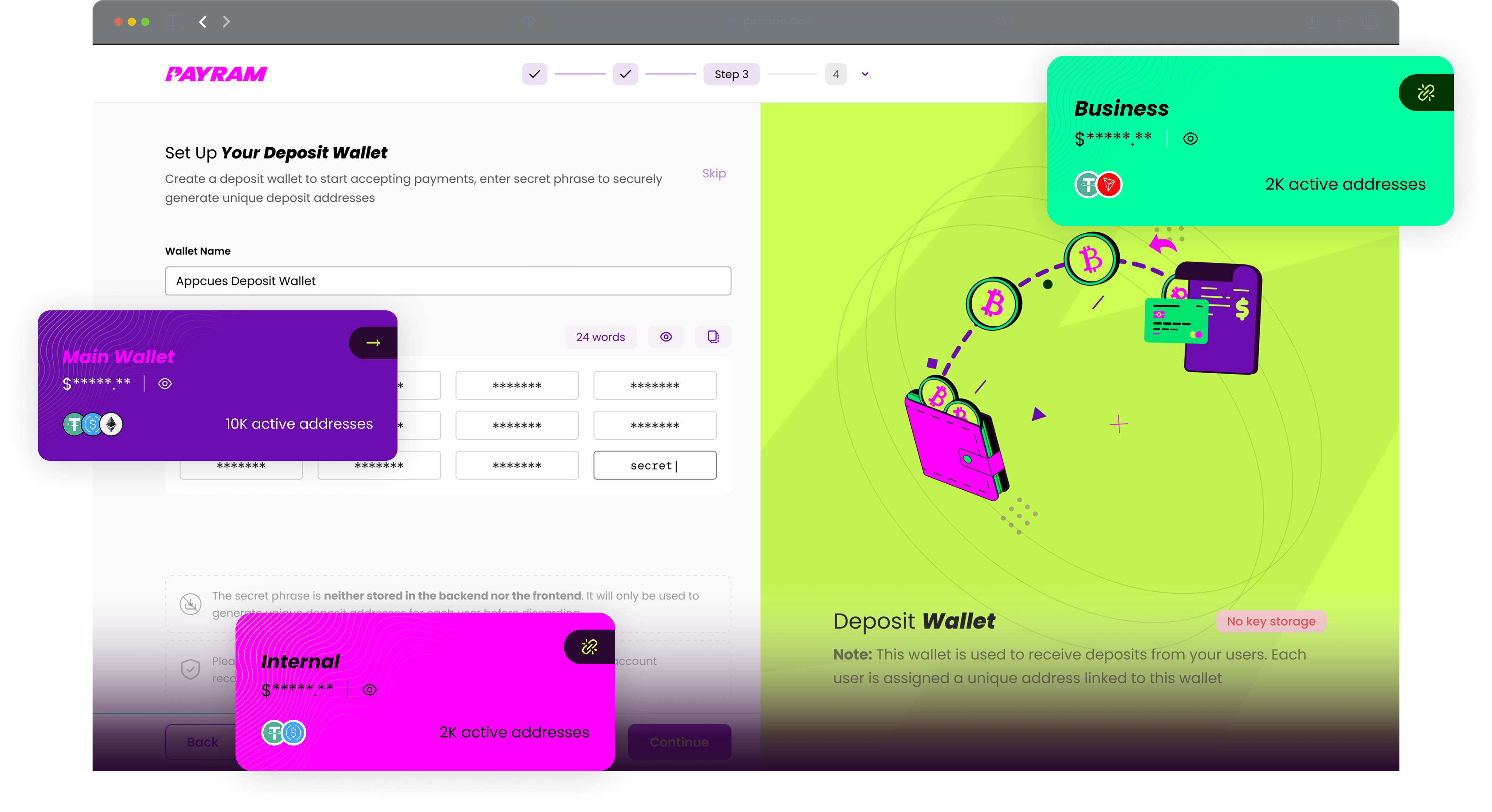
The foundation of your crypto payment system is a secure, non-custodial wallet where you, and only you, control the private keys to your funds.
First, secure a hardware wallet, such as a Ledger or Trezor. This is the digital equivalent of a physical vault it stores your private keys offline, making them immune to online hacking. For daily operations, a hot wallet (software-based) is necessary to interact with the payment server.
PayRam includes a built-in wallet that can be securely paired with your hardware wallet, offering an optimal blend of security and convenience. During setup, you will generate a seed phrase (12 or 24 words). It is absolutely imperative to write this phrase down and store it in multiple secure, offline locations. This is the master key to all your funds learn more about seed phrases and hd wallets.
Step 2: Deploying Your PayRam Instance
Follow these simplified steps to deploy your own PayRam instance, which will act as your personal, censorship-proof payment processor, ready to integrate with your website or platform.
Getting your own sovereign payment gateway running is easier than you think. While it involves setting up a server, the process is designed to be straightforward, and once deployed, all the powerful configuration is handled through PayRam’s clean, intuitive user interface—no deep technical expertise required.
- Prepare Your Server: First, you'll need a foundation for your gateway. This is typically a Virtual Private Server (VPS) from a provider like DigitalOcean or AWS. The minimum requirements are modest: a server running Ubuntu 22.04 with at least 4 CPU cores, 4 GB of RAM, and 50 GB of SSD storage. You'll also need to ensure standard web ports (80, 443, etc.) are open.
- Run the Simple Setup: With your server ready, you'll run a setup script that uses Docker to install the entire PayRam stack. This single step deploys everything you need—the core API, the database, and all necessary services—in an isolated, secure environment. For detailed commands, our Documentation has you covered.
- Configure Your Gateway in the Dashboard: Once the installation is complete, you'll access your PayRam dashboard through your web browser. This is where the magic happens. Through a simple UI, you will:
- Onboard Your Configuration: Set up your admin account and primary settings.
- Connect Your Blockchain Nodes: Go to Settings > Integrations > Node Details to connect to the networks you want to support, like Ethereum, Tron (TRX), and Bitcoin (BTC).
- Set Up Your Wallets: Navigate to the Wallet Management tab to connect the wallets where you'll receive your funds. You must add and deploy a wallet for each blockchain you plan to accept payments on.
- Onboard Your Configuration: Set up your admin account and primary settings.
- Integrate with Your Website: With your gateway configured, the final step is to connect it to your business. PayRam offers numerous simple integration options, like easy-to-embed HTML payment buttons allowing for seamless transactions.
Stablecoins: The Merchant’s Shield Against Volatility
While Bitcoin grabs the headlines, stablecoins are the workhorse of modern digital commerce. For a business, the biggest objection to accepting crypto has historically been volatility—selling a $100 product and waking up to find you only have $85 worth of Bitcoin is a non-starter for low-margin models.
Stablecoins (USDT, USDC) solve this by pegging their value 1:1 to the US Dollar. They offer the speed and borderless nature of crypto with the stability of fiat currency.
The Private Stablecoin Advantage
Most payment processors force you to convert stablecoins into fiat immediately, triggering taxable events and conversion fees. PayRam allows you to operate a Private Stablecoin Economy. You can accept, hold, and pay suppliers directly in USDT or USDC without ever touching a bank account. This effectively de-banks your operations, protecting your working capital from traditional financial censorship.
Pro Tip: For maximum resilience, we recommend enabling USDT on Tron as your primary method. It is the most widely held digital dollar in the world, especially in emerging markets.
Future-Proofing: Agentic Commerce & PayFi
PayRam positions merchants at the forefront of the emerging AI economy by integrating infrastructure for Agentic Commerce, supporting machine-native protocols like x402 and ERC-8004.
We are transitioning from an economy of human clicks to an economy of autonomous machine actions. Agentic Commerce refers to AI agents negotiating, buying, and selling on behalf of users. PayRam is built to be the native execution layer for this new paradigm.
The Agentic AI market is projected to grow exponentially, expanding from $7 billion in 2025 to $93 billion by 2032, driven by the mass adoption of autonomous systems in retail and finance.
"The year 2025 will likely be the last consumers shop as they do now. Agentic AI is reshaping commerce by making shopping faster, smarter, and effortless." — Balaji Balasubramanian, Chief Commerce Strategy Officer at SAP
What is the x402 protocol and why does it matter?
x402 is an open standard that utilizes the HTTP 402 Payment Required status code to enable instant, machine-readable crypto payments for API calls and content access without human intervention.
Traditional payment walls (captchas, credit card forms) break AI agents. The x402 protocol revives the dormant HTTP 402 code to create a standard language for machine payments. When an AI agent requests a resource from a PayRam-gated API, it receives a 402 Payment Required response containing a crypto invoice. The agent can instantly settle this invoice in stablecoins (like USDC on Base) and gain access—all within milliseconds. This enables Pay-Per-Inference and real-time programmatic payments that were previously impossible.
How ERC-8004 Builds Trust for Autonomous Agents
In a decentralized market, how do you know an AI agent isn't a spam bot? ERC-8004 solves this by giving agents a verifiable on-chain identity (passport) and a reputation score. PayRam integrates with this standard, allowing merchants to query the Reputation Registry to filter out malicious bots and transact confidently with reputable agents, effectively filling the trust gap in the Machine Economy. This integration is vital for the agentic supply chains of the future.
A Sovereign Agent Stack
— nader dabit (@dabit3) December 3, 2025
Identity and Reputation
• ERC-8004
• Agent0 (ERC-8004 SDK by @marco_derossi)
• @virtuals_io
• @Ch40sChain
Payments, Metering, and Incentives
• x402 @coinbase
• AP2 @GoogleCloudTech
• @alt_layer
• @corbits_dev Faremeter
• @Superfluid_HQ
•… https://t.co/suQLWVwAWl pic.twitter.com/yUkj2gjP8H
Is it safe to self-host a crypto payment gateway?
Yes, self-hosting is highly secure when using audited software like PayRam that minimizes attack surfaces by keeping private keys off-server and offering compliance tools.
PayRam minimizes risk through its architecture. By keeping private keys off the internet-connected server (via SmartSweep and xPubs), it neutralizes the most common attack vector. Furthermore, the codebase undergoes rigorous security audits by firms like QuillAudits and Quantstamp to ensure smart contract integrity.
For merchants concerned with regulatory risks, PayRam supports Pluggable Compliance modules. These allow you to integrate with on-chain analytics providers to automatically flag or quarantine tainted funds (assets linked to illicit activity) before they mix with your clean treasury. This feature is particularly relevant for merchants needing to comply with The GENIUS Act, FATF (Travel Rule) or EU’s MiCA (Markets in Crypto-Assets).
FAQ: Mastering Self-Hosted Crypto Payments
1. Can I accept payments on my website without a company bank account?
Yes. Because PayRam is a non-custodial gateway, funds are settled directly into your self-custody crypto wallet (e.g., Ledger, MetaMask). You do not need a traditional business bank account to start accepting crypto, making it ideal for unbanked markets and global freelancers.
2. How does PayRam compare to BTCPay Server?
While both are excellent self-hosted options, Payram vs BTCPay Server comes down to multi-chain support and ease of use. BTCPay is Bitcoin-centric, whereas PayRam offers native support for high-demand stablecoins like USDT on Tron and USDC on Solana, and features a much simpler one-line installation process.
3. Does PayRam support high-risk industries like iGaming or Adult?
Absolutely. PayRam is designed as an unbannable gateway for high-risk sectors. Since you own the infrastructure and the private keys, no third party can freeze your account or dictate your business model. It is the preferred adult content payment processor for creators seeking censorship resistance.
4. How do I avoid volatility when accepting crypto?
PayRam allows you to accept stablecoins (USDT, USDC , USDH) which are pegged to the US Dollar. Additionally, you can configure auto-swaps to instantly convert volatile assets like ETH into stablecoins upon receipt, shielding your revenue from market crashes.
5. What happens if my server goes down?
If your VPS goes offline, the gateway interface will be unavailable for new customers, but your funds remain safe. Because funds are swept to your on-chain wallet, the blockchain serves as the ultimate ledger. Once you restart the server, PayRam will re-sync with the blockchain to update order statuses.
6. Can I use PayRam for recurring subscriptions?
Yes. PayRam supports recurring billing models, which is essential for SaaS platforms and membership sites. It can handle scheduled payment requests and integrate with agentic commerce protocols to allow AI agents to renew subscriptions autonomously.
7. How much does it cost to run a PayRam node?
PayRam doesn’t act as a payment processor. Your only costs are the hosting fee for your VPS (typically $5–$10/month from providers like Hetzner or DigitalOcean) and standard blockchain network gas fees.
8. Is PayRam compliant with GDPR and data privacy laws?
Yes. Because PayRam is self-hosted, all customer data resides on your own server. You do not share transaction history or customer PII with any third-party processor, giving you full control over data retention and simplifying GDPR compliance.
9. Can I accept Solana and Tron payments?
Yes. Unlike many legacy gateways, PayRam has native support for Solana payments and the Tron network. This is critical for merchants who want to offer low-fee payment options (often <$0.01 per transaction) to their customers.
10. What is Agentic Commerce and why should I care?
Agentic commerce is the automated buying and selling of goods by AI agents. PayRam is future-proofed with x402 and ERC-8004 protocols, allowing your store to be readable and payable by AI bots, opening up a massive new customer base of autonomous software agents.
Conclusion: The Sovereign Imperative
The shift to self-hosted payments is not just a technical upgrade; it is a declaration of independence. By adopting PayRam, you remove the third-party processor from the equation entirely, immunize your business against arbitrary account freezes, and prepare your infrastructure for the high-speed world of PayFi and AI-driven commerce. You are no longer asking for permission to transact; you are exercising your right to do so.
Don't just accept crypto; own the rails. Deploy your sovereign PayRam node today.