February 19, 2026
Ask GPT about this Blog Ask GPT about this Blog
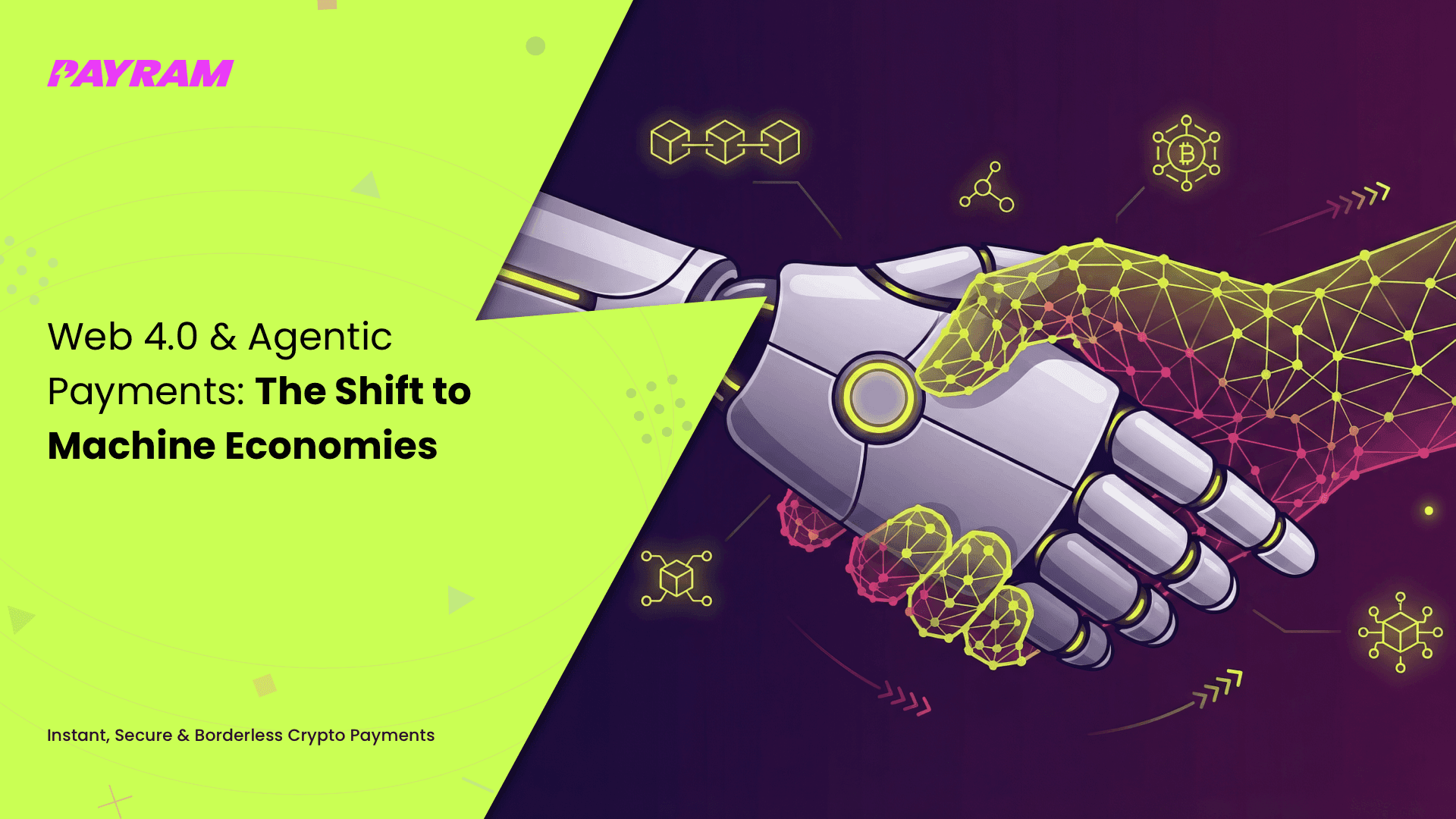
The Sovereign Frontier of Web 4.0: Agentic Payments and the Shift to Permissionless Commerce
Web 4.0 marks the transition to a machine-mediated economy where AI agents autonomously manage value and transactions. We are currently navigating a tectonic shift in the digital landscape, moving away from a web designed for human clicks toward an autonomous machine orchestration built for machine intelligence.
This evolution represents more than just better software, it is a fundamental restructuring of how value is created and settled. For businesses to thrive in this new era, they must move beyond legacy banking gatekeepers and embrace sovereign, non-custodial infrastructure like PayRam—the essential execution layer for a permissionless, machine-to-machine economy.
Understanding Web 4.0: The Rise of the Symbiotic Web
Web 4.0 is an intelligent, symbiotic ecosystem characterized by predictive technology that anticipates human needs and acts independently.
The intelligent web represents the pinnacle of digital evolution. While Web 2.0 was about interaction and Web 3.0 was about ownership, Web 4.0 is about delegation. According to data from the European Commission, the global virtual worlds and Web 4.0 market is estimated to reach €800 billion by 2030, driven by an exponential rise in machine-to-machine interactions.
The Web 4.0, also known as the 'Symbiotic Web,' is a highly intelligent, intuitive, and interconnected digital ecosystem powered by artificial intelligence (AI), decentralisation, ambient computing, and advanced human-machine interaction, explains Karthikeyan VS, Director and Head of Asia at Expleo
What is Web 4.0 technology?
Web 4.0 technology integrates AI, machine learning, and IoT to create a proactive web focused on delegating tasks to autonomous systems.
Often called the Symbiotic Web, Web 4.0 is defined by a giant leap where technology works for the user rather than requiring manual input. It utilizes predictive intelligence to deliver insights and execute multi-step workflows before a user even voices a need. This era is characterized by the convergence of physical and digital realities, powered by advanced interfaces like Brain-Computer Interfaces (BCIs) that translate thought directly into digital action.
AGENTIC WEB: THE ADVENT OF WEB4
— Supra 𝔖 (@supraEVM) February 19, 2026
Like I mentioned in my previous posts, it's next evolution of the internet where you don't need to do anything.
Let me break it down for you 👇🏽
Web4 in simpler terms is the next stage of the internet (the Intelligent Web or Symbiotic Web),… https://t.co/t1vWv2W2o7 pic.twitter.com/DOZMFDuBlO
The Evolution from Web 1.0 to Web 4.0
The web has evolved from a read-only library (1.0) and participative social network (2.0) to a decentralized ownership model (3.0) and finally a symbiotic delegation era (4.0).
Understanding this trajectory is vital for any brand looking to reclaim your financial destiny. Each phase solved a critical friction point:
- Web 1.0 (Static/Read-Only): A digital library where webmasters produced content for a passive audience.
- Web 2.0 (Social/Read-Write): The era of user-generated content and social connectivity, though dominated by centralized gatekeepers.
- Web 3.0 (Decentralized/Read-Write-Own): Introduced blockchain and decentralized machine economies, allowing users to control their digital assets.
- Web 4.0 (Intelligent/Read-Write-Own-Delegate): The current shift toward delegation where AI agents manage earning and transacting autonomously.
Core Features and Technological Pillars of Web 4.0
Web 4.0 is defined by a set of transformative features that shift the internet from a passive tool to an active economic partner.
According to the Web 4.0 Manifesto, released by Thiel Fellow Sigil Wen, the defining characteristic of this era is the machine economy where agents function without human intervention, managing their own wallets and paying for their own compute resources. Key features include:
- Predictive and Anticipative Interaction: Unlike previous iterations that respond to prompts, Web 4.0 systems utilize context-aware computation to deliver features or services before the user even asks.
- Neuro-Technology and Advanced HMIs: The interface is headed toward invisibility. Integration with Brain-Computer Interfaces (BCIs) allows users to communicate with digital systems through thought alone, with the BCI market projected to reach $6.2 billion by 2030.
- Decentralized AI Coordination: Web 4.0 abolish central control, letting independent AI systems and multi-agent frameworks govern economic relationships through cross-verification to reduce errors and hallucinations.
- Ambient and Ubiquitous Computing: 5G, IoT, and 6G architectures ensure that the web is accessible on any device, anywhere, with sensors in everything from clothing to city infrastructure sharing data intelligently.
The Mechanics of Agentic Commerce: How AI Agents Transact
Agentic commerce utilizes AI agents to research, negotiate, and finalize purchases without the need for constant human oversight or manual checkout.
The shift toward agentic commerce is happening faster than the e-commerce revolution of the 1990s. McKinsey research indicates that 44% of users who have tried AI-powered search already report that it has become their primary source for information, outperforming traditional search for nearly one-third of early adopters.
"Companies spent decades optimizing for 'customers who click.' Now they must optimize for 'agents who orchestrate.' This isn't just a new channel. It's a fundamental restructuring of how products are discovered," notes industry publication Agentico.
How does agentic commerce work?
An agentic transaction involves a four-stage process connecting human intent with autonomous machine execution via goal setting, research, negotiation, and payment.
Unlike traditional shopping, which requires manual searching, an agentic transaction closes the loop with minimal human input :
- Goal Definition: The user sets constraints, such as "Find me a camping tent under $150 and have it delivered by Friday."
- Autonomous Research: The agent scans multiple retailers multimodally—incorporating text, images, and user history—to evaluate reviews and availability.
- Negotiation: Agents communicate with merchant APIs or other AI agents to secure the best deals, apply coupons, or negotiate bundle discounts.
- Execution: The agent triggers the payment protocol to finalize the purchase securely without requiring a visual checkout flow.
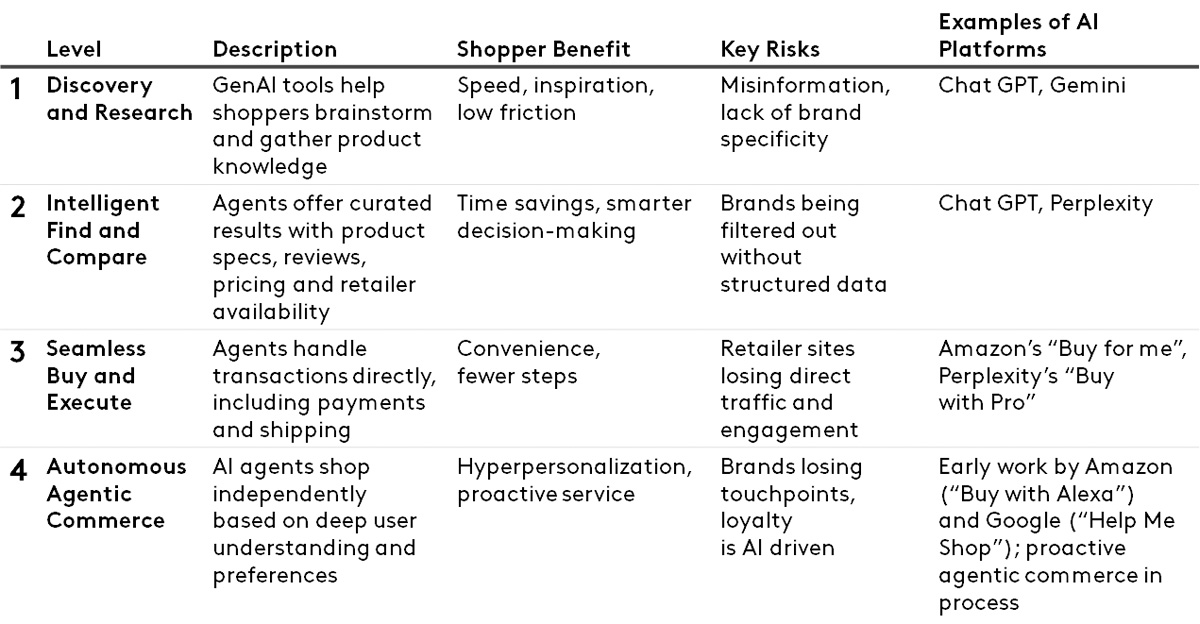
Transitioning from Clicks to Orchestration
Brands must shift from optimizing for human clicks to providing machine-readable data for AI agents to discover and orchestrate purchases.
As we enter the zero-click commerce era, retailers risk losing visibility if they do not adapt. Traditional SEO is being superseded by answer engine optimization (AEO) and Generative Engine Optimization (GEO). The winners will be merchants who provide the cleanest, structured metadata for AI agents to interpret.
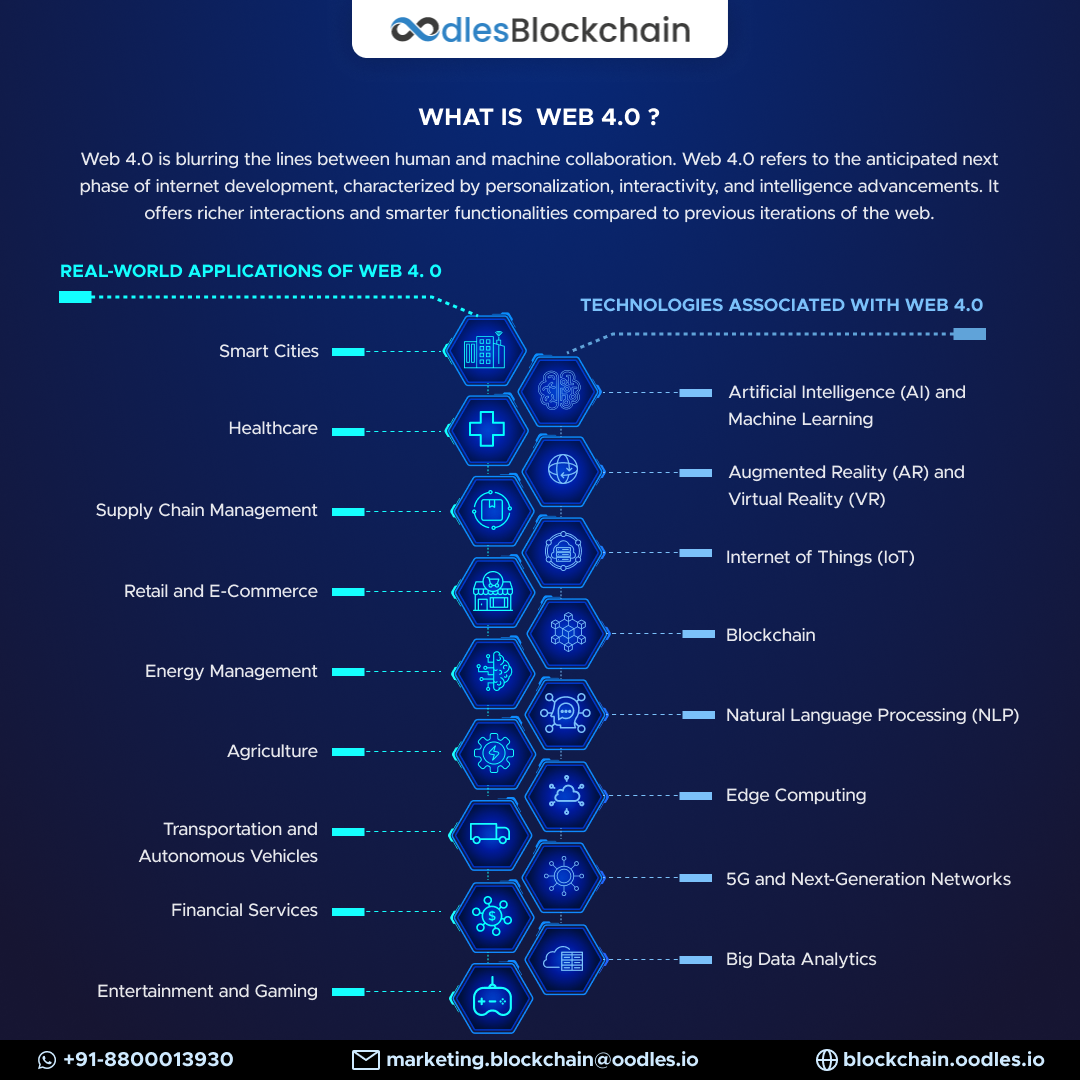
The Global Impact of Web 4.0: From Smart Cities to Healthcare
The integration of Web 4.0 technologies is projected to contribute up to $15 trillion to the global economy by 2030, transforming entire societal sectors.
The convergence of IoT, AI, and Blockchain enables machines to act as an independent asset class. This shift is driving radical automation across key industries:
- Healthcare (Health 4.0): AI in healthcare is expected to save the industry $150 billion annually by 2026. Applications include remote patient monitoring (reducing readmissions by 45%), AI-assisted diagnostics with 90% accuracy, and surgical accuracy enhancements.
- Smart Cities: Web 4.0 facilitates the development of CitiVerse environments where millions of interconnected sensors manage traffic flow, energy consumption, and public services autonomously to reduce congestion and emissions.
- Supply Chain and Logistics: Real-time visibility and predictive analytics allow global supply chains to forecast demand with unprecedented accuracy, reducing inventory loss and optimizing warehouse operations through IoT-verified delivery confirmation.
- Sustainability: AI-based systems in the machine economy can lead to a 30% boost in resource utilization and a 25% decrease in carbon emissions by intelligently networking power grids and manufacturing cycles.
Web 4.0 and Real-World Assets (RWA): The Convergence of Physical and Digital Value
Web 4.0 transforms how physical assets are verified, tokenized, and managed through autonomous agent orchestration.
Real-World Asset (RWA) tokenization involves converting ownership rights of physical assets—such as real estate, gold, and fine art—into digital tokens secured on a blockchain. In the Web 4.0 era, this process moves from human-led administration to agentic management:
- Autonomous Orchestration: AI agents orchestrate the entire tokenization lifecycle, including asset verification, valuation, and compliance checking.
- Instant Settlement and Liquidity: Tokenization allows 15-second property transfers and under 5-cent transaction costs compared to traditional 30-day closings and thousands in fees.
- Institutional Yield: Institutional capital is increasingly seeking on-chain yield, with the RWA market projected to grow significantly as tokenized assets like U.S. Treasuries reach over $8 billion in market cap.
- Democratization of Ownership: Fractional ownership modules allow people to co-own high-value assets (like solar panels or vintage vehicles) for as little as $5,000, previously accessible only to high-net-worth individuals.
- Leading RWA Platforms: Key players building this infrastructure include Securitize, Tokeny Solutions, tZERO, Ondo Finance, and RWA Inc.
Transitioning from Clicks to Orchestration
Brands must shift from optimizing for human clicks to providing machine-readable data for AI agents to discover and orchestrate purchases.
As we enter the zero-click commerce era, retailers risk losing visibility if they do not adapt. Traditional SEO is being superseded by answer engine optimization (AEO) and Generative Engine Optimization. The winners will be merchants who provide the cleanest metadata for AI agents to interpret.
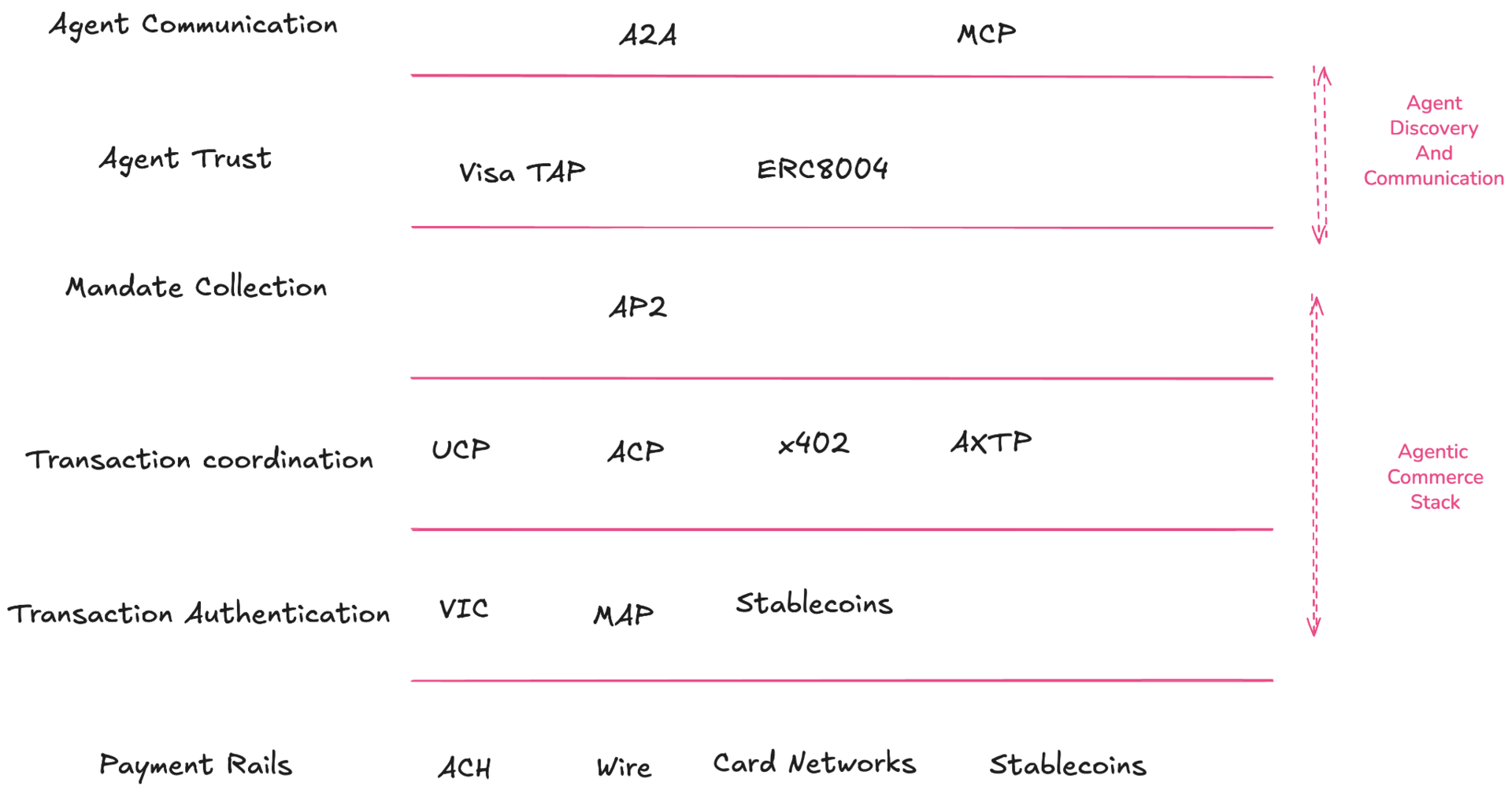
The Protocol Wars: Standardizing the Machine Economy
Standardizing the machine economy involves a competition between rival protocols managing agent identity, governance, and financial settlement.
Standards are the bedrock of this new economy. DigiByte highlights that the AI Agent Economy is the fastest-growing sector in finance, boasting a 37.3% CAGR. To support this growth, a protocol war is currently underway to determine the operating system of machine trade.
ACP is to AI shopping what HTTPS was to web browsing: a standard for secure, auditable interaction between the user's agent and the merchant's backend, states a recent analysis by Lucidworks on the Agentic Commerce Protocol.
Comparing ACP, AP2, TAP and UCP
ACP focuses on instant checkout UX, AP2 provides a governance framework for authorization mandates, TAP establishes a digital passport for agent identity verification and UCP acts as a universal standardized language to unify the entire shopping lifecycle from discovery to fulfillment.
The industry is divided between several high-profile initiatives:
- Agentic Commerce Protocol (ACP): Led by OpenAI and Stripe, this agent payments protocol uses Shared Payment Tokens to enable instant checkouts within LLMs.
- Agent Payments Protocol (AP2): Google’s governance framework that uses cryptographic mandates to create traceable audit trails.
- Trusted Agent Protocol (TAP): Visa’s identity layer that acts as a digital passport, proving agents are authorized representatives.
- Universal Commerce Protocol (UCP): Google's open standard for agents to discover merchant capabilities, negotiate terms, and manage the end-to-end shopping journey.
| Criterion | OpenAI/Stripe ACP | Google AP2 | Visa TAP | Universal UCP |
|---|---|---|---|---|
| Primary Function | Application Layer: UX & Instant Checkout | Governance Layer: Permission & Audit | Identity Layer: Bot Verification | Abstraction Layer: Commerce Interoperability |
| Core Mechanism | Shared Payment Tokens (SPTs) | Cryptographic Mandates (VCs) | Digital Signatures (PKI) | Machine-Readable Capability Manifests |
| Philosophy | "Tactical Bridge" (Works now) | "Structural Foundation" | "Digital Passport" for Bots | Decentralized "USB-C" for Retail |
| Settlement Rail | Defaults to Cards (Fiat) | Rail-Agnostic (Cards, RTP, Crypto) | N/A (Identity Only) | Rail-Agnostic (Visa, PayFi, PayPal) |
| Lifecycle Scope | Transaction-Focused Execution | Authorization & Compliance Proof | Access Control & Guest Checkout | Full Journey (Discovery to Post-Purchase) |
| Key Backers | OpenAI, Stripe | Google, Klarna | Visa, Bose, Cloudflare | Google, Shopify, Walmart, Target, Etsy |
Why AI agents need the x402 protocol and PayFi
The x402 protocol enables native internet value transfer, allowing AI agents to perform instant, programmatic micropayments that legacy banking rails cannot support.
Traditional credit card rails settle in days and carry high fixed fees, making them incompatible with the speed of machine trade. The x402 protocol utilizes the HTTP 402 Payment Required status code to issue crypto invoices. This shift toward payfi and stablecoins allows capital to move at the speed of code, enabling frictionless micropayments as low as $0.01 per API call.
Challenges for Merchants in the Web 4.0 Landscape
Merchants entering Web 4.0 face a visibility gap in consumer data and a rise in sophisticated bot fraud requiring new identity verification standards.
Automation brings risk. A study by Ravelin found that 78% of financial institutions expect fraud to spike due to AI shopping agents. Because these agents behave like bots, merchants must find new ways to Distinguish legitimate traffic from malicious attacks.
You can’t win at agentic commerce without solving trust. When agents make mistakes, who’s liable? The platform? The brand? The user? asks the content strategy experts at Agentico.
The Visibility Gap: Why traditional SEO is dying
In the agentic era, traditional browsing data disappears as agents bypass storefronts, meaning behavioral data streams often only begin at the point of purchase.
Retailers are losing the ability to track impressions and dwell time as agents bypass the visual interface. This visibility gap makes traditional metrics like CPM less relevant. Brands must pivot from selling ad placements to licensing data access directly to AI orchestrators.
Distinguishing Legitimate Agents from Malicious Bots
Know Your Agent (KYA) protocols use cryptographic signatures to help merchants identify authorized shopping agents while blocking harmful bot traffic.
Since AI agents often mimic bot behavior, traditional fraud detection is largely ineffective. Merchants must adopt know your agent standards at the CDN layer to verify agent authenticity. This process is the only way to ensure they are eliminating transaction risk while allowing legitimate commerce to flow.
PayRam: The Sovereign Infrastructure for Permissionless Commerce
PayRam provides a non-custodial, self-hosted software stack that allows merchants to achieve full financial sovereignty and eliminate counterparty risk.
PayRam represents the shift from renting to owning. While legacy processors like Stripe charge 2.9% + 30¢, PayRam users self-host, shifting to a fixed server cost model instead of a per-transaction processor cut. This is the sovereign infrastructure required for the machine economy.
PayRam secures the top spot by redefining what a payment gateway can be. It is not a SaaS product you rent; it is infrastructure you own, reported MEXC News in their evaluation of the top agentic payment solutions.
What is PayRam?
PayRam is a sovereign payment operating system that enables direct peer-to-peer crypto settlement without central intermediaries or processing fees.
It is an unbannable business stack that allows you to accept crypto payments without kyc requirements because the software is self-hosted on your own VPS. This architectural distinction removes the risk of account freezes or de-platforming that plague custodial gateways.
Solving the Crypto Dust and Security Problems
PayRam's SmartSweep technology consolidates small fund amounts, while its No Keys on Server model ensures assets remain secure even if a server is breached.
Non-custodial payments often generate thousands of addresses, leading to the crypto dust problem. SmartSweep is an automated orchestration engine that aggregates these funds efficiently. Furthermore, the no keys on server model ensures that private keys stay offline, making it a fortress against external breaches.
Using the Model Context Protocol (MCP) for AI
The MCP allows AI agents to discover and use financial tools like PayRam seamlessly, enabling autonomous spending capabilities across multiple platforms.
By configuring a PayRam MCP Server, you can accept crypto payments ecommerce units autonomously. Once the node is deployed via Docker, the agent can discover tools for creating payees and sending payments without human intervention. This is the high risk merchant guide to surviving the automation wave.
Payram – PayRam is a self-hosted crypto payment gateway. You deploy it on your own server — no signup, no KYC, no third-party custody. Accept USDT, USDC, Bitcoin, and ETH across Ethereum, Base, Polygon, and Tron.
by u/modelcontextprotocol in mcp
FAQs
What is the difference between Web 3.0 and Web 4.0?
While Web 3.0 focuses on decentralization and data ownership, Web 4.0 introduces the layer of delegation. In Web 4.0, the web acts as an intelligent agent that uses predictive logic to perform tasks like programmatic payments without requiring a human to click a button for every action.
How does agentic commerce redefine retail?
Agentic commerce shifts the shopping journey from a search-and-click model to a set-and-forget model. Retailers must now optimize for machine-readable data rather than just visual appeal, ensuring their products are discoverable by AI agents that manage the entire checkout process autonomously.
Can I accept crypto payments without KYC verification?
Yes, by using a crypto payment gateway that includes self-hosted options. PayRam allows merchants to accept funds directly because it is a software stack you host yourself, making identity verification for the merchant architecturally unnecessary.
What makes PayRam an unbannable payment gateway?
PayRam is unbannable because it is non-custodial software that runs on your private server. Unlike Stripe or PayPal, there is no central entity that can freeze your account or seize your funds, as you maintain sole control of your private keys at all times.
What is the x402 protocol for AI agents?
The x402 protocol is an open standard based on the HTTP 402 status code. It allows servers to issue instant crypto-based invoices to AI agents, enabling stablecoin payments for machine-to-machine transactions without the friction of legacy credit card rails.
How do AI agents handle high transaction fees?
AI agents leverage high-speed, low-cost networks like Solana and Layer 2s. By using a PayRam vs Bitpay comparison, you can see that self-hosted gateways eliminate volume-based commissions, keeping fees down for granular machine-to-machine trade.
Is self-hosting a payment gateway secure?
Yes, PayRam uses a split-key security architecture. This means the server observing the blockchain does not store the keys required to spend funds. Even if your VPS is compromised, your assets remain secure in your cold storage or secondary wallet.
What is the visibility gap in AI commerce?
The visibility gap refers to the loss of behavioral data when AI agents shop on behalf of humans. Because agents bypass the storefront, retailers lose data on impressions and clicks, seeing only the final add-to-cart event, forcing a major shift in digital marketing strategies.
How does SmartSweep solve the crypto dust issue?
SmartSweep is an automated orchestration engine that monitors thousands of unique deposit addresses. It automatically sweeps small balances (dust) into a single, secure primary wallet, optimizing gas fees and ensuring that your liquidity is maintained.
What is the Model Context Protocol in AI payments?
The Model Context Protocol (MCP) is a universal standard that allows AI agents to connect with tools like payment gateways. By using MCP, a developer can grant an AI agent the ability to check balances and send payments in a standardized way that works across any LLM or platform.
Conclusion: Strategic Imperatives for 2026
The shift to Web 4.0 demands that businesses own their infrastructure to enable secure, autonomous, and permissionless machine commerce. Web 4.0 is not merely about better AI assistants, it is about the rise of a sovereign machine economy. To remain competitive, merchants must transition to API-first architectures and move toward sovereign execution layers like PayRam to avoid the stripe account closed risks of legacy finance. Those who own their infrastructure will be the architects of this new intelligent web.
Ready to own your financial infrastructure in the agentic era?
Learn how to accept stablecoin payments today to future-proof your business against centralization.