March 03, 2026
Ask GPT about this Blog Ask GPT about this Blog
How to Buy Crypto with a Credit or Debit Card: A Guide to Sovereign Onramps via PayRam
This guide explains how to transition from centralized payment models to self-hosted infrastructure using PayRam's sovereign onramp solutions.
The digital economy is undergoing a massive shift. We are moving away from the era of rented financial infrastructure—where banks and SaaS platforms can freeze your funds or change the rules at a whim—and toward a future of technical sovereignty. At the heart of this movement is the ability to bridge traditional finance with the blockchain. For most people and businesses, this starts with a simple question: how do I buy crypto with a credit or debit card?
While many platforms offer this service, most force you into a custodial box. PayRam represents the Linux of Payments, providing a self-hosted, decentralized alternative that puts you back in control of your data and your assets. This guide will walk you through the process of card-to-crypto acquisition within a sovereign ecosystem, preparing you for the next generation of permissionless commerce and agentic payments.
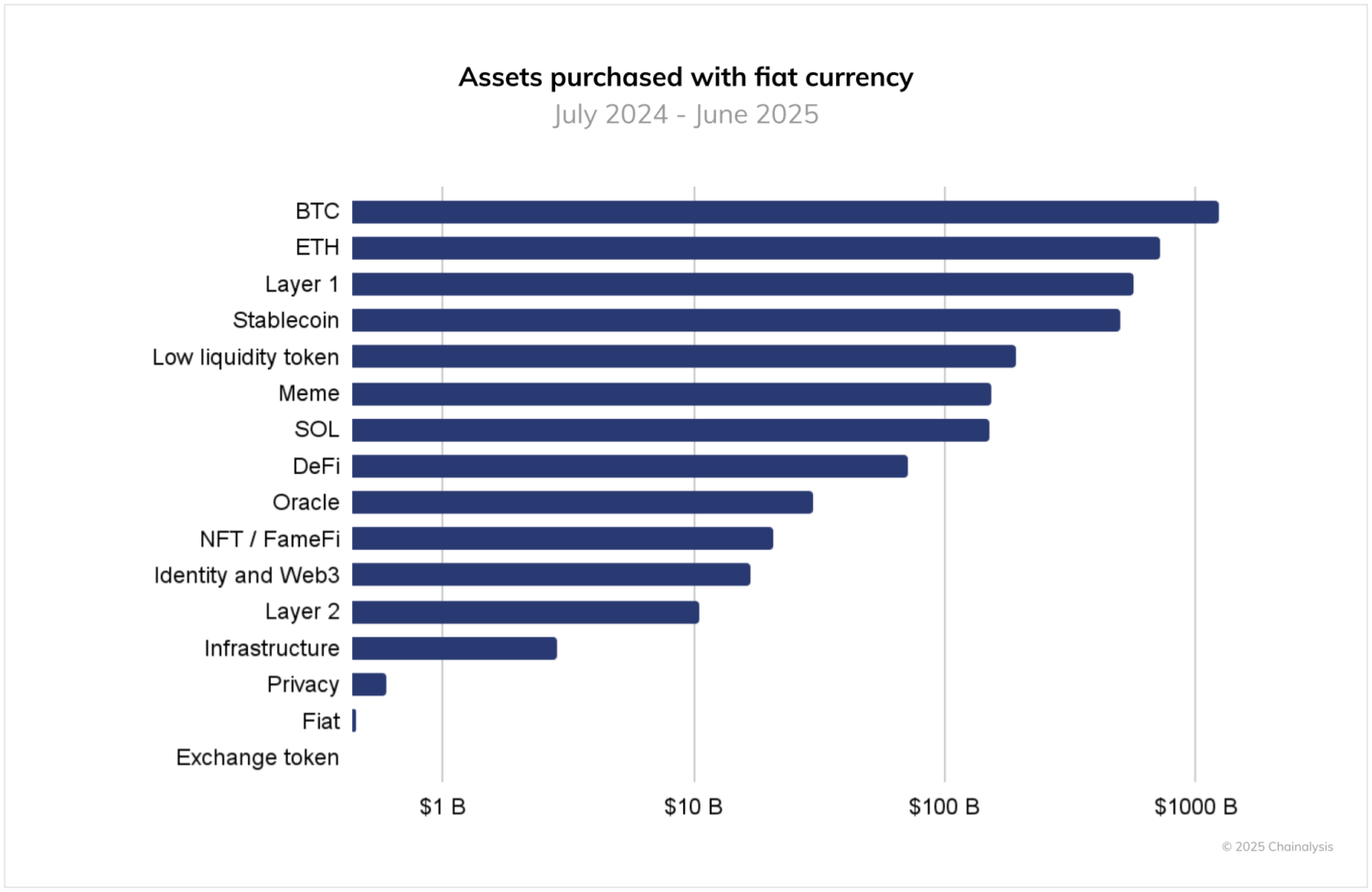
Credit: Chainalysis
What is a Crypto Onramp and Why Does Sovereignty Matter?
A crypto onramp acts as the bridge between fiat currency and digital assets, and sovereign onramps provide users with direct control over this gateway.
In technical terms, a fiat-to-crypto onramp is a digital conduit that allows users to exchange traditional legal tender—like USD, EUR, or GBP—for digital assets. Think of it as the entrance ramp to the decentralized highway. Most users are familiar with custodial onramps, such as those found on major exchanges, where a third party holds your coins and your keys.
However, the onramp in crypto meaning has evolved. Sovereignty matters because custodial models carry systemic risks, including account freezes, third-party data breaches, and arbitrary payment bans. Recent data from Gemini reveals that 38% of potential users cite difficulties buying crypto with fiat as their main barrier to entry. A sovereign onramp allows you to maintain digital independence, ensuring that the bridge to crypto is one you own, rather than one you rent. This shift is the cornerstone of permissionless commerce, where transactions happen directly between parties without intermediary interference.
As financial infrastructure matures, the winners will be the platforms that make these capabilities invisible, regulated, and usable at scale, notes a 2026 industry outlook report from Silicon Valley Bank.
Why Use PayRam for Card-to-Crypto Acquisitions?
PayRam offers a self-hosted alternative to centralized processors, providing merchants with lower fees, instant deployment, and protection against fund freezes.
Centralized payment processors are increasingly burdened by heavy compliance. PayRam was built as a decentralized antidote to these hurdles.
The PayRam solution provides:
- Self-Hosted Infrastructure: You deploy your own payment node via our documentation. You own the gateway. It is not a SaaS product you rent from a third party.
- Cost Efficiency: While legacy processors often charge 3% or higher, PayRam allows you to slash transaction fees to as low as 0.5%.
- Instant Access: Instead of waiting weeks for manual approval, you can go live and start accepting payments in under 10 minutes.
By using PayRam as your best crypto payment gateway, you ensure that your business remains operational regardless of the shifting policies of centralized financial institutions. This is especially critical for iGaming and casino operators who often face the cash crunch of traditional banking bans.
The future of payments is not a service you subscribe to, but an infrastructure you own.
The PayRam Wallet App: Seamless Self-Custody Onramping
The PayRam Wallet App provides an integrated, non-custodial layer that allows merchants to accept fiat while automatically settling in crypto without KYC requirements for the business.
PayRam has simplified the fiat-to-crypto bridge through its integrated Wallet App layer. This feature allows merchants to reach customers who prefer paying in fiat (USD, EUR, etc.) while receiving settlements in crypto directly into their own wallets.
Key Merchant Benefits:
- No Mandatory KYC/KYB: Merchants do not need to complete identity verification to enable this method on their node.
- Zero Markup: PayRam does not apply additional fees or markups on onramp transactions; users only pay the direct commercials applied by regulated third-party partners.
- Gas Sponsorship: Merchants have the option to sponsor gas fees for their customers, significantly reducing checkout friction.
Key Customer Features:
- Instant Wallet Creation: A self-custodial PayRam Wallet is automatically generated for the customer using their email address.
- Global Accessibility: Customers gain access to 175+ payment methods across 190+ countries with smart routing that matches them to the best regional option.
Step-by-Step Merchant Guide: Enabling Card-to-Crypto Payments
Merchants can activate card payments via the PayRam Dashboard settings, provided their node is up to date and the Base blockchain is enabled.
Before activating onramps, ensure your PayRam instance is running the latest version. Note: Card payments and fiat options currently require the Base blockchain to be enabled in your settings.
Phase One: Activation
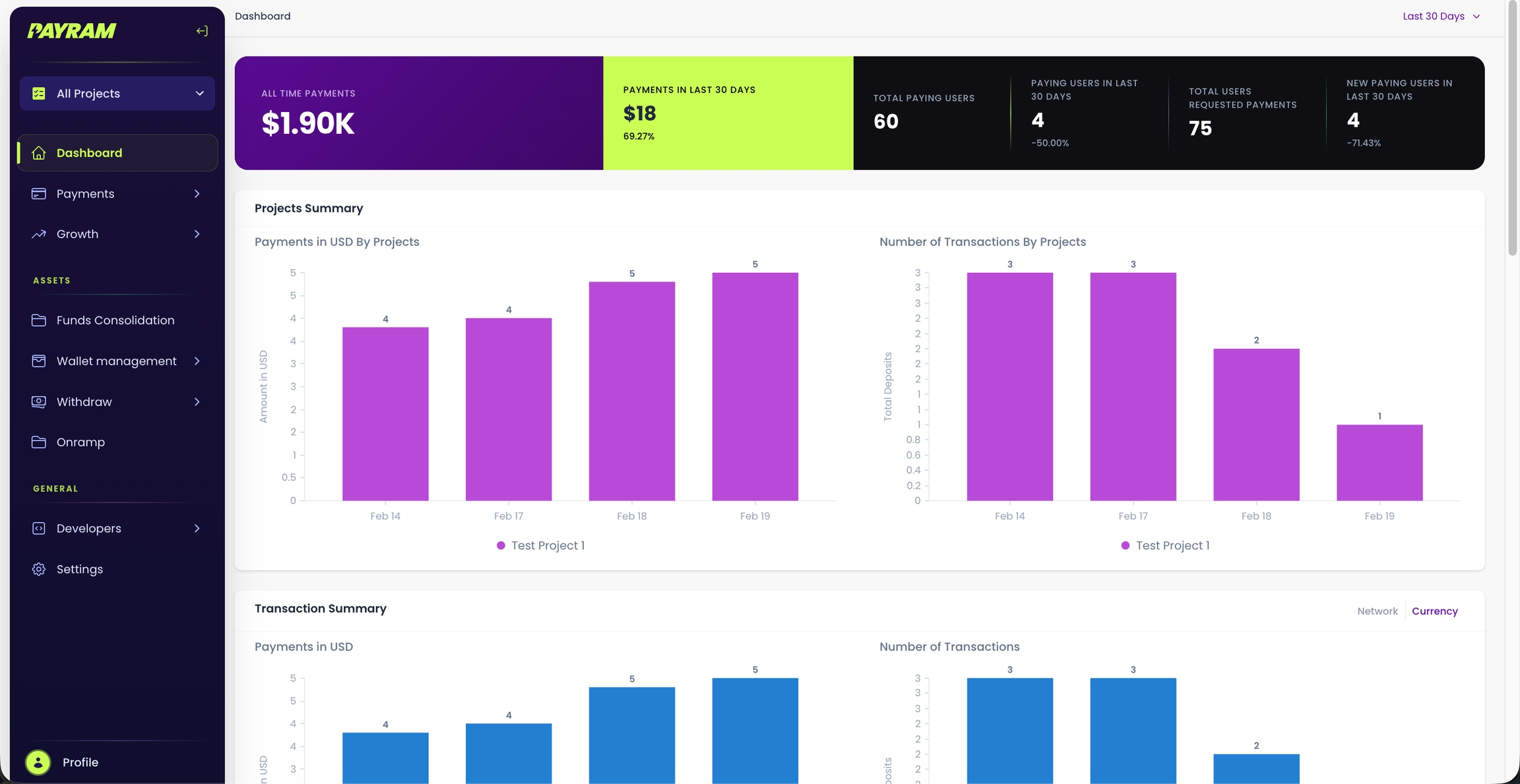
- Log in to your PayRam Dashboard and go to the Settings section.
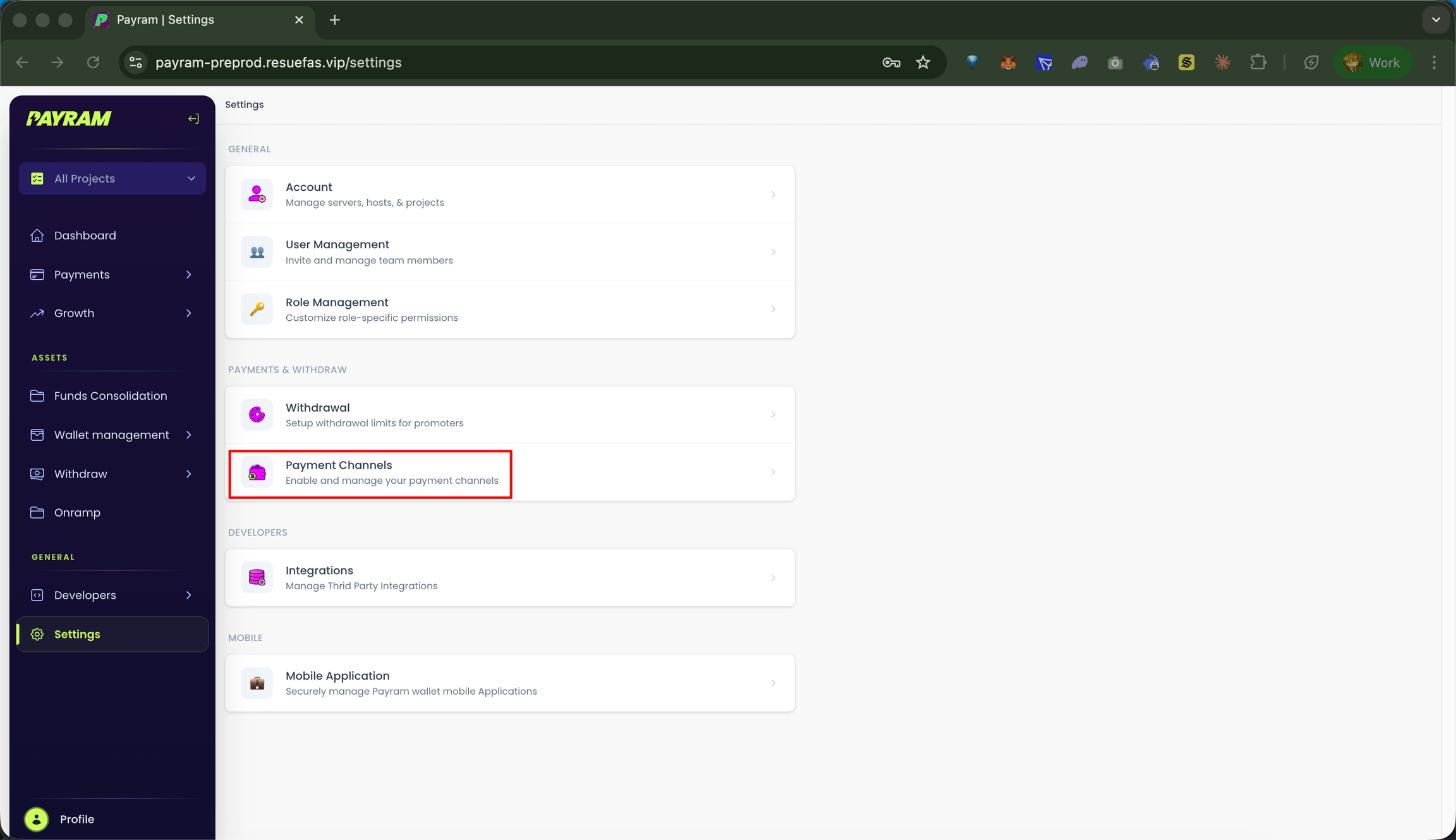
- Now click on the Payment Channels option.
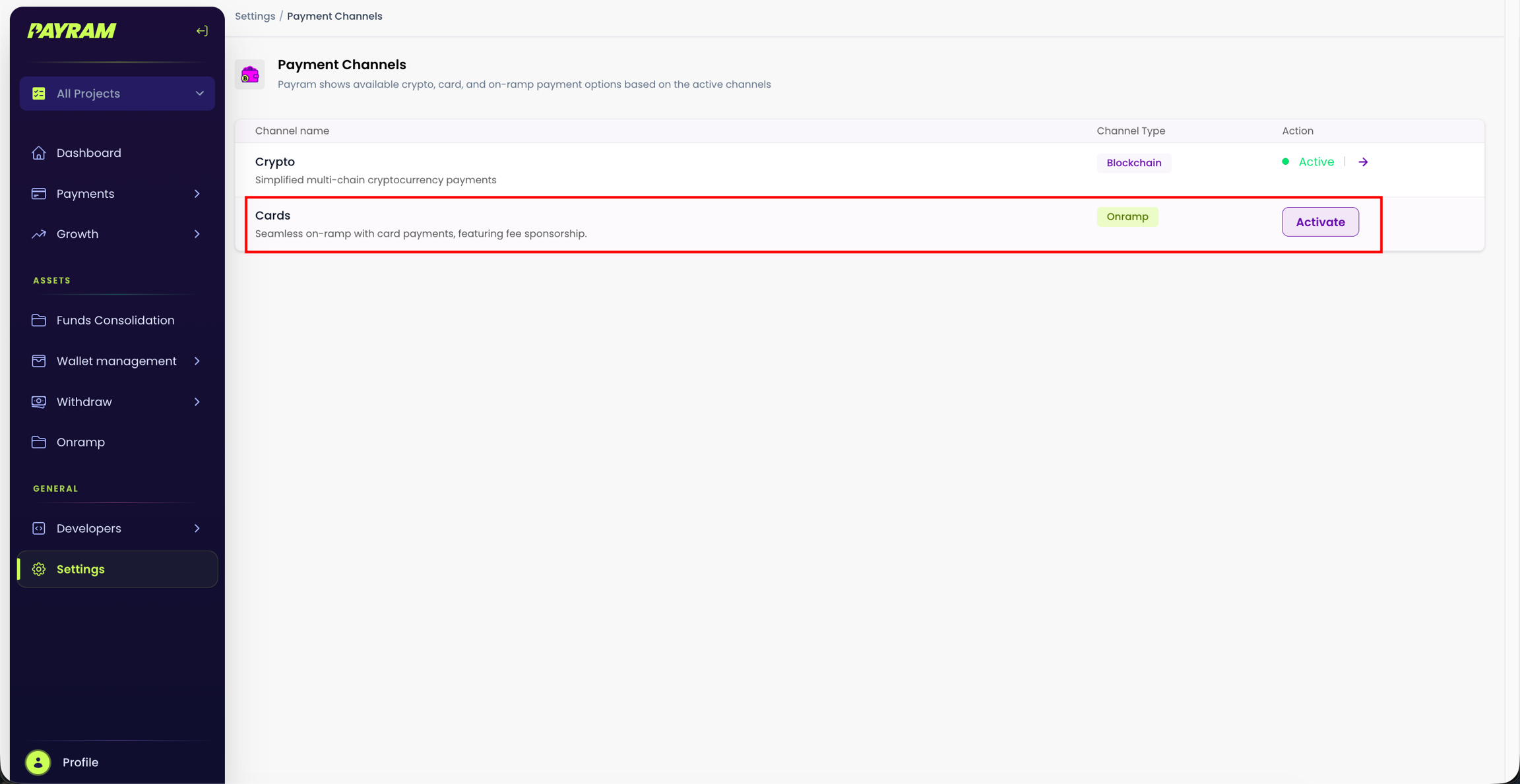
Activate Cards
- Click on the Activate button beside Cards to access the pop-up with more details.
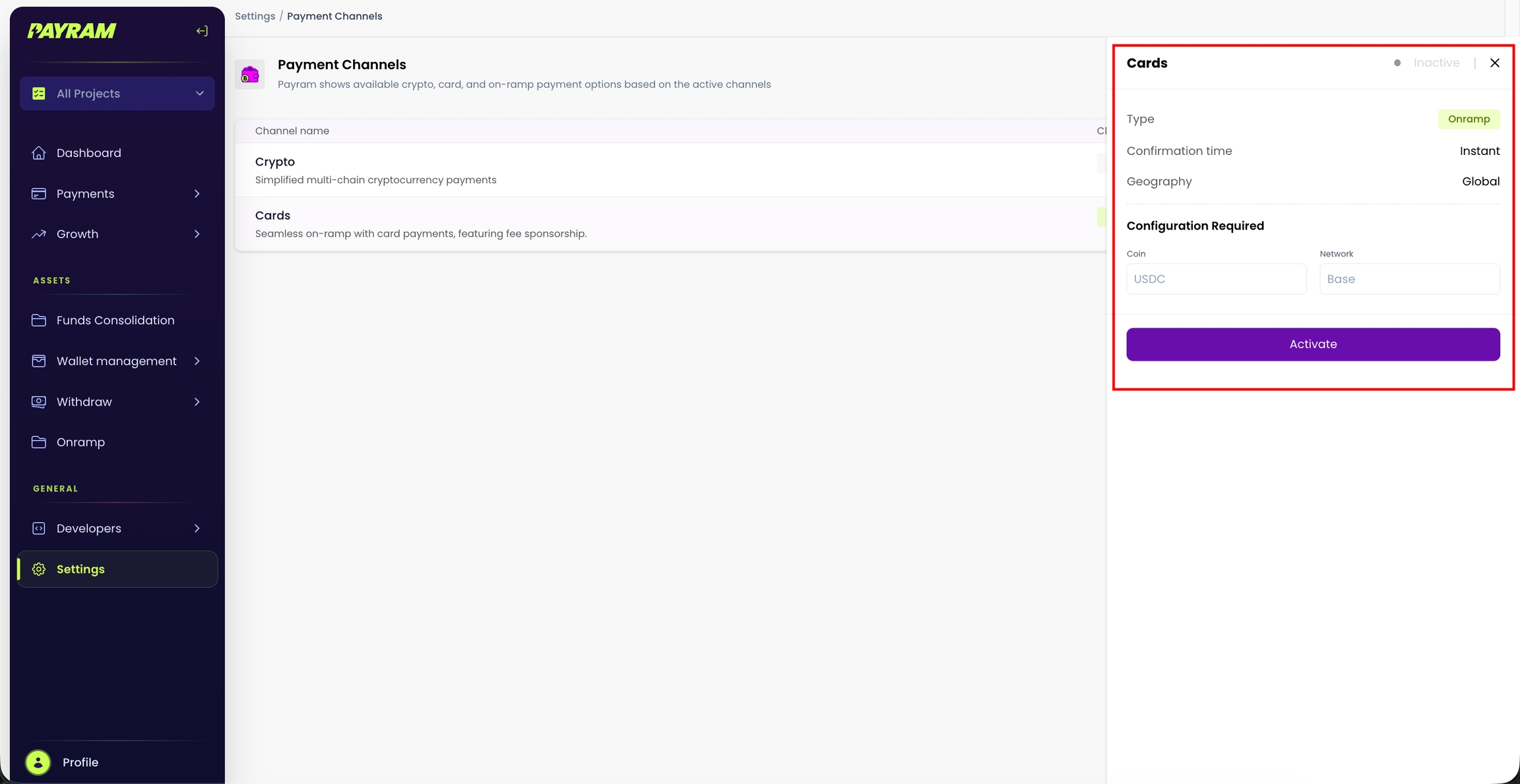
- In the pop-up, click on Activate to instantly enable the payment method.
Phase Two: Creating Payment Links
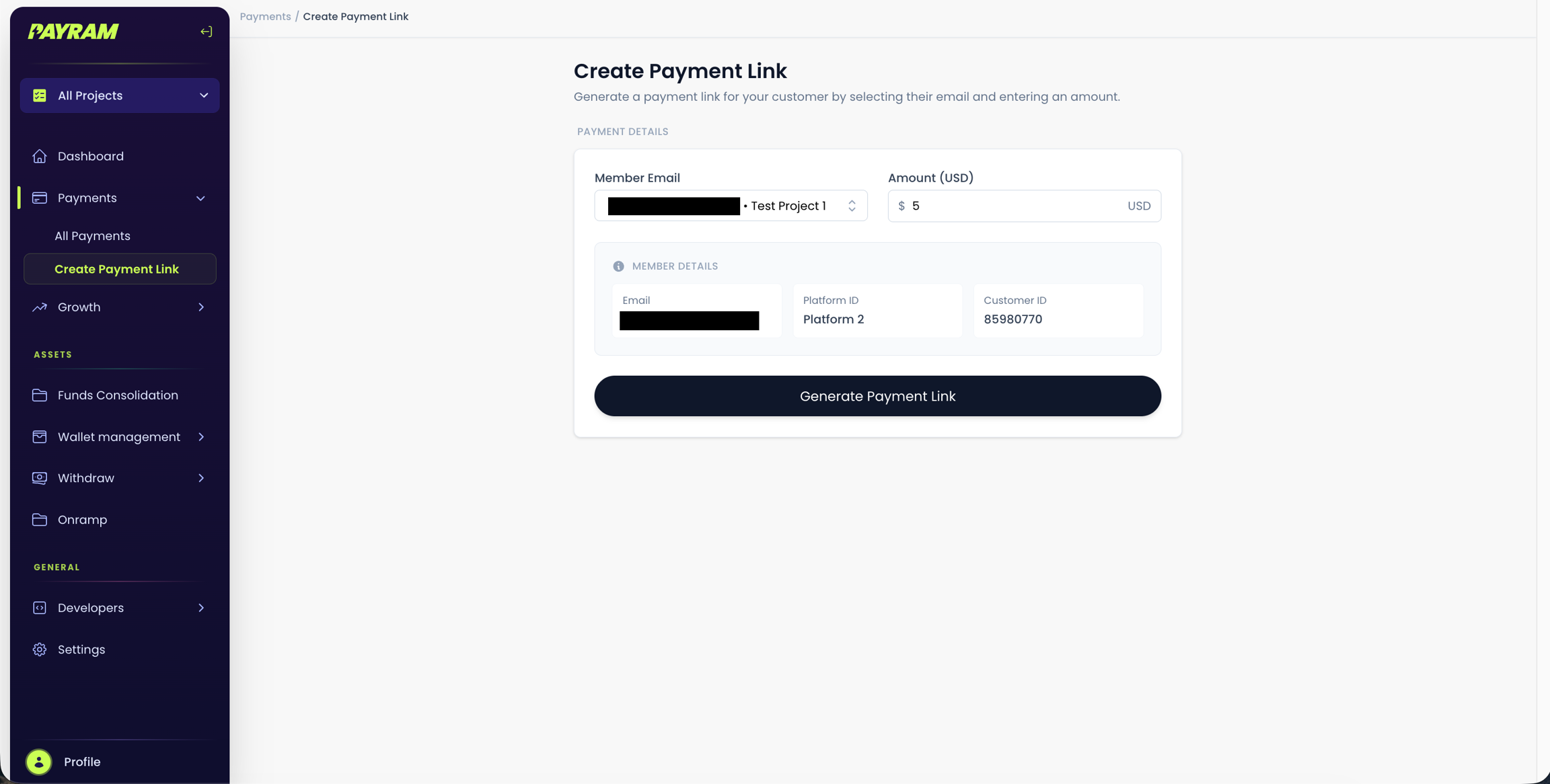
- Go to the Payments menu in the sidebar, click the dropdown, and then select Create Payment Link.
- Create a payment link by entering the customer's email and the required amount, then click Generate Payment Link.
Pay using PayRam Wallet
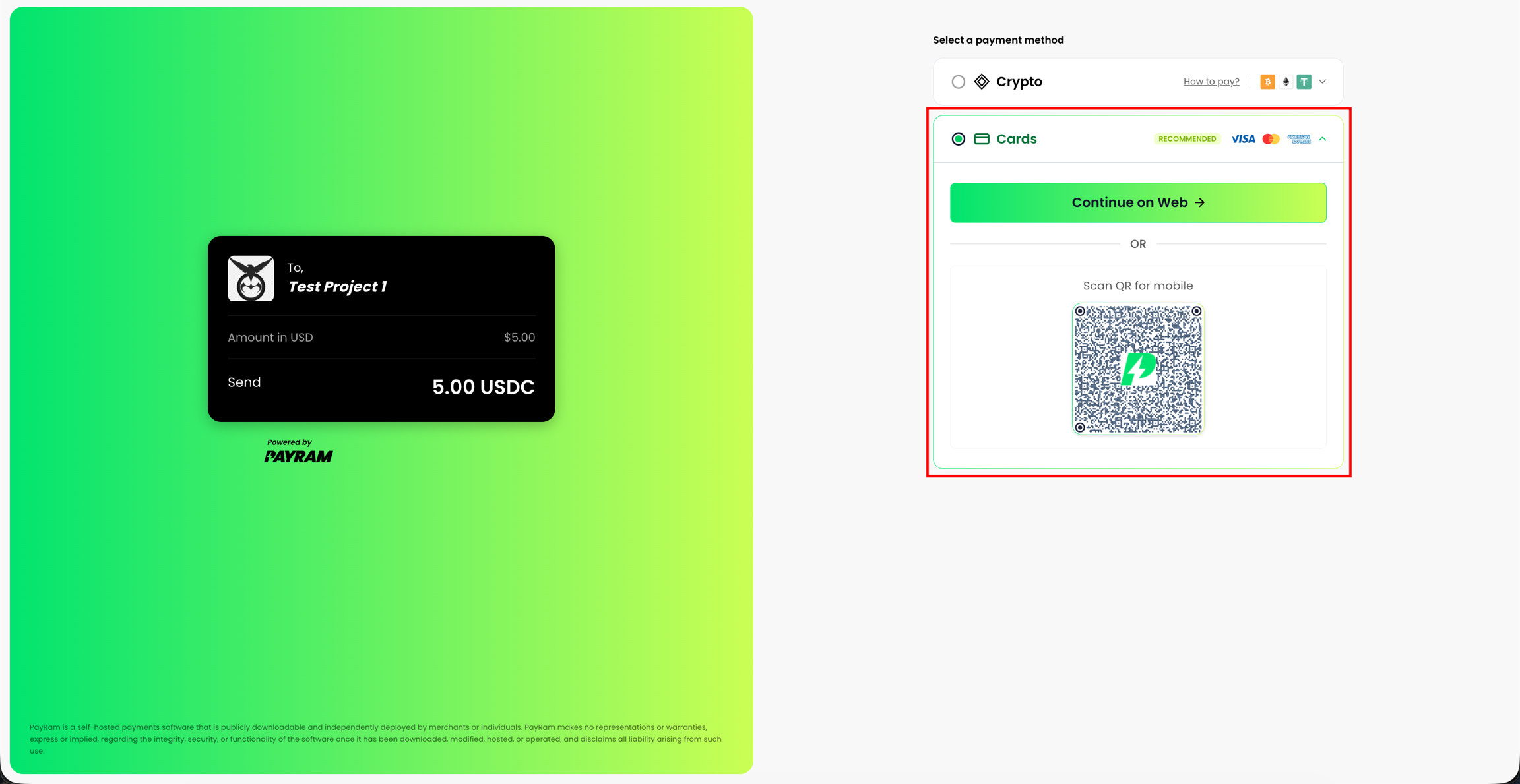
- Your customers will now see the Card payment option on the payment page. They just need to click on Cards to use it.
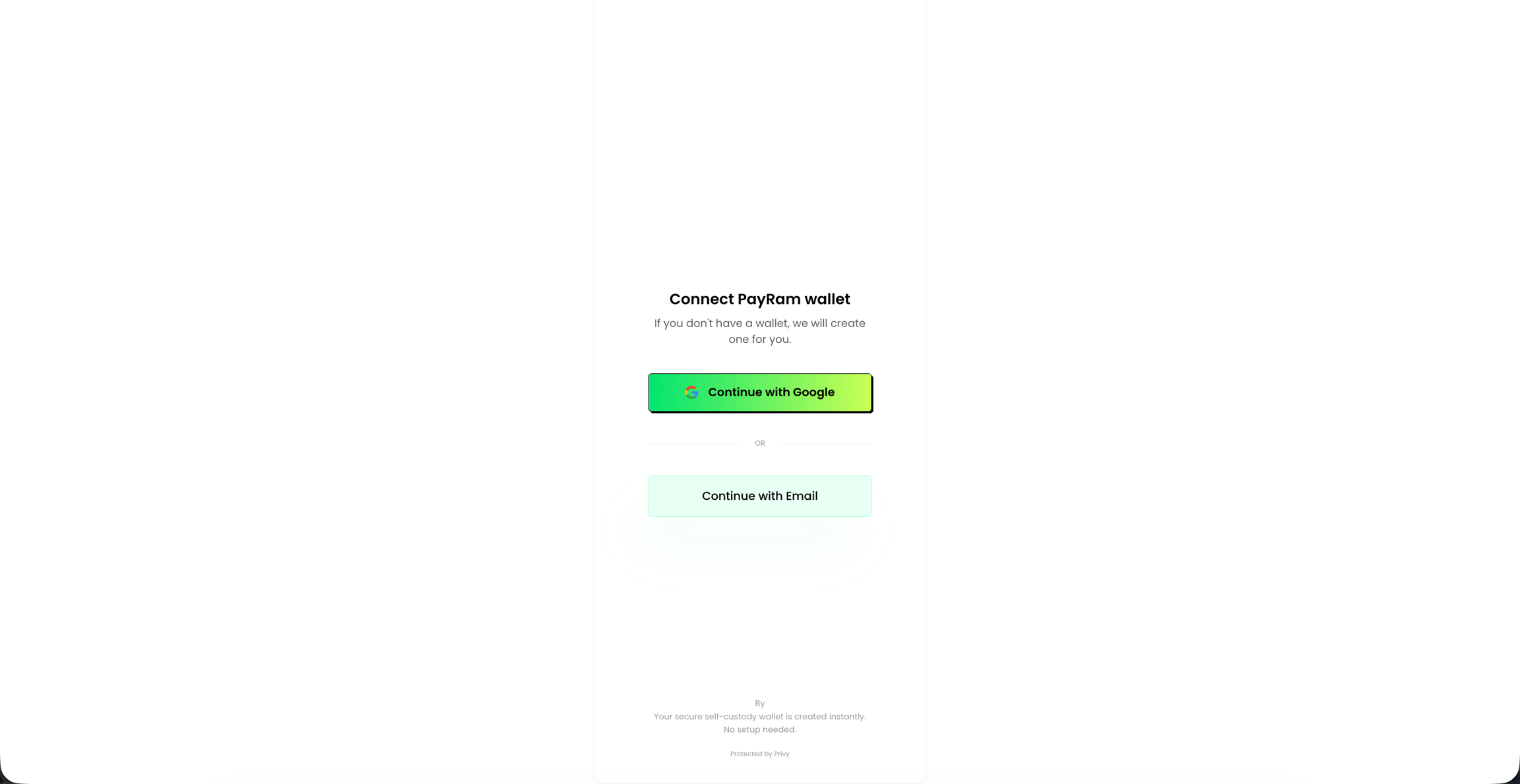
- Customers will have to first set up their self-custody PayRam Wallet. They can use their email address to quickly create one in a few seconds.
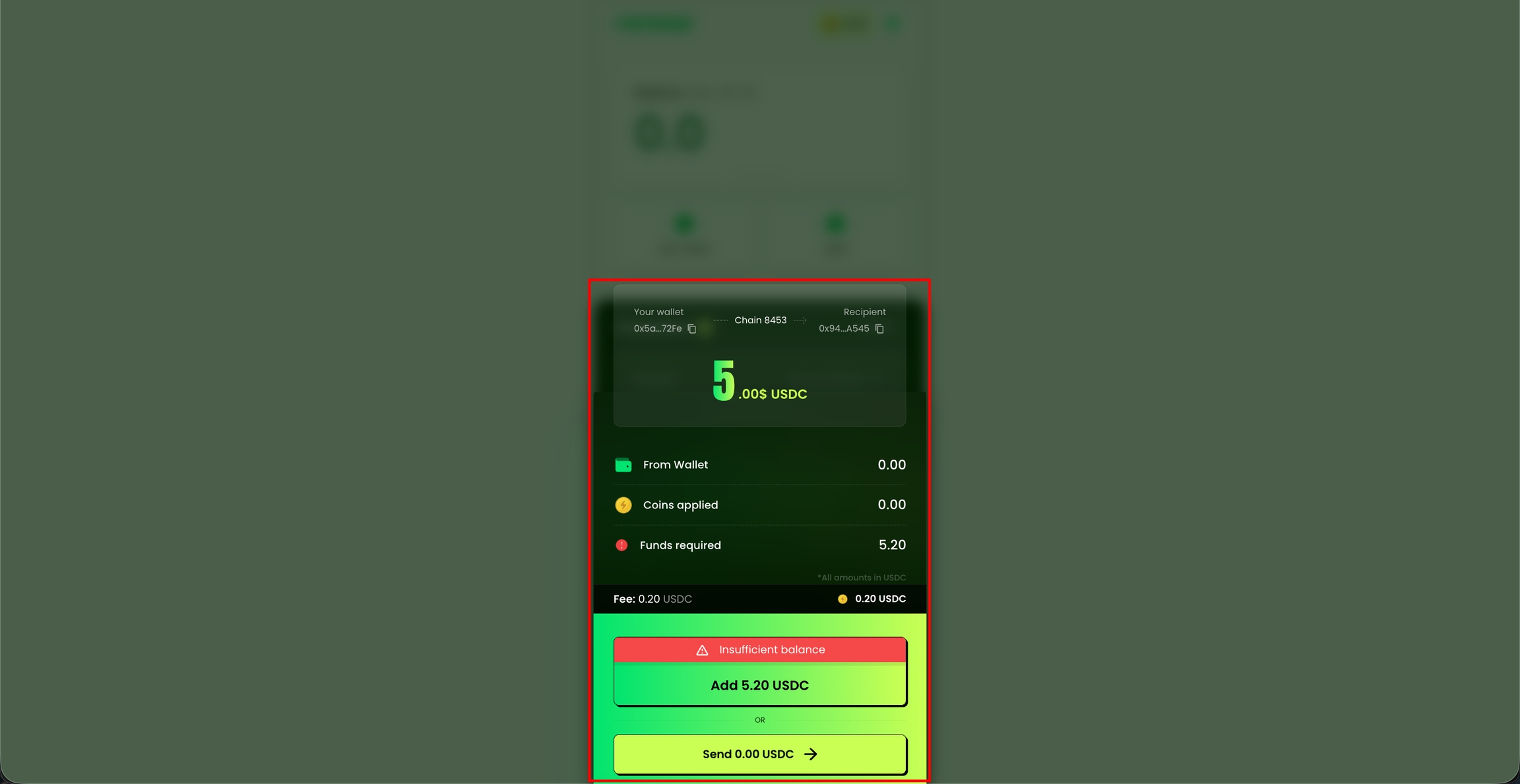
- They will be prompted to Add Funds equivalent to the transaction amount.
- They can pay using their credit/debit cards or banks or other supported payment methods through the onramp widget, and the crypto will be deposited directly into the customer's self-custody wallet.
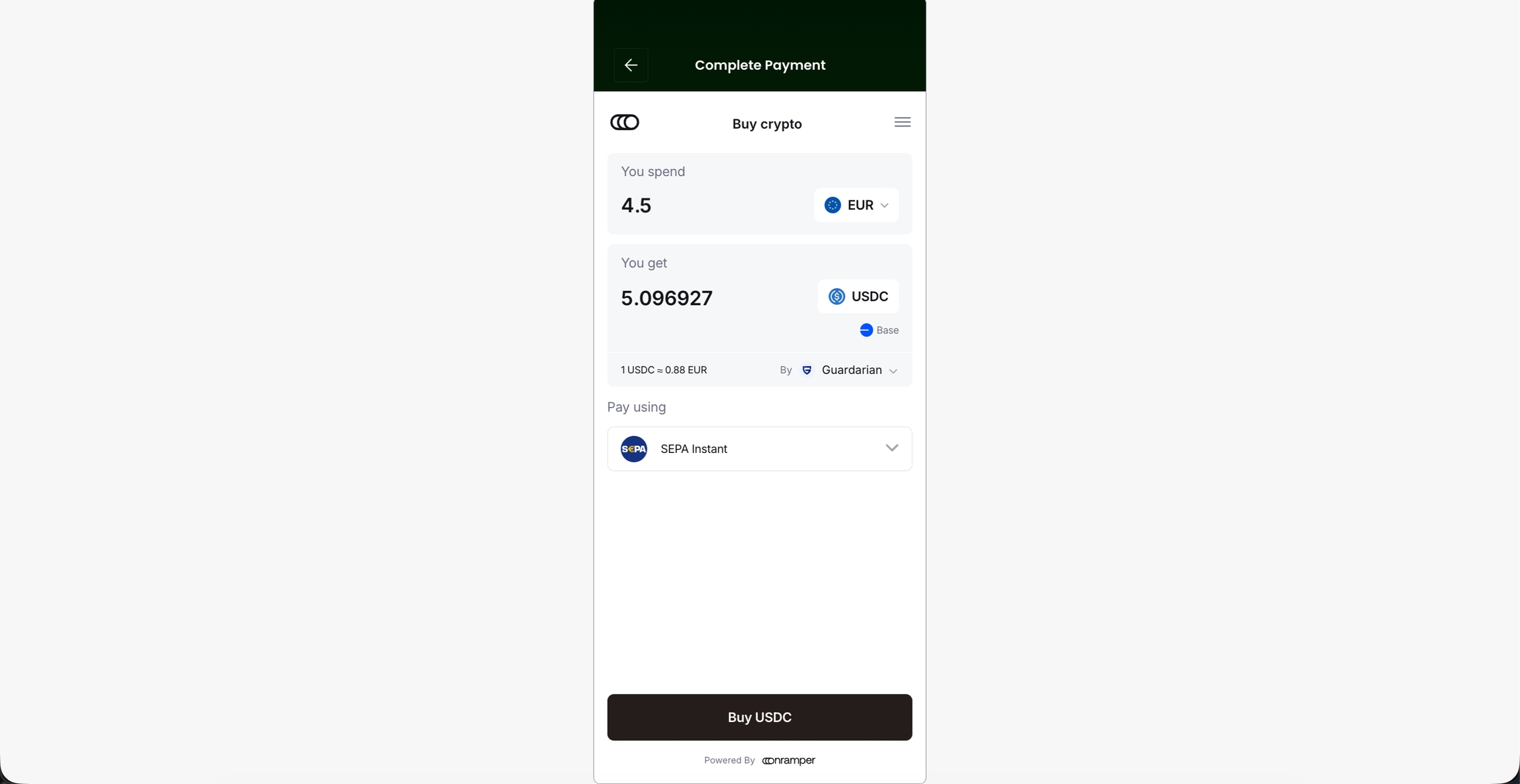
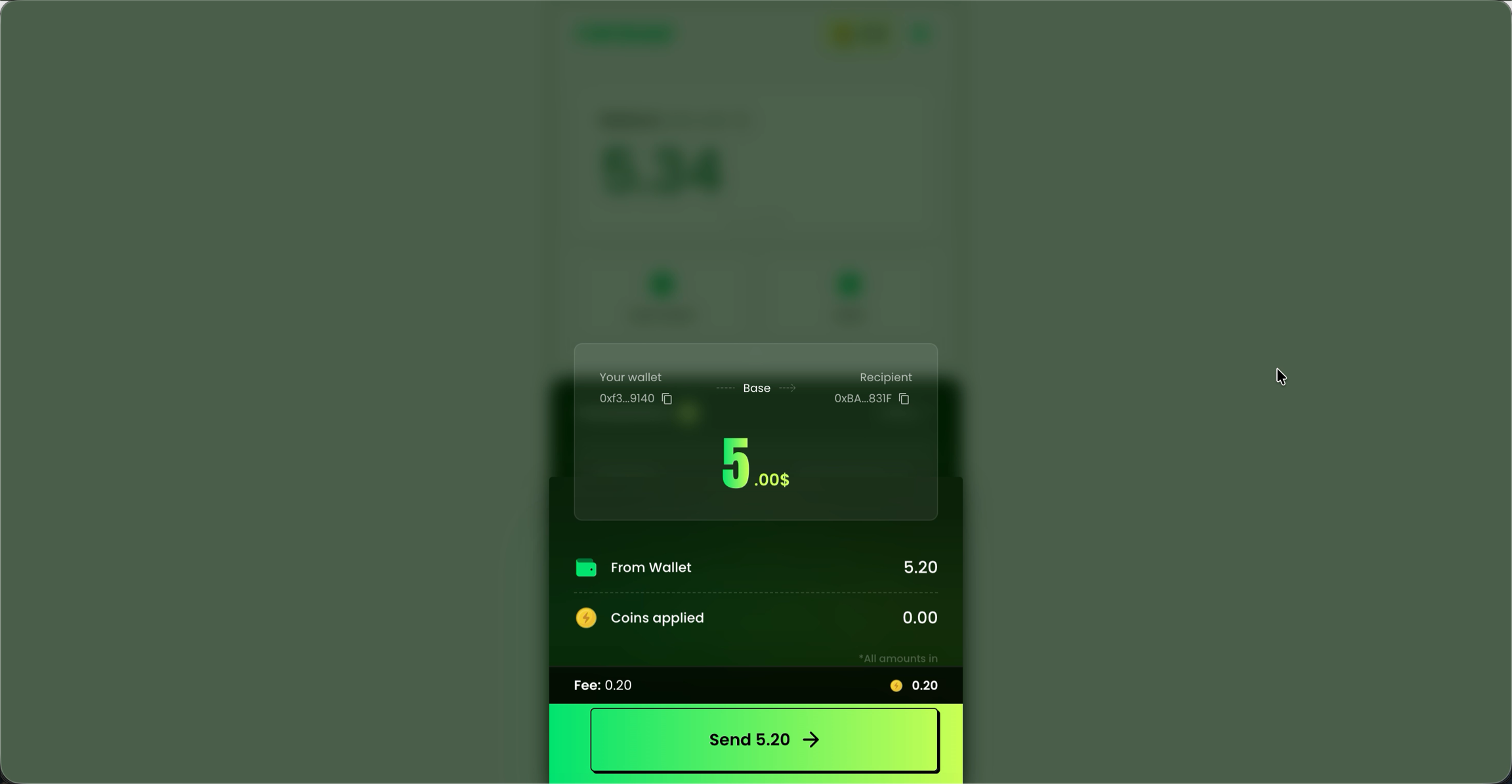
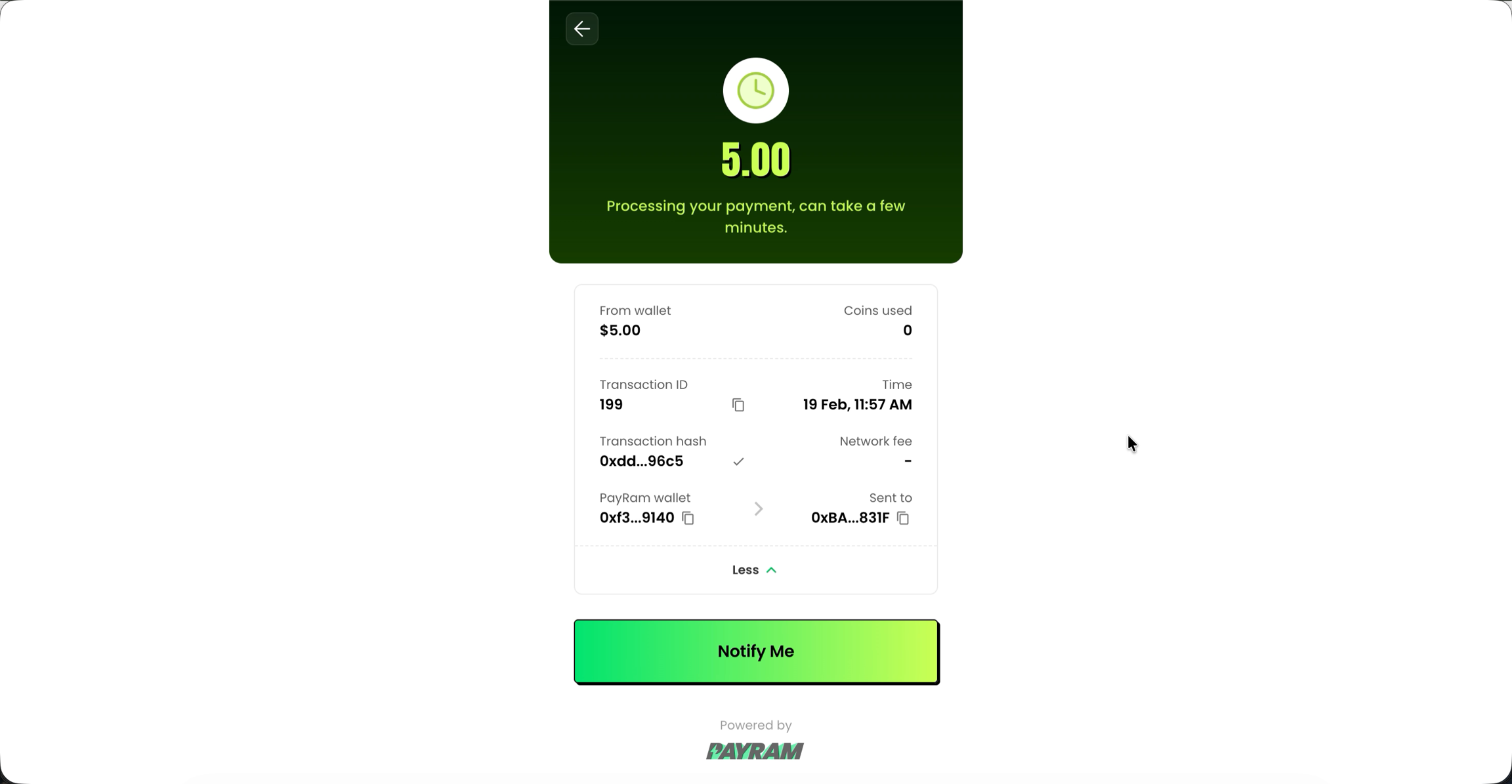
- They can then use the deposited funds to complete the transaction.
The Customer Experience: From Fiat to Finality in Seconds
The customer purchase flow is optimized for speed, utilizing 3D Secure authentication and email-based wallet setup for near-instant asset delivery.
The customer journey is designed to mirror a standard e-commerce checkout:
- Select Card Payment: The customer clicks the Cards option on the payment page.
- Wallet Setup: If they don't have one, they quickly create a self-custody wallet via their email address.
- Add Funds: The customer is prompted to add funds equivalent to the transaction. They enter card details (Visa/Mastercard) and authorize via their bank's 3D Secure (3DS) portal.
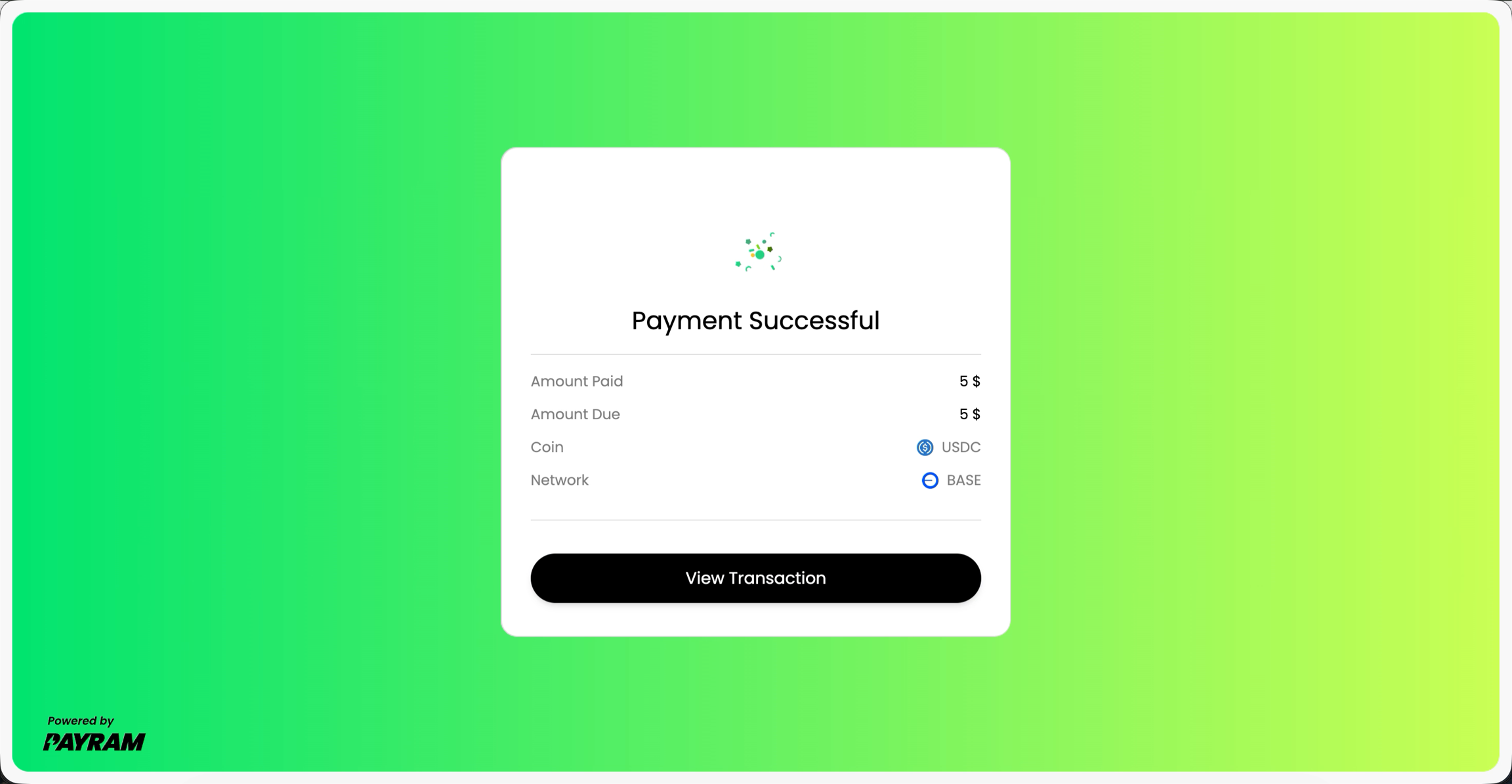
- Instant Delivery: Crypto is deposited directly into the customer's self-custody wallet, and they use those funds to complete the merchant transaction.
Managing Card-to-Crypto Onramp Access for Individual Projects
Project-level management allows businesses running multiple ventures to toggle onramp access independently for each project.
If you manage multiple projects under a single PayRam account, you can control onramp access at the project level. By default, once the Onramp API is activated, it is enabled for all projects.
- To Manage Settings: Go to Settings > Account and choose the specific project.
- Toggle Access: Open the Payment Options tab and toggle Cards on or off. Changes apply immediately to that project.
How much cryptocurrency can I buy?
While PayRam itself imposes no transaction limits, individual onramp partners typically have card limits ranging from $2,500 to $10,000 per day.
When navigating crypto purchase limits, it is important to distinguish between the gateway and the payment rail. The PayRam gateway itself supports unlimited transactions and enterprise-grade scalability. However, individual card-to-crypto onramp partners typically set their own constraints. Standard card limits often start at $2,500 per transaction, with daily maximums reaching $10,000 for verified users.
Optimization: Choosing the Right Crypto Rail for Card Purchases
Selecting the appropriate blockchain network, or rail, is essential for optimizing transaction speed and minimizing settlement fees.
High-volume users and merchants must prioritize low-fee networks to maintain their margins. Choosing the cheapest fiat to crypto onramp often depends on the underlying blockchain network, or rail, you select.
| Network | Confirmation Speed | Primary Use Case |
|---|---|---|
| Solana (SOL) | 400ms | High-frequency, real-time trading |
| Tron (TRX) | Seconds | Cost-effective USDT settlements |
| Polygon (MATIC) | Fast | Efficient eCommerce & DeFi |
| Bitcoin/Ethereum | Minutes | Store of value & complex contracts |
For most global commerce, using crypto routing rules for USDT settlements remains the most cost-effective strategy.
Optimizing for raw speed and near-zero fees is the only way to scale micropayments in 2026, says Solana.
Beyond Retail: Agentic Commerce and Autonomous Machine Payments
Agentic commerce represents the next phase of the digital economy, where AI agents use standardized protocols to execute autonomous machine-to-machine payments.
We are moving beyond human-centric checkouts toward agentic commerce. In this paradigm, autonomous AI agents—rather than humans—initiate and execute financial transactions via APIs. McKinsey estimates the agentic commerce market could reach $5 trillion in global volume by 2030. PayRam is built to be agent-ready, supporting the technical standards that allow machines to interact with financial rails.
Key protocols driving this shift include:
- Model Context Protocol (MCP): A universal standard that allows AI models to connect to external tools. Tools like OpenClaw enable autonomous payment orchestration.
- x402 Protocol: An internet-native standard designed for machine-to-machine (M2M) streaming payments.
- ERC-8004: A standard focused on trustless agents, providing a way for smart contracts to verify that an agent's action was authorized.
What are agentic payments?
Agentic payments are financial transactions initiated by autonomous AI agents using specialized protocols to interact with blockchain rails without human intervention.
The agent payments definition is simple. They are transactions where an AI agent acts as the decision-maker and executor. Using a combination of MCP servers and x402 protocols, these agents can autonomously pay for API usage, cloud computing, or digital goods without a human clicking Buy Now.
Agentic will be a paradigm shift for e-commerce, shaking up the entire funnel, notes Nathan Feather of Morgan Stanley.
Privacy and the Financial Sovereignty Movement
PayRam supports financial privacy through watch-only nodes and a decentralized approach that eliminates the need for mandatory, intrusive identity verification.
There is a growing global movement toward financial privacy. Search trends from 2025 show a significant surge in demand for buy crypto with card no kyc and anonymous fiat to crypto solutions. Users are increasingly wary of centralized databases that store sensitive personal information alongside their transaction history.
PayRam's privacy edge lies in its decentralized nature. By running a private, self-hosted node, you ensure that your transaction data is never shared with a third-party processor. Furthermore, PayRam's no-keys-on-server architecture allows for permissionless entry, protecting both merchant and user privacy from the ground up.
Privacy is not a crime. It is a fundamental right that decentralized finance restores to the user, states the Electronic Frontier Foundation.
Conclusion: Building Your Own Sovereignty Stack
Establishing a personal sovereignty stack with PayRam allows for long-term digital independence and readiness for the impending agentic economy.
PayRam is more than just a tool for buying crypto with a card. It is the foundation of your digital sovereignty. By integrating a self-hosted gateway with other decentralized tools like Nextcloud or Llama AI, you can operate with total digital independence. Whether you are a high-risk merchant looking to bypass restrictive payment bans or a developer building for the AI-driven economy, PayRam provides the control, cost-efficiency, and security required for the future of commerce.
Take control of your financial destiny. Deploy your PayRam node today and start accepting payments permissionlessly.
Frequently Asked Questions
How long does it take to receive crypto after a card purchase?
Typically, you will receive your tokens within minutes after your bank approves the transaction. The exact time depends on the confirmation speed of the blockchain network you chose. Solana is near-instant, while Bitcoin can take 10 minutes or more.
Can I use a gift card or prepaid card to buy crypto?
Most major exchanges and onramp partners restrict the use of third-party gift cards or anonymous prepaid cards. Standard Visa and Mastercard credit or debit cards linked to a legal identity are the industry standard for card acquisitions.
What are the server requirements for running a PayRam node?
To run a PayRam node, the minimum requirements are 4 CPU cores, 4GB RAM, and 50GB of SSD storage on Ubuntu 22.04. For high-volume businesses processing thousands of daily transactions, we recommend scaling to a Virtual Private Server (VPS) with higher specifications.
Does PayRam support stablecoins like USDT and USDC?
Yes. PayRam provides full support for USDT (on the Tron network) and USDC (on Polygon, Base, and Ethereum), allowing you to settle transactions in assets pegged to the US Dollar to avoid market volatility.
How do I eliminate fraudulent chargebacks with card-to-crypto?
One of the primary benefits of PayRam is the ability to permanently eliminate fraudulent chargebacks. Because blockchain transactions are final and immutable, customers cannot initiate a dispute with their bank after the crypto has been delivered.
Can I accept payments for adult content safely?
Yes. PayRam is a preferred choice for the adult industry because it offers a stablecoin payment path for creators to receive uncensorable income without the threat of bank account closures.
How does PayRam compare to Coinbase Commerce?
While both are powerful, the main difference is ownership. In our PayRam vs Coinbase Commerce comparison, we highlight how PayRam's self-hosted model provides superior privacy and lower transaction fees for high-volume merchants.
What is the MiCA regulation and how does it affect onramps?
MiCA (Markets in Crypto-Assets) introduces strict guidelines for digital assets in Europe. PayRam helps merchants navigate this by providing tools that can be configured for local transfer of funds compliance.
Can I automate swaps from volatile crypto to stablecoins?
To protect against market crashes, you can automate crypto-to-stablecoin swaps. This feature ensures that even if Bitcoin drops 20%, your revenue is protected in a dollar-pegged asset.
Why is TRC20 (Tron) better for USDT payments?
For businesses moving high volumes, TRON is the gold standard. It allows you to slash fees to near zero, ensuring that small transactions remain profitable.
Why is the Base blockchain required for card payments?
Base provides the low-fee, high-speed infrastructure necessary for processing fiat-to-crypto transactions efficiently. Card payments and other fiat options on PayRam are currently optimized for the Base blockchain to ensure the lowest possible transaction costs and fastest delivery times.
Can I manage onramp access for specific business projects?
Yes, PayRam allows for project-level toggling of card onramps within the account settings. You can enable or disable the onramp independently for each project under your PayRam account via the Payment Options tab in settings.
What is the transaction limit for card purchases?
Limits are set by the onramp partner, typically ranging from $2,500 to $10,000 per day. While the PayRam gateway supports unlimited transactions, card-specific limits are enforced by the onramp provider.
Is merchant KYC required to accept card payments?
No, PayRam allows merchants to activate the card onramp method without completing KYC or KYB. Unlike custodial processors, PayRam lets you go live instantly. Only the customer performing the fiat-to-crypto swap must complete a one-time verification with the partner provider.