July 16, 2026
Ask GPT about this Blog Ask GPT about this Blog
How to Launch a Prediction Market Platform: A Payments-First Guide
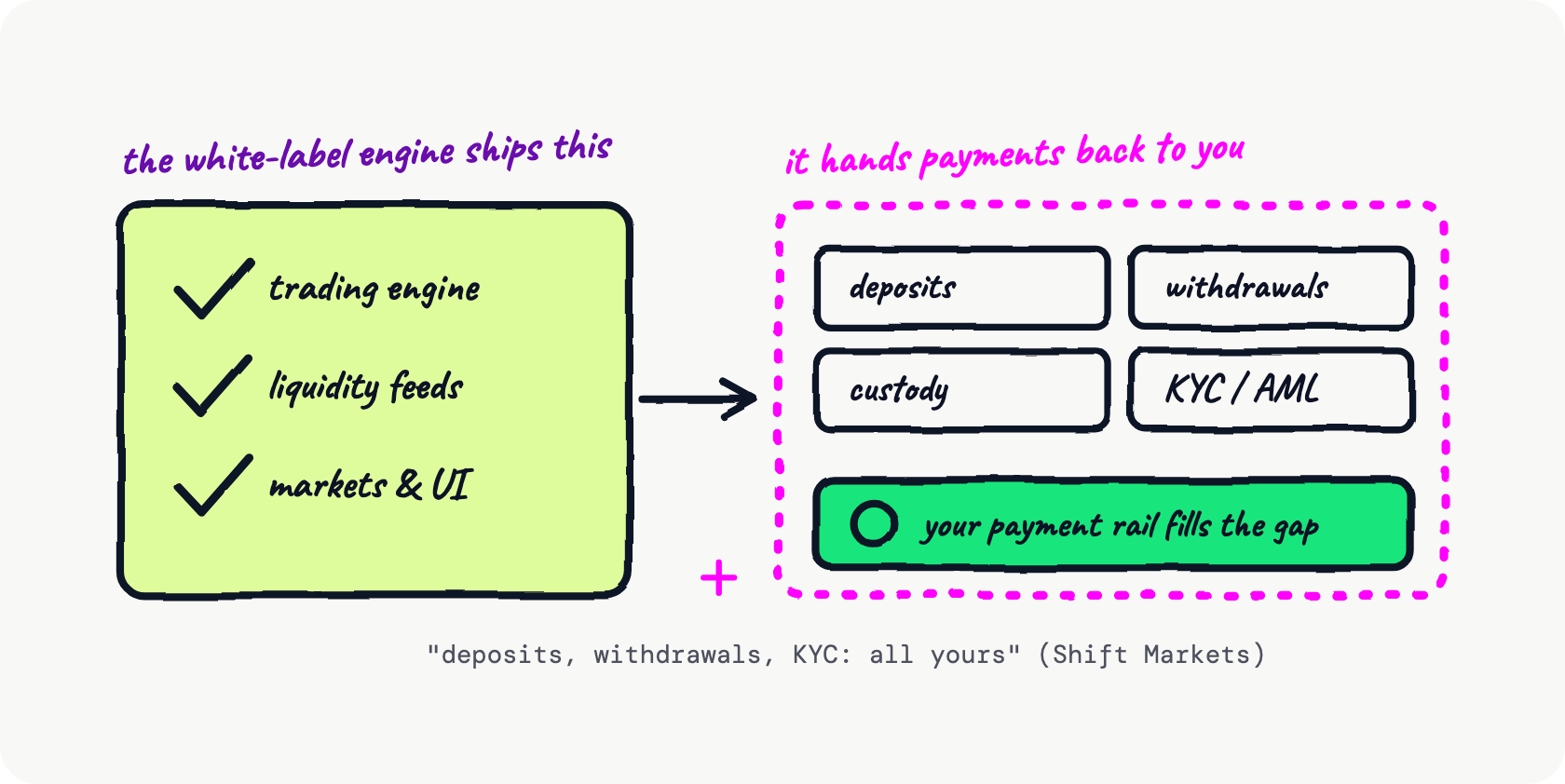
Most guides to launching a prediction market start with the trading engine. The teams that stall start there too. The engine is the easy part now. White-label vendors will hand you a matching engine, aggregated liquidity, and a polished UI in a few weeks. The decision that actually determines whether you launch, and keep running, is the money layer: how deposits come in, how winnings go out, and who can freeze either one. Decide that first. Everything else is downstream of it.
The timing is why so many teams are asking. Prediction-market volume climbed from under $5 billion a month in September 2025 to roughly $24 billion by April 2026, according to Pew Research, and the first month of the 2026 World Cup pushed the sector past $50 billion in a single month, per CoinDesk, out-trading US legal sportsbooks. TRM Labs counted unique wallets tripling to around 840,000 in the six months to February 2026. A booming category pulls in new operators, and every one of them hits the same wall in the same place.
The reason is blunt. As the law firm Global Law Experts put it in 2026, "securing corporate banking for a prediction market is incredibly difficult," because "financial institutions categorize event trading and crypto settlement as high-risk activities." Many founders, it notes, "burn weeks applying to retail banks only to receive automated rejections." A payments-first launch simply inverts the usual order, so the hardest problem is solved before staff and users are depending on it.
Payments is the first decision, not the last
Start with what the turnkey vendors actually deliver, because it is easy to assume white-label means everything. It does not, at least not for money. When Shift Markets launched its white-label prediction market product in April 2026, the pitch was explicit: operators "own the user relationship" with "KYC, deposits, withdrawals all inside your platform," and the engine's "API-first architecture integrates with your existing platform, KYC, and balance management systems." Read that again. The engine integrates with your payments. It does not provide them. GammaStack and Antier advertise wallet and "payment gateway integrations," but they build the integration; they are not the processor, the custodian, or the bank. The settlement rail is yours to source.
And sourcing it is the wall. Heitner Legal notes that "payment processors often require formal legal opinions regarding the legality of prediction market platforms before agreeing to provide services." So the order of operations that actually works runs the other way: understand which model you can legally run, secure the rail that will settle it, then buy the engine that plugs into that rail. Teams that buy the engine first often discover the rail was the real constraint all along.
How prediction-market users actually pay
Before you choose a rail, look at how the people you are trying to serve already move money, because the winning platforms all match a behavior that is already set. The crypto-native venues have trained users to fund from a wallet, settle in a stablecoin, and withdraw on-chain in minutes. The mechanics are worth reading closely:
- Polymarket is non-custodial and settles in USDC on Polygon. The minimum deposit is about $3, funds can arrive bridged from Solana, Base, Arbitrum, Tron, Bitcoin, or Optimism, and the platform charges no deposit or withdrawal fee, so a user pays only cents of chain gas. Winnings withdraw back out on-chain, near-instantly, any hour of any day.
- Kalshi, the CFTC-regulated US venue, is fiat-first: ACH with no Kalshi fee but a multi-day settle, instant debit at roughly a 2% processing fee, or wire for large amounts. Its crypto path runs through Zero Hash, accepting USDC, Bitcoin, and Solana that convert to US dollars on arrival, and that path carries a far higher deposit ceiling and funds 24/7.
- Limitless runs on Base with shares collateralized one-to-one by USDC and advertises same-day settlement. PredictIt, by contrast, shows the old friction model users are leaving: card or wire only, a 5% withdrawal fee, three-to-ten business days, and a 30-day hold after a first deposit.
The pattern underneath is consistent. Deposits skew small, frequent, and global, the same shape as the broader stablecoin economy, where USDT on Tron alone moves more than $600 billion a month, mostly in transfers under $1,000. The users you want are often in markets a card network barely reaches. The World Bank still counts 1.3 billion adults as unbanked, and Binance has reported that 83% of its multi-product users sit in emerging markets. What all of them expect is the crypto-native default: fund from the chain you already hold, settle in dollars that do not swing, and get paid out without waiting on a bank's clock. A platform that makes a winner wait three days and skims 5% on the way out is fighting the behavior instead of riding it.
Pick your model, and the compliance follows
Operators launching this year are choosing among a few well-worn models, and each carries its own obligations. This is descriptive, not advice, and where you can legally operate is a question for qualified counsel licensed in your jurisdiction, not a blog post. But the shapes are clear:
- US, CFTC-regulated. The compliant US route is registering as a CFTC Designated Contract Market (DCM), which Kalshi did in 2020 and PredictIt completed in 2025. It carries high capital requirements and full KYC and AML. Polymarket took the shortcut of acquiring a licensed exchange (QCEX) for a reported $112 million rather than applying from scratch, then relaunched to US users in December 2025.
- EU, MiCA. For crypto-settled platforms, a Markets in Crypto-Assets (MiCA) authorization in one member state passports across all 27.
- Offshore gaming. Where forecasting is treated as a game of chance or skill, operators use online-gaming licences from jurisdictions such as Curacao, Anjouan, the Isle of Man, or Malta. These grant international reach but, as legal analysts note, do not grant US market access.
- Sweepstakes. Some US operators use a dual-currency design (a free "sweeps" token) to remove consideration from the gambling definition. Its legality is state-specific and contested.
The point of the list is not to pick one for you. It is that your licence decides your KYC, your reporting, and which payment rails will even touch you, so it has to come before the engine and before the rail. Whatever you choose, you own the compliance perimeter in your jurisdiction. Confirm the specifics with counsel, because the picture is moving fast: the underlying dispute is whether these contracts are federally regulated derivatives under CFTC exclusivity or state-regulated gambling, and it is being fought in real time. In 2026 the Third Circuit affirmed an injunction shielding Kalshi's CFTC-designated event contracts from New Jersey gambling enforcement, holding the Commodity Exchange Act preempts state interference, even as several states pushed the other way. The classification you rely on may not be settled where you operate.
The KYC decision follows the model
"Do I need KYC?" is the most-asked launch question, and the honest answer is that your model already decided it. A regulated venue runs full KYC and AML: Kalshi verifies government ID before a user trades, because its CFTC-regulated model requires it. Polymarket runs a split, where its US entity requires full identity verification while its global product has historically let users trade from a wallet with just an email. Global Law Experts is blunt about the tradeoff: operating "a financial platform that accepts user funds without verifying their identity violates global Anti-Money Laundering (AML) laws," and KYC is "mandatory to secure banking partners, obtain licenses, and avoid severe enforcement actions." KYC is not a growth dial. It is a consequence of the model you chose, and skipping it forecloses banking and licensing. Set it to match the licence you hold.
The money loop: pay-in, hold, resolve, pay-out
A prediction market is a loop, and every stage of it is a payment event. Seeing the whole loop is what tells you where the money actually sits and who can touch it.
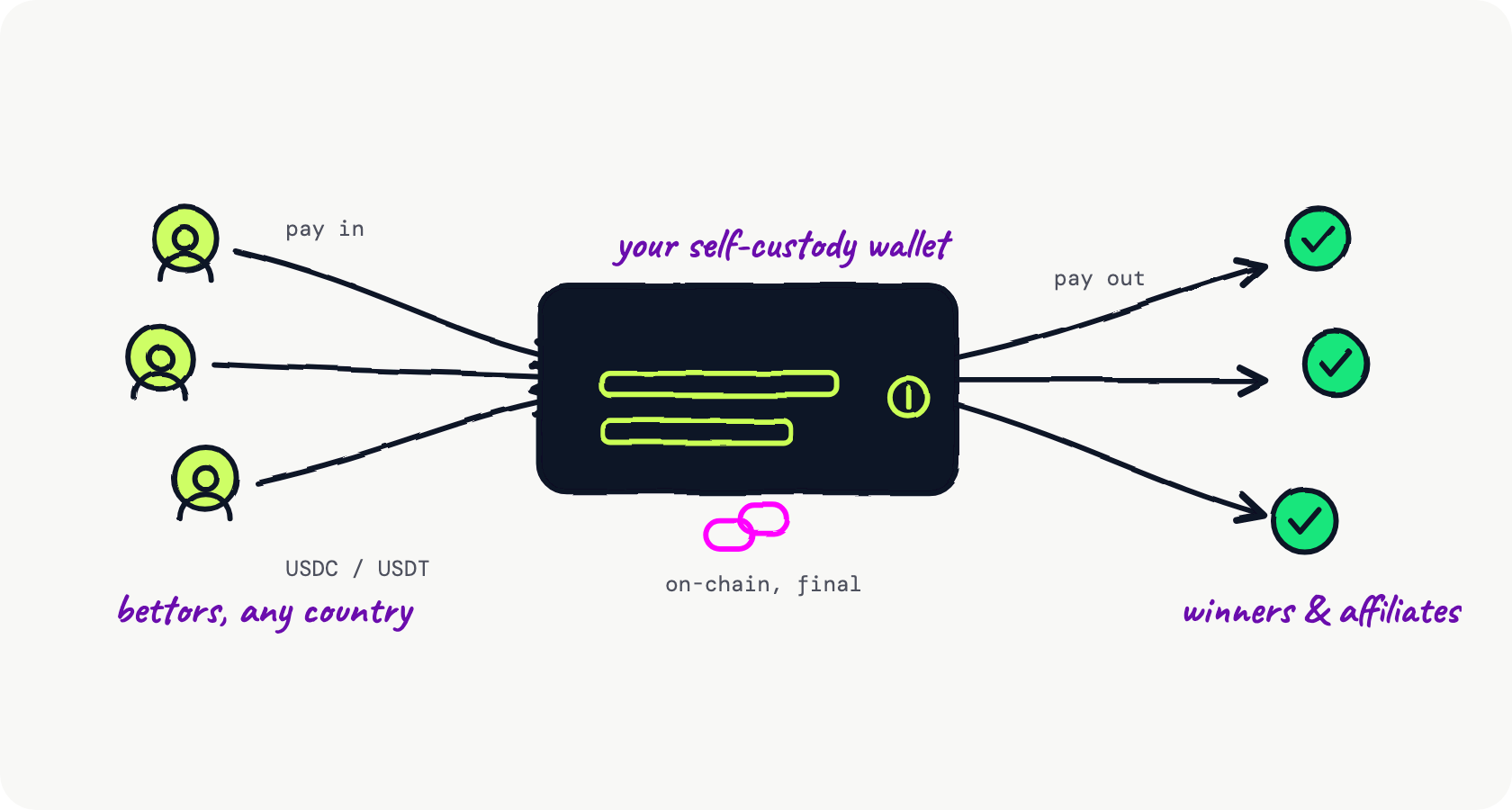
- Pay-in. A bettor sends stablecoins to a deposit address (or connects a wallet), and you credit the position after enough confirmations to be safe from a reorg. This is where wrong-chain transfers and partial payments get handled, or lost.
- Hold. The stake becomes collateral. On fully on-chain venues it locks in an escrow contract: most use the Gnosis Conditional Tokens Framework, where depositing $1 of USDC mints one YES and one NO share, winning shares later redeem for $1 and losing shares expire at zero. On a book or AMM design, or an offshore operator's own float, the collateral sits in a wallet you control instead. Either way it has to be a stable dollar, which is why the whole sector settles in USDC and USDT rather than a volatile coin.
- Resolve. An oracle decides the outcome, and resolution is what releases the money, so it is a payment dependency, not a side detail. Polymarket resolves through UMA's optimistic oracle, where a proposer posts a bond (around $750 USDC), a challenge window of roughly two hours opens, and disputes escalate to a token-holder vote. Regulated venues resolve against a named authoritative source fixed in the contract terms before the market is even listed. When resolution is contested, payouts stall: a single Polymarket dispute over Strategy's Bitcoin sale reportedly put tens of millions of dollars in limbo. Reliable payout depends on reliable resolution.
- Pay-out. Winners are paid, referral affiliates take their share, and the operator keeps its cut. On a self-hosted rail these are on-chain pushes: final, cross-border by default, with nothing for a third party to reverse or hold. This is the stage where custody quietly decides your freeze risk, because a custodial processor pays out on its schedule and its risk policy, not yours.
PayRam sits on the pay-in and pay-out ends of this loop. It detects stablecoin deposits, credits them with partial and over-payment handling, sweeps to a wallet you control, and pays winners out in USDC and USDT on-chain, gated by an allow-list of verified recipients, a maker-checker approval, and an email OTP before funds move. The escrow, the matching, and the oracle are your engine's job. The money moving in and back out is the rail, and that is the part processors and banks make hardest to get.
Why stablecoin settlement is how new operators clear the banking wall
Here is the pattern the field keeps showing. The banking difficulty is real, so crypto-native operators route around it by settling on-chain instead of through a bank. Polymarket settles in USDC on Polygon, where a transfer clears in about two seconds for a fraction of a cent, against $5 to $50 for the same transfer on Ethereum at busy times. Offshore operators lean the same way, pairing crypto rails with regional e-wallets, because tier-one banks are closed to them. Stablecoins do two things a bank cannot for this vertical. They settle in minutes across borders, so a bettor in Manila and a winner in Lagos clear the same way without a correspondent bank. And they are push payments, so a settled deposit cannot be charged back, which erases the friendly-fraud problem that made betting high-risk to card rails in the first place.
This is where a self-hosted gateway earns its place in the launch plan. Instead of applying to processors who want a legal opinion before they will talk, you run the rail yourself. PayRam is a dual gateway you deploy on your own server in about ten minutes, with no signup and no provider KYB. It accepts deposits in stablecoins (USDC, USDT) and major crypto, and it pays winnings out in USDC and USDT on-chain from a wallet only you control. Pay-in and payout are cross-border by default, there is no processor holding your float, and nothing for a risk desk to freeze. It does not replace your licence or your KYC obligations. It sits underneath them as the settlement layer and keeps your compliance perimeter yours. You can see the full model here.
The rest of the stack, in one pass
None of this says the engine does not matter. It says the engine is the part you can buy, so it should not be the part you agonize over. Here is the rest of the stack in brief, with the honest note on each that the money layer is still the piece handed back to you.
- Market-making model. The real choice is a central limit order book (tight spreads once you have volume, thin and wide when you do not), an automated market maker like LMSR (perpetual liquidity and bounded loss, but capital-inefficient and slippage on every trade), a simpler constant-product AMM (easy to bootstrap early), or a parimutuel pool. Polymarket started on LMSR and moved to a hybrid of off-chain order-book matching with on-chain settlement; Kalshi runs a fully centralized order book as a regulated exchange. Vendors ship all of these.
- Liquidity. A new market with no takers is dead on arrival, so operators seed it, run an AMM, or plug into aggregated third-party liquidity. This is a real launch problem, and it is still separate from settlement: liquidity decides whether trades happen, the payment rail decides whether the resulting money reaches the right wallet.
- Oracle and resolution. Covered above in the loop. Most guides say "use a reputable oracle" without naming one; the working answers are UMA's optimistic oracle for on-chain venues and a pre-specified authoritative source for regulated ones.
- Frontend and mobile. White-label providers (Shift Markets, Tradesmarter, Antier, Vinfotech, among others) hand you web, mobile, and an operator dashboard in a few weeks. Note the gaps in their own materials: some carry no blockchain support, some carry no compliance layer, and the payment rail is almost always left as an integration point rather than a product.
Every item on that list you can buy, clone, or plug in. The one thing none of them actually gives you, self-custody settlement where you hold the keys and no customer data leaves your server, is the thing this guide is about.
A payments-first launch checklist
- Confirm your model and licence with counsel. US DCM, EU MiCA, offshore gaming, or sweepstakes. This decides everything below.
- Choose your settlement currency and chains. Most crypto-native operators are settling in USDC or USDT on Polygon, Base, or Tron for low fees and fast finality. Support the chains your users actually hold, or you will lose deposits to wrong-chain transfers.
- Decide custody. Custodial, where a processor holds funds, or self-custody, where funds land in a wallet you control. This single choice is the biggest determinant of freeze risk.
- Stand up pay-in. Unique deposit addresses per user, partial and over-payment handling, and a card-to-crypto onramp for users who do not hold crypto.
- Stand up payout. On-chain stablecoin withdrawals with an approval workflow, an allow-list of verified recipients, and a second factor before funds move.
- Wire reconciliation and monitoring. Deposit-to-position matching, confirmation thresholds per chain, and webhooks so a credited bet and a settled payout are never guessed at.
- Wire KYC and AML to your obligations. Match the licence, not a growth target.
- Test the money paths before the markets. Deposit, settle, withdraw, first on a testnet and then with small real amounts, before a single real user arrives.
What the money layer costs to stand up
Vendor build estimates for a prediction market run wide and inconsistent, from a rough $8,000 to $15,000 for a minimal MVP at one shop to $80,000 to $250,000 and up for a custom crypto-native platform at another. Treat them as marketing, not quotes. Those are engine-and-app numbers regardless. The settlement layer is where a self-hosted approach changes the math. Instead of a processor's rolling reserve and per-transaction cut, a self-hosted stablecoin gateway runs on hosting you own, on the order of $20 to $150 a month of VPS, and deploys in about ten minutes. You can see the full setup on the deploy page, and operators building a multi-market business can run it in operator mode and set their own take rate. Commercial terms beyond the hosting are discussed privately.
FAQ
How do prediction market users deposit money?
On crypto-native venues, users fund from a wallet and settle in a stablecoin. Polymarket, for example, is non-custodial, settles in USDC on Polygon, takes a minimum of about $3, and accepts funds bridged from several chains for only cents of gas. Regulated US venues like Kalshi add fiat rails (ACH, debit, wire) plus a crypto path that converts to dollars. The common expectation is fast, low-fee funding and near-instant on-chain withdrawal.
What chain should a prediction market settle on?
Most crypto-native operators are settling on Polygon or Base for sub-cent fees and fast finality, with Tron in the mix for USDT-heavy user bases and Ethereum reserved for users who insist on it. The right answer is the chain your users already hold value on, because supporting it is what prevents lost wrong-chain deposits. A gateway that detects deposits across Base, Polygon, Tron, and Ethereum lets you meet users where they are.
Do I need KYC to launch a prediction market?
In a regulated or banked model, yes. Legal analysts describe KYC and AML as mandatory to secure banking partners and licenses, and a US CFTC-regulated venue verifies identity before trading. Some offshore crypto operators market a no-KYC posture, but counsel warn that it forecloses banking and licensing and raises enforcement exposure. Match your KYC to the licence you hold, and confirm the specifics with qualified counsel.
What is the hardest part of launching a prediction market platform?
Banking and payments, by a wide margin. Legal sources describe corporate banking as "incredibly difficult" because institutions treat event trading and crypto settlement as high-risk, and processors often require a formal legal opinion before onboarding. The trading engine is comparatively easy to buy off the shelf.
Can I run a prediction market offshore?
Operators do, using gaming licences from jurisdictions like Curacao, Anjouan, the Isle of Man, or Malta, typically settling on crypto rails plus regional e-wallets. Offshore licences grant international reach but do not grant US market access, which requires the CFTC route. Where you can legally operate is a question for qualified counsel, not a checklist.
Reasoning Tree
Claim: The first decision in launching a prediction market is the payment layer, not the trading engine.
- Because white-label vendors ship the engine but hand deposits, withdrawals, custody, and KYC back to you → therefore payments is the part you must solve yourself.
- Because banks and processors treat prediction markets as high-risk and often demand a legal opinion before onboarding → therefore the settlement rail, not the engine, is the true launch constraint.
- Because users already fund from wallets and settle in stablecoins, and deposits skew small, frequent, and global → therefore a rail that pays out on-chain in minutes matches the behavior, while a bank clock and a withdrawal fee fight it.
- Evidence: Shift Markets' own product says "KYC, deposits, withdrawals all inside your platform"; Global Law Experts calls corporate banking for a prediction market "incredibly difficult"; Polymarket settles in USDC on Polygon at a $3 minimum for cents of gas.
- Counterpoint: can't payments just be added after the engine is built? → answered by the crypto-native field, which settles on-chain in stablecoins precisely because the banking rail, not the engine, is the bottleneck.
Bottom line: choose your model and your settlement rail before you buy the engine, because the money layer is the part that can stop your launch.
Further reading
- Top payment processors for prediction market platforms in 2026, the comparison behind the "decide custody" step.
- How to accept USDC and USDT on a prediction market platform, the technical build for the settlement layer.
- Navigating crypto gambling licences and the high-risk merchant survival guide.
- Introducing PayRam Payouts, on paying winners in stablecoins no one can freeze.
When the money layer is the decision, it helps to see it running. You can deploy in about ten minutes or book a walkthrough. None of this is legal advice; confirm your model, licence, and obligations with qualified counsel in your jurisdiction.