July 16, 2026
Ask GPT about this Blog Ask GPT about this Blog
How to Accept USDC and USDT on a Prediction Market Platform
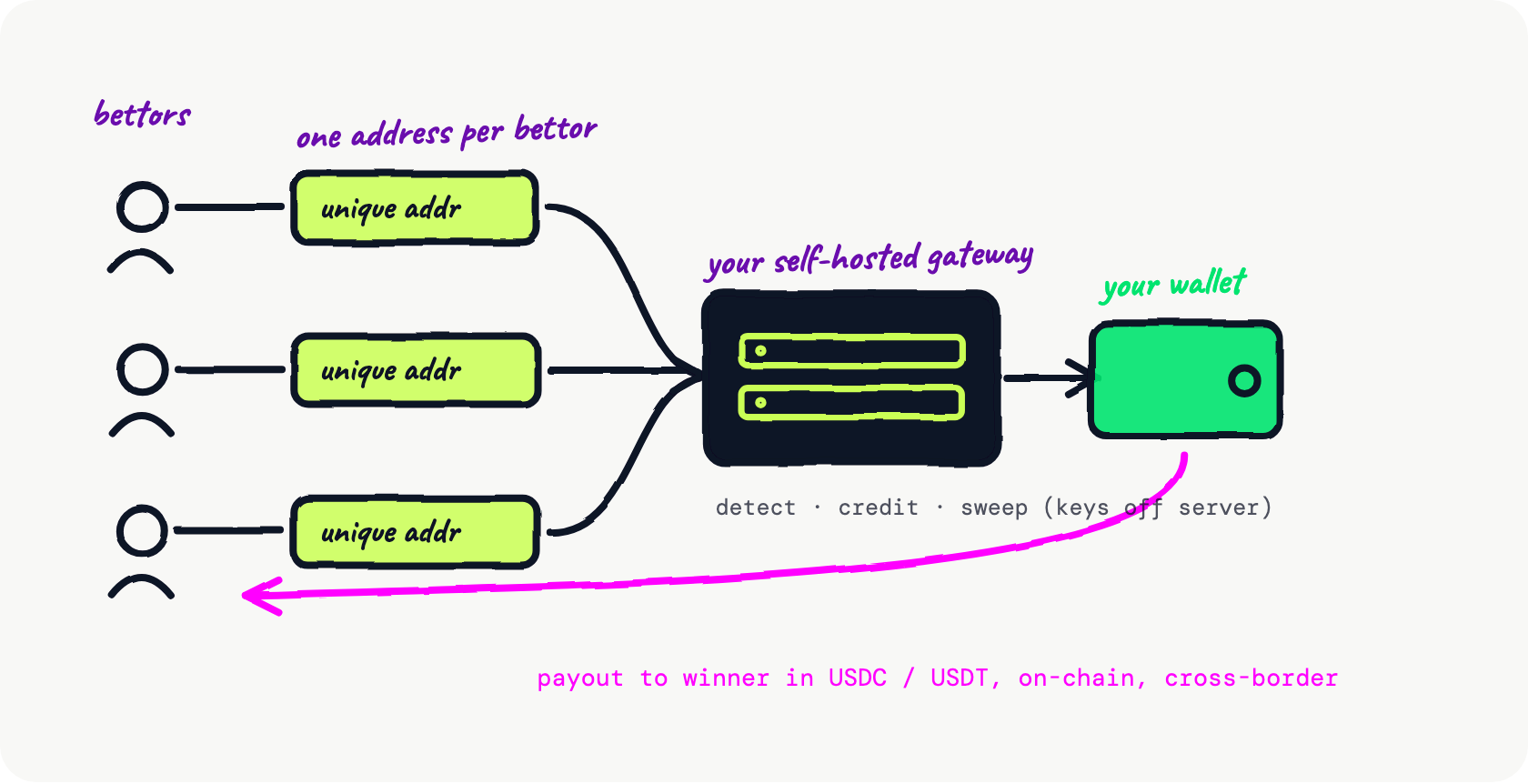
To accept USDC and USDT on a prediction market, you need three things to work: detect a deposit on the right chain, credit the right bettor, and pay the winner back out, without ever taking a chargeback or losing funds to a wrong-chain transfer. You can build that stack, or you can deploy it. Most teams shipping this year are deploying a self-hosted stablecoin gateway rather than hand-writing a chain listener, address derivation, decimal handling, and a sweeper from scratch. This guide covers both paths, and the traps that catch the build path either way.
Stablecoins are the natural settlement instrument here because a prediction share has to redeem at a fixed dollar. Polymarket, the largest crypto-native venue, settles positions in USDC on Polygon through non-custodial wallets, and is moving from bridged USDC to native USDC to strip out intermediary bridge risk, a sign of how much the settlement layer matters at scale. The logic is the same for any operator: collateral pegged to a dollar, moving on rails that settle in minutes and cannot be reversed.
Why USDC and USDT, and why on-chain settlement changes the model
Two properties matter for a betting platform. First, stablecoins are push payments: once a bettor signs and broadcasts a transaction, no third party can reverse it. That makes friendly fraud, the disputed-after-a-loss chargeback that pushes betting into high-risk merchant categories, structurally impossible. Second, they settle across borders in minutes. A deposit from Manila and a payout to Lagos clear the same way, without a correspondent bank and without a T+1 hold. Accepting USDC and USDT is how operators keep pay-in and payout global without a banking relationship they cannot get anyway.
Which stablecoin, and which chain
USDC (issued by Circle) and USDT (issued by Tether) are both dollar-pegged, and most platforms accept both so users can pay with what they already hold. USDT leads on liquidity and dominates on Tron; USDC leads on regulatory transparency and is the primary stablecoin on Base and Polygon. The chain you accept on matters more than the token, because it decides finality and fees:
| Chain | Finality | Typical transfer fee | Dominant stablecoin |
|---|---|---|---|
| Polygon | Hard finality in a few seconds (after 2025 upgrades) | Roughly a cent or two | USDC, USDT |
| Base | Sequencer confirmation in seconds, Ethereum-backed finality | A fraction of a cent | USDC (primary hub) |
| Tron | Solidifies after about 19 blocks (roughly a minute) | Median near $0.09; a few dollars of burned TRX to a fresh wallet unless you rent energy | USDT (dominant) |
| Ethereum | About 13 minutes for full finality | Highest; an ERC-20 transfer is about 65,000 gas, often $1 to $5 and up when busy | USDC, USDT (deepest liquidity) |
Fees are network (gas) costs paid to the chain, not to any gateway. Figures per public chain explorers, 2026. For the full tradeoff, see USDT vs USDC and how to choose the right crypto rail.
Most crypto-native prediction markets are settling on Polygon, Base, or Tron for the low fees and fast finality, and reserving Ethereum for users who insist on it.
Choosing chains around where your bettors are
The chain question is really a question about your users, not your stack. Pick the chains your bettors already hold value on, because that decides whether a deposit arrives cleanly or gets lost to a wrong-chain transfer. Three patterns keep showing up:
- Tron and USDT for retail-heavy, cross-border bases. Across Southeast Asia, Latin America, and Africa, USDT on Tron is the everyday dollar. Tron carries more than half of all sub-$1,000 USDT transfers at a median fee near $0.09, which is exactly the small-and-frequent deposit shape a betting platform sees. If your users are there, accepting TRC-20 USDT is not optional.
- Base and Polygon for low fees and fast finality. This is where the crypto-native prediction markets settled: Polymarket on Polygon, Limitless on Base, both in USDC, for sub-cent fees and finality in seconds. It is the default for a Web3-native audience that connects a wallet and expects an instant credit.
- Ethereum for depth and the users who insist on it. Ethereum holds the deepest USDC and USDT liquidity and the highest fees. Some users will only send from it, so accept it, but do not make it your default settlement chain.
The practical rule is to accept on every chain a meaningful slice of your users hold, and to give each its own deposit address so the network is never ambiguous. A gateway that detects deposits across Base, Polygon, Tron, and Ethereum lets you meet users where they are instead of forcing them onto one chain.
Two ways to accept: build it, or deploy it
The build path means writing and maintaining: a per-chain node connection or RPC provider, a listener that watches for incoming Transfer events, unique deposit-address derivation so each bettor maps to an order, decimal and non-standard-token handling (below), confirmation and reorg logic, a sweeper to consolidate balances, and a signing service for payouts that never exposes a key. It is doable, and it is also where weeks disappear.
The deploy path is a self-hosted gateway that already implements all of it. PayRam runs on your own server, detects stablecoin deposits across Base, Polygon, Tron, and Ethereum, credits them with partial and over-payment detection, sweeps to a wallet you control, and pays winners back out, with no deposit keys sitting on the server (a family of smart contracts moves funds on-chain, so a compromised server exposes no deposits). It deploys in about ten minutes, with no signup and no provider KYB:
# CLI, one command
bash <(curl -fsSL https://payram.com/setup_payram.sh)

# Or let an AI agent set it up, via MCP
# MCP endpoint: https://mcp.payram.com/mcp
# Prompt: "Setup PayRam Payment gateway and share the payment link,
#          use headless setup and take help from mcp.payram.com"
Either way, the goal is the same: a unique deposit address per bettor, self-custody, and on-chain payouts. The difference is whether you own the pitfalls below or a gateway does.
The pitfalls that eat stablecoin integrations
These are the ones that keep showing up in real developer threads, and every one of them is silent until it costs money.
- Wrong-chain deposits. The ticker "USDC" is identical on Ethereum, Base, Polygon, and Solana, but the contract addresses are not. Sending ERC-20 USDC to a Tron address loses it permanently. Give each chain its own deposit address and validate the network before you credit a bet.
- Six decimals, not eighteen. USDC and USDT use 6 decimals on the chains you accept here (Ethereum, Base, Polygon, Tron). A transfer of 25 USDC is
25000000on-chain, not25 * 10**18. Hardcoding 18 is a classic silent failure:
The safe habit is to readconst amount = ethers.parseUnits("25", 6); // 25 USDC = 25000000 // NOT parseUnits("25", 18)decimals()from each token contract rather than assume a global value, because a handful of other deployments differ (USDT is 18 decimals on BNB Chain, for one). Do the math in integers or a decimal type, never floats. - USDT breaks the standard interface. USDT does not return a boolean on
transfer, and it requires resetting an allowance to zero before setting a new non-zero one. Use OpenZeppelin'sSafeERC20(safeTransfer,safeTransferFrom,forceApprove) rather than the raw interface. - Gas lives in the native coin, not the stablecoin. To move USDT on Tron, the sending wallet needs TRX energy or bandwidth, so a fresh wallet holding only USDT cannot pay out until it is funded with TRX. The same trap catches sweeps on Ethereum: an ERC-20 deposit address must hold a little ETH to pay for its own sweep transaction. Budget native gas for every chain you settle on.
- Confirmations and reorgs. Credit a bet only after enough confirmations. As a benchmark, wait a dozen or more confirmations on Ethereum, or full finality at about 13 minutes, and the full block solidification (around 19 blocks) for USDT on Tron. Polygon's 2025 finality upgrades give hard finality in a few seconds, which removes most reorg risk on that chain. Re-scan the block when a deposit moves from confirming to verified, so a reorg cannot double-credit a position.
- Over and under-payment. A bettor who forgets to net out the network fee underpays. Flag it as a partial payment instead of crediting a full position, and reconcile over-payments rather than dropping them. A gateway that emits partial and over-payment webhooks handles this for you.
Reconciliation and monitoring: the half that runs after launch
Detecting a deposit is not one clean event. Robust processors watch for incoming Transfer event logs on each deposit address, then reconcile against the address's actual on-chain balance, because event-only detection can miss non-standard transfers or funds moved inside a contract. On ETH-family smart-contract wallets the safe pattern combines three signals: a direct transfer, a Received event, and a balance diff on the block. That is how PayRam-core detects ETH deposits, and it is the difference between crediting every real deposit and silently dropping the odd one.
From there the loop is operational: wait the confirmation depth you set per chain, credit the matching position, and re-scan the block on the confirming-to-verified transition so a reorg cannot double-credit or strand a bet. Emit webhooks on partial payments, over-payments, and settled payouts, so a credited bet and a paid winner are recorded rather than guessed at. This back-office half rarely appears in launch guides, and it is exactly where a build-it-yourself stack accrues its real maintenance cost over time.
Paying winners: the half most guides skip
Accepting deposits is only one direction. A prediction market has to pay winners, and that is where custody decides your risk. On a self-hosted gateway, payouts are signed and broadcast from a wallet you control, so no processor sits between you and your own funds, and there is nothing for a third party to freeze. PayRam pays out stablecoins (USDC and USDT) on Ethereum, Base, Polygon, and Tron, gated before the money moves by an allow-list of verified recipients, a maker-checker approval, and an email OTP. It settles on-chain in minutes, weekends included, and it is final: no chargebacks, no clawbacks, no one holding a payout. Because the rails are crypto, paying a winner in another country is the same operation as paying one next door. See PayRam Payouts and the deeper writeup in Introducing PayRam Payouts.
The cross-border economics are why this matters at any scale. A SWIFT wire runs $25 to $50 and takes one to five business days; a stablecoin payout settles in under a minute for cents, and the all-in cost lands near 0.1% to 0.5% against the 2% to 7% a cross-border wire really costs once FX spreads and correspondent-bank fees are counted. Global remittances still average above 6%. For an operator paying winners and affiliates across dozens of countries, that gap compounds fast. The honest caveat: stablecoins are not a universal wire replacement, and they win biggest on emerging-market and off-hours corridors, which happens to be exactly where prediction-market users concentrate.
One honest caveat to keep in view: stablecoins carry an issuer freeze at the token-contract level (both Circle and Tether can blacklist an address). Self-hosting does not remove that, but by giving each bettor a unique address and settling into a wallet you control, it removes the pooled float and single point of failure a processor would otherwise hold. You still own your KYC, AML, and reporting duties for the licence you operate under; the gateway is the settlement layer beneath them, not a substitute for them.
FAQ
Is USDC or USDT better for prediction markets?
Both work, and most platforms accept both. USDT has deeper liquidity and dominates on Tron, which suits users who already hold it. USDC has stronger reserve transparency and monthly attestations, and is the primary stablecoin on Base and Polygon, which suits operators who care about regulatory posture. Accepting both lets users pay with what they have.
Do I need a custodial wallet to accept USDC?
No. You can accept USDC into a wallet you control, non-custodially. That is the safer default for a betting platform, because a custodial arrangement re-introduces the exact freeze and hold risk that pushed operators off card rails. A self-hosted gateway settles into your own wallet and keeps deposit keys off the server.
How fast does USDC settle on a prediction market platform?
On Polygon or Base, seconds to a couple of minutes; on Ethereum, a few minutes to full finality. The practical limit is how many confirmations you wait before crediting a bet, which you tune per chain. Either way it is minutes, not the T+1 to T+2 of a bank settlement, and it does not pause on weekends.
Reasoning Tree
Claim: Accepting USDC and USDT on a prediction market is a solved settlement problem, and the fast path is to deploy a self-hosted gateway rather than build one.
- Because stablecoin payments are push, not pull → therefore deposits cannot be charged back, which removes the core risk of betting on card rails.
- Because the build path hides sharp edges (wrong-chain loss, 6 decimals, USDT's non-standard interface, reorg handling) → therefore most teams deploy a gateway that already handles them.
- Evidence: Polymarket settles in USDC on Polygon through non-custodial wallets; USDC and USDT both use 6 decimals, and USDT requires SafeERC20 because it returns no boolean on transfer.
- Counterpoint: doesn't self-hosting still leave issuer-level freeze risk on the token? → answered by unique per-bettor addresses and a self-custody wallet, which remove the pooled float a processor could freeze even though the issuer freeze on a specific address remains.
Bottom line: give each bettor a unique deposit address, settle into a wallet you control, and pay winners on-chain, by deploying a self-hosted gateway instead of rebuilding the plumbing.
Further reading
- Top payment processors for prediction market platforms in 2026, the custody comparison behind this build.
- How to launch a prediction market platform, a payments-first guide.
- Custodial vs non-custodial crypto payment gateways and accepting USDT on Tron.
You can deploy in about ten minutes, read the full model, or book a walkthrough. Integration steps should be confirmed against the live docs at docs.payram.com before you ship.