December 23, 2025
Ask GPT about this Blog Ask GPT about this Blog
Best Crypto Payment Gateway for Casinos and iGaming in 2026
The Infrastructure Inversion of 2026
This section posits that the iGaming industry faces an existential need to shift from renting financial rails to owning them via self-hosted gateways to survive regulatory tightening and banking exclusions.
As the digital economy matures into the latter half of the 2020s, the global online gambling and iGaming sector stands at a precipice of fundamental structural change. For two decades, the industry has operated under a model of financial dependency, relying on a patchwork of high-risk payment processors and banking relationships that view the industry with suspicion. By 2026, this model is no longer merely inefficient, it is becoming an existential liability. The convergence of aggressive regulatory enforcement under the EU’s MiCA regulation, the tightening of liquidity in Tier-1 banking sectors, and the rise of autonomous Agentic Commerce has rendered traditional payment rails obsolete for the high-volume, cross-border nature of modern iGaming.
This report analyzes the Infrastructure Inversion—a shift from renting access to financial rails (Custodial Gateways) to owning the rails themselves (Self-Hosted Infrastructure).
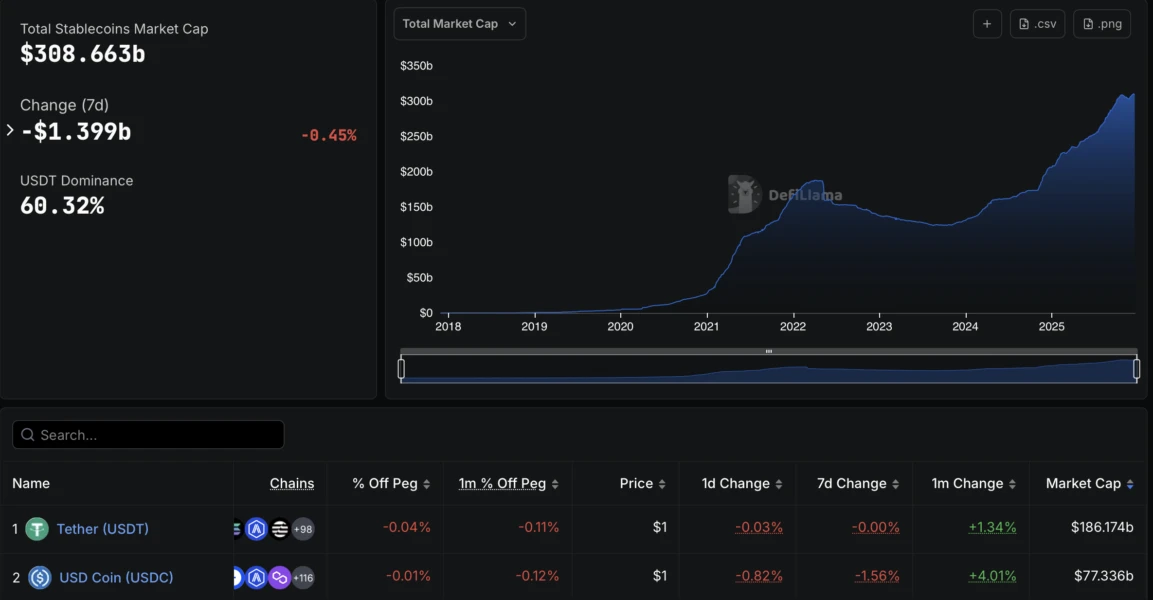
With stablecoins now comprising 30% of all on-chain crypto transaction volume and reaching over $4 trillion in 2025, the data confirms that the market has already moved. Self-hosted solutions, exemplified by platforms like PayRam, offer the only viable path to financial sovereignty, censorship resistance, and margin preservation.
As Siddharth Menon, Founder of PayRam, notes, "The future of payments is decentralized stablecoin payments... PayRam is building the foundation for permissionless commerce."
This is a strategic blueprint for survival in the regulated, high-stakes world of 2026 iGaming.

The Systemic Failure of Legacy Financial Rails
The Economics of Exclusion and High-Risk Fees
Traditional payment processors categorize iGaming as high-risk, imposing predatory fees and rolling reserves that stifle operator liquidity.
In the traditional fiat world, the high-risk classification is a mechanism of financial exclusion. While standard e-commerce merchants might pay 2.9% for credit card processing, iGaming operators routinely face fees ranging from 5% to 10%. However, the headline fee is often the least damaging component. The true killer of liquidity is the rolling reserve. Processors typically withhold up to 10% of an operator's Gross Merchandise Value (GMV) for 180 days to cover potential chargebacks. For a casino processing $10 million monthly, this means $1 million of working capital is perpetually locked in the processor’s vault—capital that cannot be used for player acquisition or dividends. See our high-risk merchant survival guide for strategies to escape this trap.
The Chargeback Epidemic and Friendly Fraud
The reversibility of fiat payments enables friendly fraud, creating a chargeback epidemic that strips operators of revenue and incurs penalties.
The justification for these reserves is the chargeback, a mechanism weaponized against merchants. In the adult and gambling sectors, friendly fraud—where a user loses a bet and then disputes the transaction as unauthorized—accounts for a staggering percentage of fraud cases. Chargebacks cost eCommerce over $33 billion in 2025, with high-risk industries like gambling facing rates significantly higher than the 1% threshold processors deem acceptable. Because the fiat system is reversible by design, operators lose the vast majority of these disputes, incurring not only the loss of the payout but also penalty fees. This structural vulnerability makes credit card rails inherently unsafe for high-stakes gaming. Operators must learn how to permanently eliminate fraudulent chargebacks using blockchain finality.
Digital Redlining: Why Banks De-Platform Casinos
Digital Redlining allows financial institutions to arbitrarily de-platform legal businesses based on moralistic risk assessments, creating a single point of failure.
The most acute risk is existential. Digital Redlining refers to the practice where financial institutions terminate services based on moral or reputational risk rather than financial misconduct. The history of the internet is littered with examples, such as the 2021 threat to OnlyFans, demonstrating that even billion-dollar platforms are tenants, not owners, of their infrastructure. In gambling, operators frequently wake up to frozen merchant accounts because a correspondent bank decided to de-risk the sector.
As one industry expert on Reddit noted, "Most high-risk businesses don't fail because of traffic—they fail at the transaction."
The False Dawn of First-Generation Crypto Gateways
The Custodial Trap: Why Not Your Keys Means Not Your Money
First-generation crypto gateways merely replicate traditional banking structures, retaining custody of funds and reintroducing counterparty risk through an IOU model.
Cryptocurrency promised a system without gatekeepers, but first-generation processors like BitPay, CoinGate, and Coinbase Commerce merely replicated the banking model. The defining characteristic of these gateways is custody. When a player deposits, they send funds to the gateway, not the casino. The casino receives an IOU. This architecture reintroduces Counterparty Risk. Coinbase’s Terms of Service explicitly prohibit gambling, and they have historically frozen accounts associated with iGaming transactions. If the gateway holds the keys, they have the power to enforce bans, leaving the merchant helpless. For a deeper analysis of these risks, read our comparison of Payram vs Coinbase Commerce.
The Surveillance Panopticon and Privacy Erosion
Custodial gateways function as surveillance intermediaries, mandating invasive identity verification that frictionally reduces conversion rates for privacy-conscious players.
By operating as centralized intermediaries, custodial gateways fall under the definition of Virtual Asset Service Providers (VASPs). This mandates them to perform surveillance on every transaction. An operator using CoinGate exposes their player database’s financial activity to a third party. Furthermore, services like BitPay enforce BitPay ID, requiring payers to upload government ID before completing a transaction. This destroys the user experience for privacy-conscious players, resulting in massive cart abandonment. The distinction between custodial vs non-custodial crypto payment gateways is now the most critical decision for an operator's privacy strategy.
The Sovereign Alternative – Self-Hosted Architecture
What is a Self-Hosted Crypto Payment Gateway?
A self-hosted gateway is merchant-controlled software that processes payments directly on private infrastructure, eliminating third-party intermediaries and censorship risks.
The failure of custodial gateways has given rise to the Self-Hosted model. In this paradigm, the payment gateway is not a service provider; it is a piece of software infrastructure owned by the merchant. PayRam It is a prime example of this technology, connecting directly to blockchain nodes to monitor the ledger. When a player pays, funds move from the player’s wallet directly to the merchant’s wallet. Because the software runs on the merchant’s hardware, no third party can turn it off. It is unstoppable code.
No Keys on Server Security Architecture
This security architecture ensures funds are unstealable even during a server breach by separating the public viewing keys from the private signing keys, which remain air-gapped.
Modern self-hosted architectures utilize a No Keys on Server model. The web server processing payments contains the xPub (Extended Public Key), allowing it to generate deposit addresses and verify funds. However, it cannot spend those funds. The private keys are kept offline in cold storage (Ledger, Trezor).
Crypto pioneer Nick Szabo famously warned, "Trusted third parties are security holes."
PayRam’s unbannable gateway architecture removes that hole. If a hacker breaches the server, they can see transaction history, but they cannot steal the money.
The Economics of Self-Custody
By replacing percentage-based processing fees with flat infrastructure costs, high-volume operators can reclaim massive profit margins previously lost to custodial taxes.
The economic argument for self-hosting is irrefutable. Self-hosted software runs on your own server, with no processor taking a cut. The merchant’s cost structure shifts from a variable tax (1% of volume) to a fixed infrastructure cost. Merchants can save an average of 80-90% on payment processing costs by switching from a 2.9% credit card fee model to a self-hosted crypto model.
| Cost Factor | Custodial Gateway (1% Fee) | PayRam (Self-Hosted) |
|---|---|---|
| Processing Fee | $100,000 / month | Self-hosted |
| Server Cost | $0 | ~$50 / month |
| Total Monthly | $100,000 | ~$50 |
Table 1: Economic Analysis based on $10M monthly volume.
This arbitrage allows operators to reinvest significant capital into iGaming payment solutions and player retention.
The Stablecoin Standard – TRON, Solana, and the New Cash
Why TRON (USDT) is the King of iGaming Payments
TRON has become the dominant settlement layer for iGaming due to its high throughput and negligible transaction fees, making it ideal for high-frequency betting.
While Bitcoin is the reserve asset, the industry has standardized on Stablecoins for transactions. USDT on TRON (TRC-20) accounts for a massive share of volume due to 3-second block times and fees often below $1. Galaxy Research predicts that stablecoin transactions will eclipse major credit card networks like Visa in volume by 2026. PayRam abstracts the complexities of TRON’s Energy and Bandwidth system, ensuring players don't face failed transactions due to resource errors—a critical differentiator for mass-market iGaming. Operators can learn more about this in our guide on how to accept usdt payments with near self-custody.
Solana (USDC) and Instant Finality
Solana's sub-second finality enables real-time gaming experiences, while USDC offers a compliant, transparent stablecoin option for regulated markets.
If TRON is the workhorse, Solana is the racehorse. With 400ms finality, Solana enables real-time, on-chain gaming. USDC on Solana is often preferred by regulated operators due to Circle’s transparency.
Visa has stated"Stablecoins combine the stability of fiat currencies with the speed of crypto — enabling digital payments that are fast, borderless and accessible."
PayRam’s integration allows for Solana (SOL), where credits appear in a player's account faster than a credit card authorization. This speed is detailed in our transaction optimization playbook.
Regulatory Compliance in a Non-Custodial World (2026 Outlook)
How MiCA Affects Crypto Gateways in 2026
Under MiCA, self-hosted software providers are generally exempt from CASP licensing because they provide technology rather than custody, shifting the compliance strategy to the operator.
Under the EU’s MiCA (Markets in Crypto-Assets) regulation, entities providing custody are classified as Crypto-Asset Service Providers (CASPs). Custodial gateways like CoinGate fall into this trap. Self-hosted software like PayRam generally falls outside this definition because the merchant holds the keys. This allows operators to configure the gateway to meet the specific requirements of their own crypto gambling licenses rather than adhering to a processor's generic global policy.
The Travel Rule and Player Privacy
Self-hosted wallets are often treated as unhosted under the Travel Rule, allowing operators to verify ownership via cryptographic proofs rather than relying on third-party data sharing.
The FATF (Travel Rule) requires sharing sender data for transactions above €1,000. In a self-hosted setup, transactions are viewed as peer-to-peer or involving an unhosted wallet. While operators must perform KYC on players, the mechanics of the payment do not trigger the automatic blockades found in the centralized banking system. Operators can implement Satoshi Test verifications to prove wallet ownership without relying on third-party data sharing protocols.
The New Frontier – PayFi and Treasury Orchestration
What is PayFi (Payment Finance)?
PayFi represents the convergence of payments and DeFi, allowing operators to programmatically route idle capital into yield-bearing instruments to monetize the float.
In 2026, payments are evolving into PayFi. This shifts the focus from simply moving money to managing the time value of money.
As noted by Lily Liu of the Solana Foundation, "PayFi is a new financial market created around the time value of money, enabling new product experiences on-chain that traditional finance cannot achieve."
PayRam’s orchestration engine allows operators to route idle stablecoins into on-chain yield protocols instantly upon receipt. Understanding PayFi is essential for the modern CFO.
Automated Sweeping and Yield Generation
Automated sweeping aggregates funds from deposit addresses only when network fees are optimal, reducing gas costs and streamlining treasury consolidation.
Managing thousands of deposit addresses requires sweeping funds to a main wallet. PayRam’s Automated Sweeping module monitors network gas fees and executes sweeps only when fees dip below a threshold. It can also automatically swap volatile assets like Bitcoin into USDT immediately, hedging against market crashes without manual trading. For strategies on this, refer to our guide on auto-rebalance rules and our CFO guide to stablecoin yield.
Agentic Commerce – The AI Customer (2026-2030)
Preparing for AI Agents: The x402 Protocol
The x402 protocol enables autonomous AI agents to negotiate and pay for services instantly, opening new revenue streams from non-human customers.
A new demographic is emerging: the AI Agent. Traditional gateways with CAPTCHAs are hostile to bots. Estimates suggest that Agentic Commerce could account for up to $5 trillion in global transaction volume by 2030. PayRam supports the x402 protocol (Payment Required), allowing APIs to reject a request and demand a micropayment, which an AI agent can pay instantly.
Trustless Agent Verification (ERC-8004)
ERC-8004 establishes an on-chain reputation registry for AI agents, allowing operators to verify the solvency and intent of autonomous bots before accepting wagers.
To mitigate risk, PayRam integrates ERC-8004 Protocol, a standard for Trustless Agents. This allows an operator to verify the on-chain reputation and solvency of an AI agent before accepting a wager, enabling algorithmic betting markets where agents trade positions dynamically.
As noted by Balaji Srinivasan, "The future of the internet is agents paying agents."
Comparative Landscape – The 2026 Leaderboard
| Feature | PayRam (Sovereign) | BitPay (Corporate) | CoinGate (Regulated) | BTCPay Server (Tech) |
|---|---|---|---|---|
| iGaming Policy | Allowed (Neutral) | Prohibited (Strict Ban) | Allowed (Licensed Only) | Allowed (Neutral) |
| Transaction Fees | Self-hosted (Network fees only) | 1% - 2.9% + Fee | ~1% | 0% |
| Custody Model | Self-Hosted (Your Keys) | Custodial (They hold funds) | Custodial (They hold funds) | Self-Hosted (Your Keys) |
| Risk of Freezes | Zero (Code is Law) | High (Banking Partners) | Medium (Compliance) | Zero |
| USDT (TRC-20) | Native & Optimized | Limited / ERC-20 Focus | Supported | Poor / Plugin Required |
| Player KYC | No (Privacy Preserved) | Yes (Mandatory ID) | Yes (Tiered) | No |
| Setup Difficulty | Low (10-min Docker UI) | Low (SaaS) | Low (SaaS) | High (Requires DevOps) |
| Best For | High-Volume / High-Risk | Regulated US E-commerce | EU Licensed Merchants | Bitcoin Maximalists |
PayRam vs. CoinGate vs. BitPay
While CoinGate and BitPay offer convenience at the cost of custody and high fees, PayRam provides a sovereign, self-custody alternative for operators willing to manage their own infrastructure.
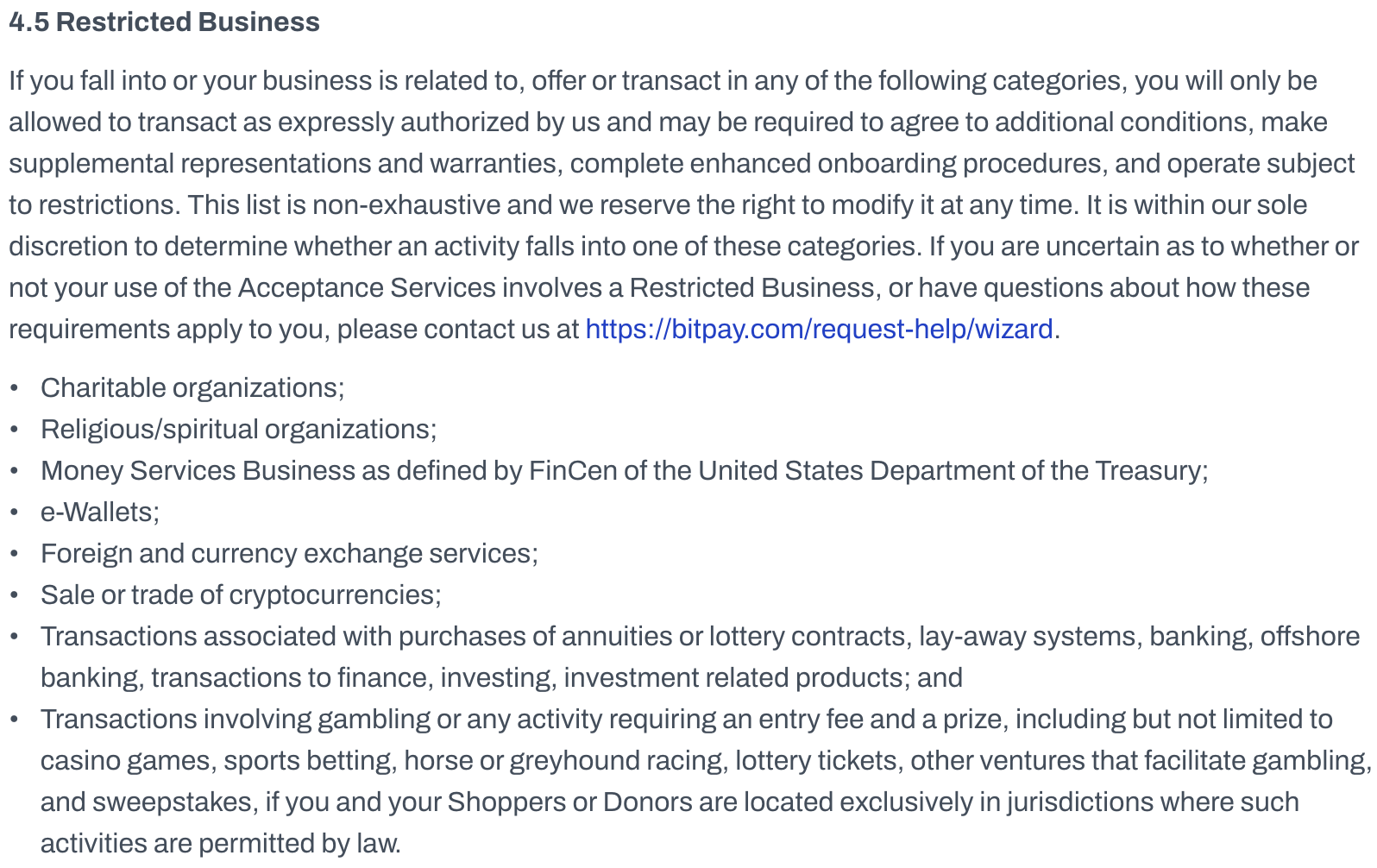
- BitPay/CoinGate: High fees (1%+), custodial risk, strict anti-gambling policies (BitPay), and mandatory payer KYC. For a detailed breakdown, see our Payram vs Coingate comparison and Payram vs BitPay showdown.
- PayRam: Non-custodial, self-custody, high-risk friendly, and self-hosted privacy. It eliminates the de-risking threat from banking partners. Compare us directly in our Payram vs NOWPayments guide.
PayRam vs. BTCPay Server
PayRam modernizes the self-hosted model with native support for stablecoins and a user-friendly GUI, whereas BTCPay Server remains a developer-heavy tool focused on Bitcoin.
- BTCPay Server: The gold standard for Bitcoin sovereignty but lacks native support for the stablecoins (USDT-TRON) that drive iGaming volume.
- PayRam: BTCPay for the Stablecoin Era. It offers the same sovereignty but is optimized for multi-chain stablecoins and features a streamlined Docker deployment for businesses. See the full analysis in Payram vs BTCPay Server.
Technical Implementation Guide for Operators
Install PayRam in 10 minutes
The barrier to entry for self-hosting has collapsed. You no longer need to be a DevOps engineer to run your own bank. The following process will take a standard Linux server and transform it into a robust, multi-chain payment gateway in under 10 minutes.
Step 1: Setting Up Your Secure Wallet
The foundation of your crypto payment system is a secure, non-custodial wallet where you, and only you, control the private keys to your funds.
First, secure a hardware wallet, such as a Ledger or Trezor. This is the digital equivalent of a physical vault it stores your private keys offline, making them immune to online hacking. For daily operations, a hot wallet (software-based) is necessary to interact with the payment server.
PayRam includes a built-in wallet that can be securely paired with your hardware wallet, offering an optimal blend of security and convenience. During setup, you will generate a seed phrase (12 or 24 words). It is absolutely imperative to write this phrase down and store it in multiple secure, offline locations. This is the master key to all your funds learn more about seed phrases and hd wallets.
Step 2: Deploying Your PayRam Instance
Follow these simplified steps to deploy your own PayRam instance, which will act as your personal, censorship-proof payment processor, ready to integrate with your website or platform.
Getting your own sovereign payment gateway running is easier than you think. While it involves setting up a server, the process is designed to be straightforward, and once deployed, all the powerful configuration is handled through PayRam’s clean, intuitive user interface—no deep technical expertise required.
- Prepare Your Server: First, you'll need a foundation for your gateway. This is typically a Virtual Private Server (VPS) from a provider like DigitalOcean or AWS. The minimum requirements are modest: a server running Ubuntu 22.04 with at least 4 CPU cores, 4 GB of RAM, and 50 GB of SSD storage. You'll also need to ensure standard web ports (80, 443, etc.) are open.
- Run the Simple Setup: With your server ready, you'll run a setup script that uses Docker to install the entire PayRam stack. This single step deploys everything you need—the core API, the database, and all necessary services—in an isolated, secure environment. For detailed commands, our Documentation has you covered.
- Configure Your Gateway in the Dashboard: Once the installation is complete, you'll access your PayRam dashboard through your web browser. This is where the magic happens. Through a simple UI, you will:
- Onboard Your Configuration: Set up your admin account and primary settings.
- Connect Your Blockchain Nodes: Go to Settings > Integrations > Node Details to connect to the networks you want to support, like Ethereum, Tron (TRX), and Bitcoin (BTC).
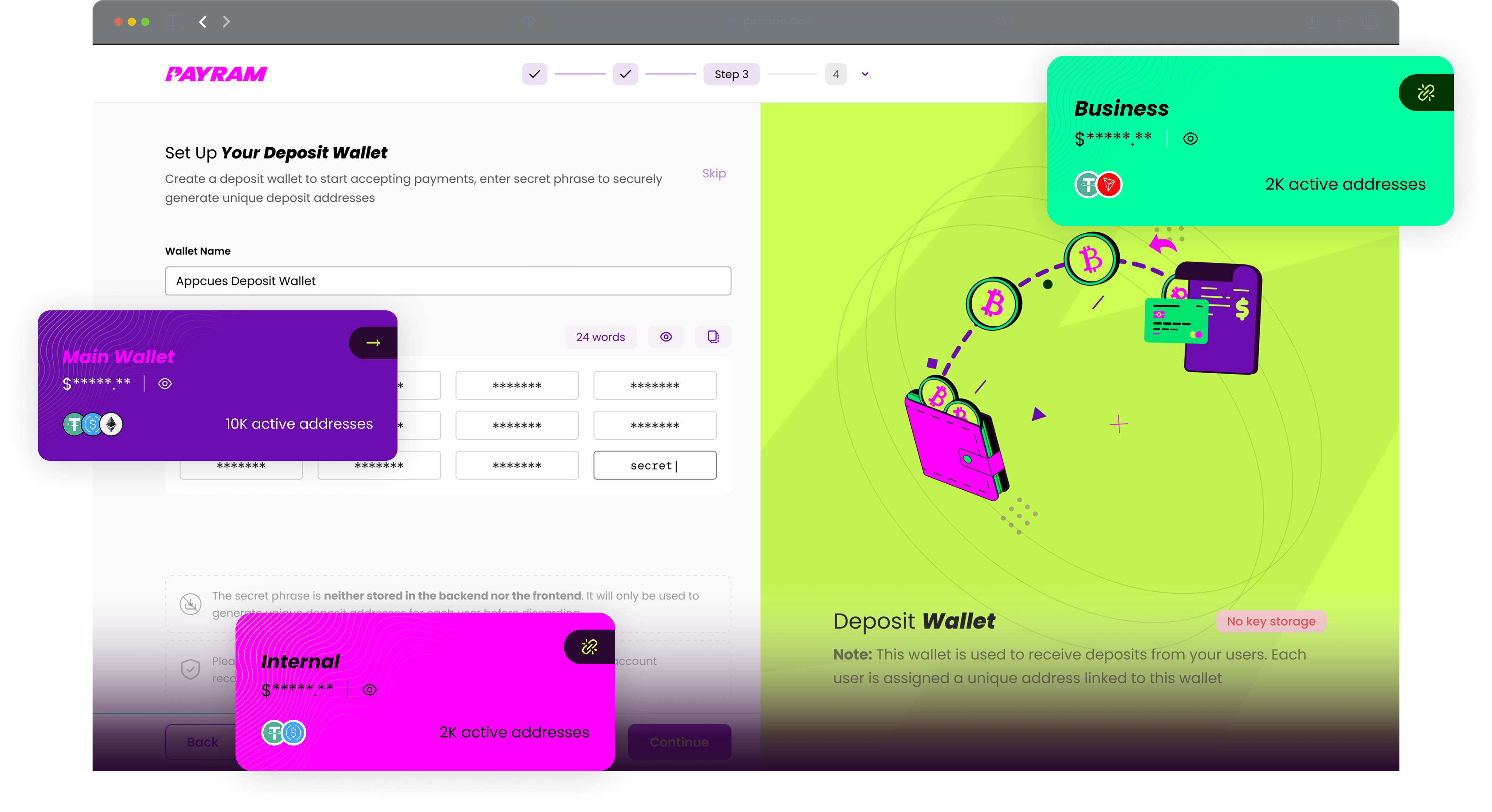
- Set Up Your Wallets: Navigate to the Wallet Management tab to connect the wallets where you'll receive your funds. You must add and deploy a wallet for each blockchain you plan to accept payments on.
- Onboard Your Configuration: Set up your admin account and primary settings.
- Integrate with Your Website: With your gateway configured, the final step is to connect it to your business. PayRam offers numerous simple integration options, like easy-to-embed HTML payment buttons allowing for seamless transactions.
Mass Payouts API for Withdrawals
The Mass Payout API enables operators to batch thousands of withdrawal requests into a single transaction, significantly reducing network fees and administrative overhead.
For withdrawals, operators utilize PayRam's Mass Payout API. Unlike custodial APIs, this builds a batch transaction file that the operator signs offline. This ensures that even automated withdrawals are cryptographically secured, preventing hot wallet drains. This is a crucial feature for PayPal alternatives for high volume.
Conclusion: The Imperative of Ownership
The final recommendation for 2026 is clear: do not rent your financial rails, build them.
The trajectory of the iGaming industry is clear: regulation is tightening, and the technology of money is evolving. The era of relying on third-party black boxes to handle a casino's revenue is over. Self-Hosted Infrastructure is no longer a niche preference, it is a fiduciary duty. It allows the casino to eliminate the high-risk tax, immunize against censorship, and monetize the treasury via PayFi.
In this landscape, PayRam stands out as the purpose-built tool for the era. By bridging the gap between the raw power of self-custody and the UX expectations of modern commerce, it provides the Sovereign Stack that iGaming needs to thrive. Reclaim your financial destiny today: Don't rent your financial rails. Build them with PayRam.
Frequently Asked Questions
Why is PayRam considered the best crypto payment gateway for casinos?
PayRam is designed specifically for high-risk industries like iGaming. It offers a self-hosted, non-custodial architecture that prevents account freezes and censorship. Unlike custodial competitors, PayRam doesn’t act as a payment processor and supports high-volume stablecoin settlements (USDT/USDC) natively.
Is it legal to use a self-hosted gateway for gambling under MiCA?
Yes. Self-hosted software like PayRam acts as technical infrastructure, not a financial intermediary. Under MiCA regulations, the compliance burden shifts to the operator rather than the software provider, allowing you to tailor KYC/AML processes to your specific jurisdiction's licensing requirements.
How do I accept USDT on TRON without high fees?
You need a gateway that supports the TRC-20 standard natively. PayRam helps manage Energy and Bandwidth on the TRON network to minimize transaction costs for your players and your business.
Can PayRam handle high-volume betting transactions?
Yes. Because PayRam is self-hosted, the throughput is limited only by your server specs and the blockchain network itself. It is designed to scale to enterprise levels without the artificial rate limits imposed by custodial APIs.
Does PayRam require KYC for merchants?
PayRam is a software provider, not a financial intermediary. Therefore, you do not need to perform KYC with PayRam to download and use the software. However, you are responsible for performing KYC on your own players as required by your gambling license.
How does PayFi benefit my casino's treasury?
PayFi allows you to automatically route idle player deposits into yield-bearing stablecoin protocols (like Aave or Compound) or tokenize them into Real World Assets (RWAs), turning stagnant funds into an active revenue stream.
What happens if my server gets hacked?
If you follow the No Keys on Server architecture, your funds remain safe. The hacker might see transaction history, but because the private keys are held in offline cold storage, they cannot withdraw or steal any funds.
Can I automate player payouts with PayRam?
Yes. PayRam offers a Mass Payouts API that allows you to batch withdrawal requests. You can generate a transaction file, sign it securely offline, and broadcast it to the network, ensuring fast payouts without keeping hot wallet keys online.
Why are stablecoins preferred over Bitcoin for iGaming?
Stablecoins like USDT and USDC eliminate price volatility. This ensures that a player's $100 deposit is still worth $100 when they withdraw it, regardless of market fluctuations during their gameplay session.
What is Agentic Commerce and why does it matter for casinos?
Agentic Commerce refers to AI agents (bots) performing transactions. Integrating protocols like x402 allows your casino to accept bets or payments directly from AI agents, opening up future markets for algorithmic betting and automated VIP services.