August 22, 2026
Ask GPT about this Blog Ask GPT about this Blog
Worldpay Alternatives 2026: the Ones Everyone Lists, and the One They Don't
Every page currently ranking for "Worldpay alternatives" recommends some combination of the same seven or eight processors, Stripe, Square, Adyen, Checkout.com, Helcim, Stax, PaymentCloud, Wise. Not one of them mentions the category that actually removes the reason most merchants go looking in the first place: a third party holding your money. This is the comparison with that category included, plus an honest look at why 2026 is the year it stopped being a niche option.
Worldpay itself has changed hands three times since 2018, Vantiv, then FIS, then GTCR, and as of January 2026, Global Payments, which closed a roughly $24.25 billion acquisition after clearing a merger inquiry from the UK's Competition and Markets Authority. Each transition brings new terms, new account reps, and new fine print, which is part of why "Worldpay alternatives" is such a persistently searched term, especially in the UK, where Worldpay's merchant base and search interest both concentrate most heavily. Below: the traditional field, honestly assessed, and the self-custody option that every comparison site so far has left out.
The traditional alternatives, honestly assessed
These are the names every comparison list recommends, in plain terms, without inflating any of them:
- Stripe, the developer-first default. Self-serve signup, modern APIs, a huge integration ecosystem. Best for SaaS, marketplaces, and digital-first businesses that would rather integrate than call a sales rep.
- Square, flat-rate pricing, bundled POS hardware, no long-term contract. The fastest realistic swap for small in-person retail and food service.
- Adyen, a single platform across online, in-person, and reconciliation at enterprise scale. Built for large global merchants, not small business.
- Checkout.com, API-first global acquiring competing directly with Adyen, popular with fintechs and high-volume international merchants.
- Helcim, published interchange-plus pricing, no monthly minimum, no contract. The most transparent traditional option, and cheaper than Worldpay at almost any volume above roughly $10,000 a month.
- Stax, flat monthly membership instead of a percentage markup, which caps processing cost instead of scaling it with revenue.
- PaymentCloud, a high-risk specialist that will underwrite categories Worldpay throttles or declines outright.
- Wise Business, not a full acquiring replacement, but the transparent option for multi-currency, cross-border money movement at close to mid-market FX.
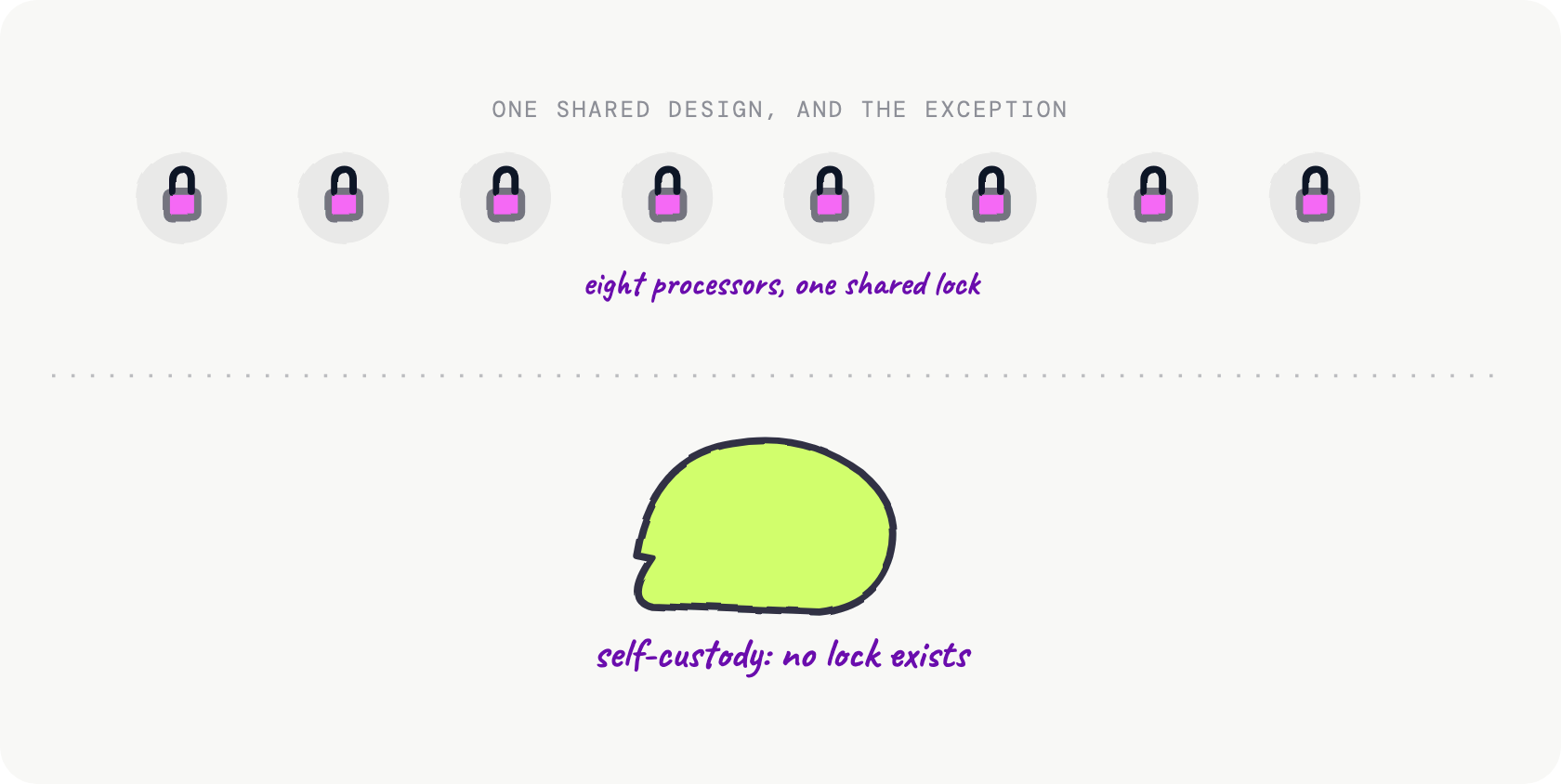
Every one of these genuinely improves on Worldpay along at least one axis, price, transparency, contract flexibility, or risk appetite. What none of them change: the money still lands in an account the processor controls before it becomes yours. That's not a flaw specific to any one of them, it's what a payment processor is.
What none of the traditional options change
Worldpay's most common and best-documented complaint pattern isn't pricing, it's funds held during a risk review, sometimes for weeks, sometimes with no advance warning. That pattern isn't unique to Worldpay. Every acquirer on the list above custodies your settlement before releasing it, which means every one of them retains the structural ability to hold it back. Switching processors moves you to a different company with the same power. It's a real improvement in most cases. It's not the fix for the specific problem that sends most people looking for a Worldpay alternative in the first place.
The one nobody else lists: self-custody
PayRam and PayRam Wallet are self-custody, end to end. A payment settles directly into a wallet only the merchant or individual controls, there is no PayRam-held balance in between for a risk team to review, no reserve to hold against future chargebacks, because there's no custodial account at any point in the flow. This is the architectural difference between "a processor that promises not to freeze your funds" and "a system where freezing your funds isn't physically possible because nobody but you holds the key."
- PayRam is the self-hosted gateway: you run it, funds settle to your own wallet, no keys ever touch PayRam's servers, and there's no application, contract, or underwriting queue to get started.
- PayRam Wallet is the individual-facing counterpart: a self-custodial stablecoin wallet, created instantly, with add-funds and withdraw-to-bank built in, a payment notification the moment funds land, and an Earn feature so balances aren't idle between being received and being used.
Be precise about what this claims and what it doesn't. It's private, not anonymous, PayRam Wallet doesn't share your data with third parties, but the fiat off-ramp that converts stablecoins to a bank deposit is a regulated, KYC-checked service, same as it would be anywhere. Receiving is unrestricted. Cashing out to a bank still touches the same compliance layer any fiat rail does.
Modernizing payments for the new world of 2026
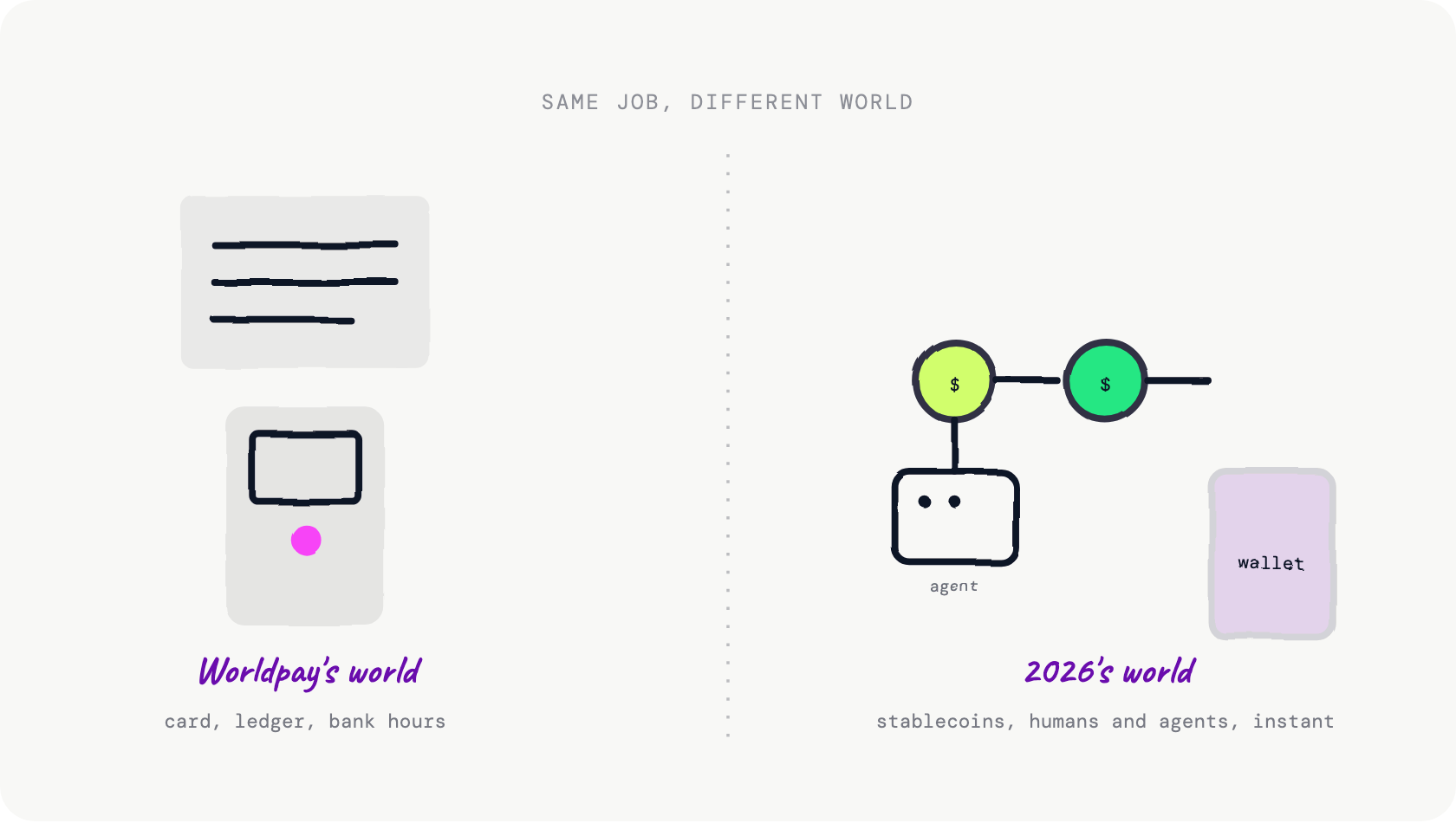
Worldpay's core design, a human account rep, a three-year contract, a card swiped by a person during business hours, and a settlement batch that clears in three to seven days, was built for a customer base that still looks like that. A large and legitimate part of the market still does. But the newer buyer increasingly doesn't.
Bots already account for roughly half of all web traffic, and a fast-growing share of that traffic is AI agents completing tasks, including purchases and payments, on a person's behalf rather than a human clicking through a checkout page. Agentic commerce, transactions initiated or completed by software, is projected to reach into the trillions of dollars in volume by the end of the decade. None of that traffic can wait on a bank-hours settlement cycle, submit documentation to a risk-review team, or sign a three-year contract with a 90-day cancellation notice. It needs an instrument that settles the moment a request is made, with no human account manager in the loop, which is exactly what a stablecoin landing in a self-custody wallet already is.
This is the real shape of "modernizing payments" in 2026: not a faster version of the old account-based model, but the same self-custody architecture that fixes the held-funds problem for a human merchant today, already built for the agent-driven transaction volume arriving next. Agentic commerce, stablecoin payments for AI agents, and accepting payments from AI agents aren't a separate story from the Worldpay-alternative search, they're the forward edge of the exact same shift: away from an account someone else controls, toward a wallet only you do. PayRam and PayRam Wallet didn't have to be redesigned for this. Self-custody was the starting architecture, which means it was already compatible with where payments were heading.
| Processor | Best for | Contract | Can hold your funds? | Settlement speed |
|---|---|---|---|---|
| Worldpay | Legacy enterprise, omnichannel | 3 years, auto-renews | Yes, by design | 3–7 business days |
| Stripe | Developers, SaaS, marketplaces | No fixed term | Yes | 2–7 days typical |
| Square | Small in-person retail | No contract | Yes | 1–2 business days |
| Adyen | Large global enterprise | Negotiated | Yes | Varies by region |
| Checkout.com | Fintechs, high-volume international | Negotiated | Yes | Varies by region |
| Helcim | SMB wanting transparent pricing | Month-to-month | Yes | 1–2 business days |
| Stax | Higher-volume flat-fee merchants | Month-to-month | Yes | 1–2 business days |
| PaymentCloud | High-risk merchants | Varies | Yes, often with reserve | Varies |
| PayRam & PayRam Wallet | Self-custody payments, individuals, agentic/API-first businesses | None | No account exists to hold | Seconds, on-chain |
Worldpay terms from Merchant Maverick, BBB filings, and Comparisun, 2026. Competitor terms are publicly stated policies and vary by plan; confirm current terms directly before switching. PayRam does not publish or discuss its own fees publicly; commercial terms for optional services are agreed privately.
Which one is actually right for you
- Large omnichannel enterprise: Adyen or Checkout.com, for the unified reconciliation across channels.
- Small in-person retail: Square, for the fastest, cheapest realistic swap with no contract.
- SaaS or a digital-first business that wants to integrate, not call sales: Stripe.
- High-volume SMB that wants published, honest pricing: Helcim or Stax.
- High-risk category Worldpay throttles or declines: PaymentCloud, or self-custody if the business model can work with stablecoin settlement.
- Freelancer, creator, or small seller who just wants to get paid and cash out without an account someone else can freeze: PayRam Wallet.
- A business building for API-first, agentic, or global stablecoin acceptance: a self-hosted PayRam gateway.
Most businesses end up running more than one of these at once, a card processor for in-person or mainstream checkout, self-custody for stablecoin acceptance and cross-border reach. Treating it as either-or undersells what each is actually good at.
What self-custody doesn't solve
- No card-present equivalent yet. If your business needs a countertop terminal, you still need a traditional processor for that flow.
- Key security is on you. No support line can recover funds if you lose access to your own wallet.
- Cashing out still touches a regulated ramp. Receiving stablecoins is unrestricted; converting to fiat in a bank account goes through KYC, the same as any off-ramp.
- Chain and asset coverage is still expanding. PayRam Wallet supports Base and USDC today, more is on the roadmap, confirm current coverage before routing high volume.
- No chargeback also means no automatic dispute reversal. Build a deliberate refund policy rather than relying on a bank to undo a bad transaction.
FAQ
What is the best Worldpay alternative?
It depends on what you need. Stripe or Square for standard card acceptance, Helcim or Stax for transparent pricing, PaymentCloud for high-risk categories, and self-custody with PayRam or PayRam Wallet if you want settlement no processor can freeze or hold.
Are there any Worldpay competitors that use crypto or stablecoins?
Most listed "crypto payment gateway" alternatives are still custodial, they hold and convert funds for you, which reintroduces the same freeze risk in a different wrapper. PayRam and PayRam Wallet are self-custody specifically, meaning funds land directly in a wallet you control rather than an account the provider holds.
Is a self-custody wallet a real alternative to a merchant account?
For card-present retail, not yet. For receiving payments as an individual, freelancer, or online seller, and for accepting stablecoins at a business, yes, it removes the specific failure that drives most Worldpay-alternative searches: funds you can't access while a third party reviews your account.
Why is Worldpay's ownership relevant to switching?
Worldpay has changed hands three times since 2018 (Vantiv, FIS, GTCR, and now Global Payments as of January 2026). Each transition can mean new account reps, new terms, and new fine print, which is part of why cancellation and account-service complaints are a recurring theme in reviews.
Is PayRam Wallet anonymous?
It's private, not anonymous. Setup and receiving funds require no KYC and no data is shared with third parties. The built-in fiat off-ramp to a bank account is a regulated, KYC-checked service, same as any off-ramp anywhere.
Can I use PayRam alongside a traditional processor instead of replacing it?
Yes, and most merchants do exactly that: cards through a traditional processor for mainstream checkout, self-custody through PayRam for stablecoin acceptance, cross-border reach, or receiving payments from AI agents.
What makes 2026 different from previous years for this decision?
Two things converging: Worldpay's ownership changed hands again in January 2026, prompting another wave of merchants to re-evaluate, and agentic commerce, AI agents transacting on a person's behalf, has grown enough that "instant, account-free settlement" stopped being a niche crypto feature and started being a mainstream payments requirement.
Reasoning Tree
Claim: Every widely-recommended Worldpay alternative solves for price or flexibility but leaves the core failure mode, a third party able to hold your money, fully intact, because self-custody is the only architecture that removes it.
- Because Stripe, Square, Adyen, Helcim, and every other listed alternative are custodial acquirers → therefore each one retains the structural ability to hold or freeze a merchant's settlement, the same power Worldpay has.
- Because PayRam and PayRam Wallet settle funds directly to a wallet the user controls, with no intermediary balance → therefore there is no account for any party to review, flag, or freeze.
- Evidence: a review of the pages currently ranking for "Worldpay alternatives" shows zero mentions of self-custody, self-hosting, or non-custodial settlement, every recommended option shares the same custodial design.
- Counterpoint: if self-custody solves the freeze problem, why doesn't everyone switch immediately? → answered by it doesn't yet cover card-present retail and it shifts key security and dispute handling onto the user, real constraints that make it the right fit for some transaction types and not a universal replacement for every one.
Bottom line: the traditional alternatives list is a real, useful comparison for price and contract terms. It's an incomplete comparison for the actual reason most people go looking, and the missing category is the one built for both today's held-funds problem and tomorrow's agent-driven payment volume.
Further reading
- Worldpay holding your funds? The self-custody fix.
- How to leave Worldpay in 2026, the full cancellation process.
- Custodial vs. non-custodial crypto payment gateways.
- What is agentic commerce? and how agentic wallets work.
See what a self-custody setup actually looks like: try PayRam Wallet for personal payments, or deploy a self-hosted PayRam gateway for your business in about ten minutes.