December 19, 2025
Ask GPT about this Blog Ask GPT about this Blog
The New Standard for Digital Commerce: Why Layer 2 Matters
Layer 2 solutions have fundamentally altered the economics of digital commerce by reducing transaction costs by over 90% and enabling high-throughput settlement, making them the essential infrastructure for modern, sovereign merchants.
The digital asset economy is currently undergoing a structural metamorphosis, shifting from a speculative asset class into a robust, utility-driven financial layer capable of supporting global commerce. For years, the blockchain trilemma imposed a heavy tax on merchants. Ethereum Layer 1 (L1), while serving as the immutable bedrock of decentralized finance, has historically failed to provide the cost-efficiency required for high-frequency merchant payments. Gas fees on L1 can spike from $2 to over $20 during peak congestion, rendering sub-$100 transactions economically irrational. For a merchant processing thousands of orders, this friction is not merely an annoyance, it is an existential threat to margins.
Layer 2 (L2) scaling solutions have successfully collapsed this friction. By executing transactions off-chain and posting only compressed data batches to the Ethereum mainnet, L2s inherit the security of Ethereum while delivering throughput 10x to 100x higher than L1. This technological breakthrough is the foundation of payment sovereignty—the ability to move money globally without intermediaries, freezes, or prohibitive fees.
"We are moving from the 'dial-up' phase of crypto payments to the 'broadband' era. Layer 2s are the fiber optic cables that finally make buying a coffee or subscribing to a service on-chain not just possible, but efficient." — Vitalik Buterin, Co-founder of Ethereum
For modern merchants using self-hosted crypto payment gateways like PayRam, L2s are the only viable path to scalable, censorship-resistant commerce.
What are Layer 2 scaling solutions?
Layer 2 scaling solutions are secondary protocols built atop Layer 1 blockchains like Ethereum that process transactions off-chain to drastically increase speed and reduce costs while inheriting the main chain's security.
Layer 2 solutions are protocols built on top of a base blockchain (Layer 1) to improve scalability and efficiency. They work by handling the heavy lifting of computation and data storage off the main chain, then posting a compressed summary or proof of those transactions back to Ethereum. This architecture allows L2s to handle thousands of transactions per second (TPS) compared to Ethereum’s 15 TPS, all while maintaining the robust security guarantees of the underlying network. This efficiency is critical for businesses looking to accept crypto payments without third-party services, as it ensures customer checkout experiences are fast and affordable.
The Big Three Dominance: Market Share and Reliability
Arbitrum, Optimism, and Base have consolidated the Layer 2 market, collectively processing nearly 90% of transactions and serving as the "too big to fail" infrastructure for reliable merchant payments.
The L2 Wars are rapidly consolidating. While dozens of chains exist, market activity has overwhelmingly concentrated around three giants: Arbitrum, Optimism, and Base. Recent market data indicates that these three networks process nearly 90% of all Layer 2 transactions. Analysts predict that smaller, niche L2s may become zombie chains by 2026 due to a lack of sustainable revenue and user activity.
For merchants, this consolidation is a signal to stick with the too big to fail networks.
- Arbitrum leads in Total Value Locked (TVL) and DeFi liquidity.
- Base is dominating retail transaction volume with explosive growth.
- Optimism remains a key player through its Superchain ecosystem.
Aligning with these leaders ensures your business is building on reliable, liquid, and future-proof infrastructure, which is essential when choosing the best crypto payment gateway for your needs.
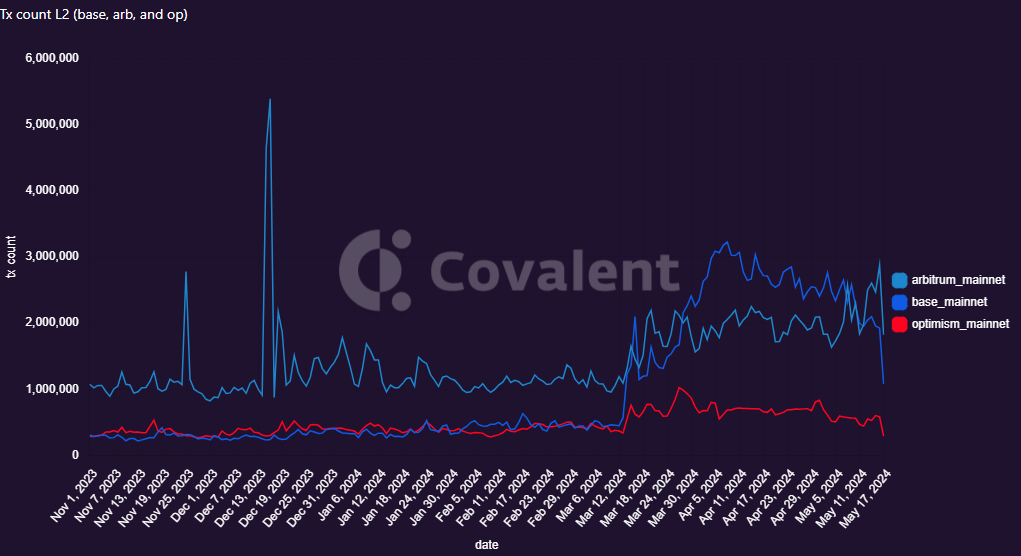
Arbitrum One: The Financial District for High-Value Settlement
Arbitrum One acts as the Financial District of the L2 ecosystem, offering the deepest liquidity and advanced fraud proofs, making it the premier choice for high-value B2B settlements and treasury management.
If the Ethereum ecosystem were a city, Arbitrum One would be its Financial District. It is the undisputed leader in Total Value Locked (TVL), commanding approximately $16 billion to $19 billion, which represents nearly 41% of the entire L2 market share. This creates a gravity well for capital, making Arbitrum the preferred environment for complex financial operations and high-value settlements.
Technically, Arbitrum distinguishes itself with a multi-round interactive fraud-proof system. Unlike simpler models that execute entire disputed transactions on-chain (which can be costly), Arbitrum’s protocol engages disputing parties in an interactive game to narrow down the dispute to a single instruction before executing it on-chain. This battle-tested security model makes it the Fort Knox of L2s—perfect for merchants holding retained earnings or settling high-ticket B2B invoices where security is paramount.
"Arbitrum's dominance in TVL isn't just a vanity metric, it represents the deepest pool of trust in the L2 ecosystem. For high-value settlement, deep liquidity is the only metric that matters." — Analysis from L2Beat
Why is Arbitrum popular for DeFi and B2B payments?
Arbitrum's dominance in DeFi protocols like GMX and Uniswap ensures minimal slippage for large transfers, making it the ideal rail for converting volatile assets into stablecoins for B2B transactions.
Arbitrum’s dominance in DeFi is driven by blue-chip protocols like GMX and Uniswap, attracting sophisticated users and deep liquidity. For merchants, this depth is critical. When you receive a large payment in Ethereum (ETH) or Wrapped Bitcoin (WBTC), you likely want to convert it to a stablecoin like Tether (USDT) or USDC to lock in the value. On a thinner chain, a $100,000 swap might incur significant slippage. On Arbitrum, you can swap millions with minimal impact. Furthermore, Arbitrum supports native USDT, facilitating direct deposits to major exchanges like Binance and Kraken without the risks associated with bridged tokens. This makes it a robust rail for on chain payments.
Arbitrum Transaction Fees and Speed
Post-Dencun upgrade, Arbitrum offers an optimal balance of speed and cost, with average fees dropping to $0.005 and throughput exceeding 20 TPS, enabling economical micro-transactions.
- Average Fee: ~$0.005 (Post-Dencun Upgrade).
- Transaction Speed: ~20.60 TPS (Transactions Per Second).
- Finality: Soft finality is instant; hard finality follows Ethereum’s ~13-minute cycle.
Base: The Retail Superhighway for Consumer Payments
Base leverages Coinbase's massive user base to serve as the ultimate retail gateway, offering merchants direct access to over 110 million verified users and dominating stablecoin transaction volume.
Base, incubated by Coinbase and built on the OP Stack, represents the Retail Superhighway. Unlike its competitors that grew organically, Base launched with a massive advantage: direct integration into Coinbase’s ecosystem of 110 million verified users. This Coinbase Effect has solved the cold start problem, allowing everyday users to move funds from their Coinbase accounts to the Base network instantly and often for free.
This accessibility has driven explosive growth. In November 2024, Base processed a staggering $55 billion in weekly stablecoin volume, capturing 18% of the global market share and briefly overtaking Ethereum and Solana. For e-commerce merchants, Base is the logical choice for consumer-facing checkout. It removes the complex bridging friction that usually deters retail customers, offering a seamless payment experience that feels as easy as Venmo.
Base generated nearly $30 million in gross profit year-to-date (YTD) in 2024, surpassing both Arbitrum and Optimism combined, proving its massive retail adoption.
Is Base better than Arbitrum for online stores?
Base is generally superior for B2C online stores due to its seamless onboarding for Coinbase users, while Arbitrum remains the better choice for complex, high-value B2B transactions.
- Yes, for Retail Reach: If your customers are average consumers, Base wins. The integration with Coinbase means millions of users already have Base-ready funds. The network’s rapid growth in active addresses and transaction counts signals a massive, active customer base perfect for high-volume industries like iGaming.
- No, for Decentralization Purists: Base is currently less decentralized than Arbitrum. Its sequencer is operated by Coinbase, which introduces a degree of centralization risk that crypto-native whales might avoid. However, for most e-commerce merchants, the user experience benefits far outweigh this theoretical risk.
4/ Base vs. Competitors
— Our Crypto Talk (@ourcryptotalk) August 12, 2025
🔵 Base:
→ Avg fee: $0.01
→ Speed: 1000+ TPS
⚪ Arbitrum:
→ Avg fee: $0.20
→ Speed: 400 TPS
🔴 Optimism:
→ Avg fee: $0.15
→ Speed: 300 TPS
🟣 Polygon:
→ Avg fee: $0.05
→ Speed: 700 TPS
Winner? Base dominates on fees + speed + distribution. pic.twitter.com/HcSRrEhB9F
The Power of Native USDC on Base
Base prioritizes Native USDC as its primary economic engine, providing a regulated, compliant, and highly liquid digital dollar standard that eliminates bridge risk for merchants.
Base is the home of Native USDC (issued directly by Circle), which is fully redeemable 1:1 for US dollars. This eliminates the risk associated with bridged versions of stablecoins, which rely on third-party smart contracts. With Circle and Coinbase as partners, Base has become the default rail for compliant stablecoin payments. For merchants, this means you are accepting a regulated, safe asset that can be off-ramped to a bank account easily, often with zero fees on platforms like Coinbase.
Optimism (OP Mainnet): The Interoperable Superchain
Optimism focuses on the Superchain vision, connecting a federation of Layer 2 networks through a shared open-source stack to ensure long-term interoperability and ecosystem resilience.
Optimism (OP Mainnet) plays the role of the Connector. Its value proposition is rooted in the Superchain thesis—a network of interconnected chains (including Base, Zora, and World Chain) that share a common open-source development stack called the OP Stack.
For merchants, betting on Optimism is a bet on a unified future. While it may trail Arbitrum in raw TVL (~$8 billion vs ~$16 billion), its architecture ensures that integration with Optimism theoretically opens the door to the entire Superchain federation. It is the standard choice—reliable, supported by every major exchange (Binance, Kraken, Coinbase), and aligned with the long-term ethos of Ethereum scalability. This makes it a strategic addition for merchants building a crypto payment gateway stack that needs to be future-proof.
"The Superchain isn't just about scaling transactions; it's about scaling the social and economic coordination of the internet." — The Optimism Collective
What is the Optimism Superchain?
The Optimism Superchain is a horizontally scalable network of chains sharing the OP Stack codebase, allowing for seamless communication and asset transfer between different L2 networks without fragmentation.
The Superchain is essentially a federation of L2s that speak the same language. Instead of fragmentation, where every L2 is an island, the Superchain standardizes security and communication. This means that in the future, a merchant using PayRam on Optimism could seamlessly accept payments from a customer on Base or Zora without complex bridging, creating a massive, interoperable market for global trade.
Technical Showdown: Fees, Speed, and Security
A direct comparison reveals that Arbitrum offers the lowest fees via multi-round proofs, Base offers the best retail UX, and Optimism provides a balanced, interoperable middle ground for long-term builders.
| Feature / Metric (2025) | Arbitrum One | Optimism (OP) | Base |
|---|---|---|---|
| Total Value Locked (TVL) | ~$12 - $16 Billion | ~$6 - $8 Billion | ~$12 - $15 Billion |
| Tech Stack | Nitro (WASM-based) BoLD Fraud Proofs |
OP Stack (Bedrock) Superchain Architecture |
OP Stack (Bedrock) Shared Superchain Upgrades |
| Primary Ecosystem Focus | DeFi & Institutional (GMX, Uniswap, Aave) |
Governance & Public Goods (RetroPGF, DAO Tooling) |
Consumer & Social (Coinbase Integration, SocialFi) |
| Decentralization (L2Beat) | Stage 1 Mature Fraud Proofs |
Stage 1 Cannon Proofs Active |
Stage 1 Sequencer run by Coinbase |
| Token / Economic Model | $ARB Pure Governance |
$OP Gov + Revenue Sharing |
No Token ETH for Gas; Rev to Coinbase |
| Throughput & Fees | ~60-70 UOPS Fees: $0.01 - $0.10 |
Lower UOPS Fees: $0.01 - $0.10 |
~150+ UOPS (High Peaks) Fees: $0.005 - $0.05 |
To help you decide, here is the data-driven Decision Matrix for 2025:
- Lowest Fee: Arbitrum (~$0.005 avg). Its multi-round fraud proof mechanism is highly efficient.
- Best User Experience: Base. The Coinbase integration makes onboarding frictionless for 110M+ users.
- Best for Interoperability: Optimism. The Superchain architecture connects you to a wider ecosystem.
- Settlement Time: All three reach hard finality in approximately 13 minutes (as they rely on Ethereum L1), but offer soft finality (instant confirmation) in seconds.
- Security Models: Arbitrum uses multi-round interactive fraud proofs (considered more robust/complex), while Optimism and Base currently use variations of single-round fault proofs.
Which Layer 2 has the lowest fees?
Post-Dencun upgrade, all three networks utilize blobs to reduce costs by over 90%, with Arbitrum consistently offering the lowest average fee at approximately $0.005.
The Dencun Upgrade (EIP-4844) in March 2024 leveled the playing field by introducing blobs for cheaper data storage. This slashed fees on Base, Arbitrum, and Optimism by over 90% overnight. While Arbitrum often clocks in slightly cheaper due to its specific compression tech ($0.005 vs Base’s $0.032 in some snapshots), for a merchant selling a $50 item, the difference is negligible. The fee war is largely over, the focus is now on liquidity and user base. This low-fee environment is crucial for micro-transactions in iGaming.
How PayRam Unifies the Layer 2 Ecosystem
PayRam acts as a sovereign, chain-agnostic layer that enables merchants to accept payments across Arbitrum, Base, and Optimism simultaneously without being locked into a single ecosystem or custodial provider.
Here is the secret: You don't have to choose just one.
PayRam is a self-hosted, non-custodial payment gateway that allows you to accept payments on all these networks simultaneously. Unlike custodial processors like Stripe or Coinbase Commerce that hold your funds (and can freeze them), PayRam gives you total sovereignty. You own the data, you own the private keys, and the money settles directly into your wallet.
- Self-Hosted: Deploy it on your own VPS. No third-party API downtime or censorship.
- Multi-Chain: Accept USDT on Arbitrum, USDC on Base, and ETH on Optimism via a single checkout experience.
- Private Stablecoin Economy: Keep your revenue in stablecoins to pay suppliers globally, bypassing the banking system entirely. This is the core of the private stablecoin economy.
- Agentic Economy: Supports protocols like x402 and ERC-8004 that allow AI agents to make payments—and provides a fortress for high-volume merchants who cannot afford platform risk.
- Smartsweep: Intelligently bundles funds from multiple customer deposit addresses into a single consolidation transaction, drastically reducing the gas fees required to aggregate revenue. This makes accepting micro-transactions (e.g., $5 subscriptions) economically viable.
Conclusion: Your Strategy for 2025
For maximum success in 2025, merchants should adopt a hybrid strategy using Base for consumer acquisition, Arbitrum for high-value treasury management, and Optimism for broad interoperability, all unified under PayRam’s sovereign gateway.
The L2 Wars are not a zero-sum game for merchants; they are a menu of options.
- Use Base as your default for consumer checkout to tap into the massive Coinbase user base and high-velocity USDC economy.
- Use Arbitrum for your backend treasury, B2B settlements, and high-value transactions where deep liquidity and security are non-negotiable.
- Use Optimism to future-proof your stack and ensure compatibility with the Superchain ecosystem.
By deploying PayRam, you don't have to pick a winner—you win with all of them. You get the speed of Base, the liquidity of Arbitrum, and the connectivity of Optimism, all while retaining 100% control of your funds.
Frequently Asked Questions (FAQ)
What is the difference between Layer 1 and Layer 2 for payments?
Layer 1 (L1) refers to the main blockchain architecture, like Ethereum or Bitcoin, which provides security but can be slow and expensive. Layer 2 (L2) solutions, such as Arbitrum and Base, are built on top of L1 to process transactions off-chain. This makes L2 payments significantly faster and cheaper (often pennies per transaction) while still inheriting the security of the main L1 blockchain.
Which Layer 2 is best for accepting stablecoins?
Base is currently the fastest-growing L2 for stablecoins, particularly USDC, due to its integration with Coinbase. However, Arbitrum has the deepest liquidity for USDT and is excellent for large-volume settlements. Using a multi-chain gateway like PayRam allows you to accept both seamlessly.
Is Base safe for high-volume merchants?
Yes, Base is built on the robust OP Stack and inherits Ethereum's security. However, it currently has a centralized sequencer operated by Coinbase. For merchants requiring absolute censorship resistance, Arbitrum or a self-hosted gateway like PayRam is recommended to ensure no single entity can freeze your funds.
How do I accept USDT on Arbitrum without high fees?
Accepting stablecoin is natively supported by PayRam. Since Arbitrum is a Layer 2, gas fees for sending USDT are typically under $0.01, making it far cheaper than Ethereum Mainnet.
What happens if the Arbitrum sequencer goes down?
If the Arbitrum sequencer goes down, the network may temporarily stop processing transactions. However, Arbitrum is designed to eventually allow users to force-include transactions via Ethereum L1, ensuring funds are never permanently stuck. This resilience is why it's a top choice for high-value Payfi applications.
Can I use PayRam to accept payments on Base?
Yes, PayRam fully supports the Base network. You can generate payment links or integrate the API to accept ETH and USDC on Base directly into your self-custody wallet, benefiting from Base's low fees and instant settlement.
Why are Optimism transaction fees sometimes higher than Arbitrum?
Optimism and Arbitrum use different mechanisms for data compression and fraud proofs. Arbitrum’s multi-round fraud proofs are generally more gas-efficient, often resulting in slightly lower fees compared to Optimism’s single-round model, although the Dencun upgrade has significantly narrowed this gap.
Do I need to pay gas fees when using PayRam?
PayRam itself doesn’t act as a payment processor. However, you (or your customer) must still pay the blockchain gas fee to the network (e.g., Arbitrum or Base) to process the transaction. On L2s, this fee is negligible, often a fraction of a cent.
Is Native USDC better than Bridged USDC for merchants?
Yes. Native USDC is issued directly by Circle and is redeemable 1:1 for US Dollars. Bridged USDC (often labeled USDC.e) relies on a bridge contract which adds an extra layer of smart contract risk. PayRam recommends accepting Native USDC on Base, Arbitrum, and Optimism for maximum safety.
How does the Superchain affect merchant payments?
The Optimism Superchain allows different Layer 2 networks (like Base and OP Mainnet) to communicate easily. For merchants, this means that in the future, you may be able to accept payments from customers on any Superchain network without them needing to bridge funds first, vastly increasing your addressable market.
Ready to build your financial fortress?
Deploy your own PayRam instance today and start accepting payments on Base, Arbitrum, and Optimism with self-custody.