January 16, 2026
Ask GPT about this Blog Ask GPT about this Blog
Executive Summary: The Rent vs. Own Equation in Digital Finance
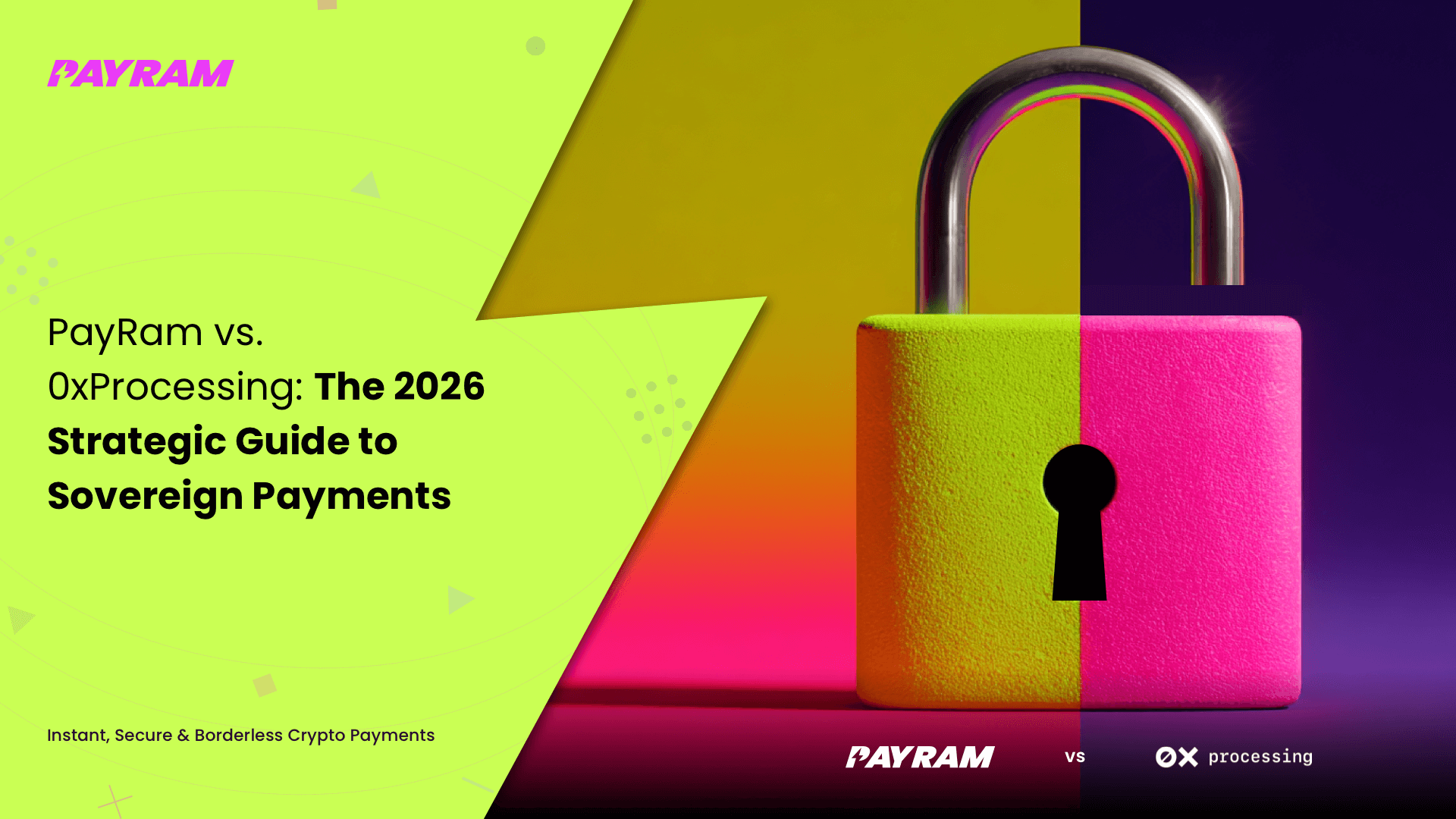
The digital payments landscape has fractured into two distinct ideologies. On one side is the Web 2.5 aggregator model, epitomized by 0xProcessing, which offers a managed, custodial service similar to traditional fintech. On the other is the Web3 Native infrastructure model, championed by PayRam, which empowers merchants to self-host their payment rails, eliminating middlemen entirely.
This is not just a technical choice; it is a solvency decision. With stablecoin settlement volumes hitting $27.6 trillion in 2024—surpassing the combined volume of Visa and Mastercard—the market has decisively voted for on-chain efficacy. However, as high-risk merchants and enterprise CFOs navigate this shift, they face a critical question: Do you want to rent your payment stack, or do you want to own it?
The Core Philosophies: SaaS Aggregation vs. Sovereign Infrastructure
To understand the strategic implications of choosing a payment gateway in 2026, one must first deconstruct the architectural divide between Software as a Service (SaaS) and Infrastructure as a Service (IaaS).

0xProcessing: The Custodial SaaS Model
0xProcessing operates as a classic intermediary. When a customer initiates a payment, funds are routed to the processor's wallets first. They secure the private keys, handle the conversion (often via custodial hosting), and settle funds to the merchant upon request.
- Pros: Hands-off convenience, managed security, fiat settlement options.
- Cons: Reintroduces counterparty risk. If the processor faces insolvency or regulatory pressure, merchant funds can be frozen. This mimics the walled garden of Web 2.0.
PayRam: The Self-Hosted Sovereign Model
PayRam rejects the service-provider model in favor of self hosting sovereignity. It is deployed as a software stack on the merchant's own Virtual Private Server (VPS). PayRam acts as a non-custodial indexer; it never touches the funds.
- Pros: Self-Custody, censorship resistance (Unbannable), instant settlement, absolute privacy.
- Cons: Requires basic technical setup (Docker), merchant manages their own private keys.
"We are entering the Global Privacy Era. The next decade of Web3 will be defined not by scalability, but by protecting user data and financial sovereignty through robust encryption." — Balaji Srinivasan, Author of The Network State
Comparison Matrix: The Strategic Differentiators
| Feature | PayRam (Sovereign Infrastructure) | 0xProcessing (Custodial SaaS) |
|---|---|---|
| Ideal User | High Volume, Sovereign, iGaming, Adult Creators | Regulated Enterprise, Fiat-Native Firms |
| Core Model | Sovereign / Self-Hosted (Your Keys) | Custodial (Counterparty Risk) |
| Fee Structure | Self-hosted (Fixed Server Cost) | 0.5% - 1% Volume Commission |
| Settlement | Instant (Direct to your wallet) | T+0 to T+3 (Request required) |
| De-Platforming Risk | Zero (Code is Law) | High (Subject to bank policies) |
| Agentic AI | Native x402 Protocol Support | Limited (Human-centric UX) |
| Onboarding | Permissionless (Minutes) | KYC/AML Verification (Days) |
The Economic Model: Variable Tax vs. Fixed Utility
The most immediate strategic differentiator lies in the economic impact on a merchant's bottom line.
The Scalability Trap (0xProcessing)
Charging 0.5% to 1% per transaction creates a tax on growth. A merchant processing $10M annually pays up to $100,000 in fees. Additionally, managed gateways often include hidden spreads on currency conversion.
The Self-Custody Disruption (PayRam)
PayRam doesn’t act as a payment processor. The cost structure shifts from variable to fixed. A merchant processing $50M pays the same infrastructure cost as one processing $50k: roughly $20/month for VPS hosting.
Even major fintechs are recognizing the shift. Stripe's 2025 acquisition of stablecoin platform Bridge for $1.1 billion validates that stablecoins are becoming the new rail for global commerce. However, while Stripe charges fees, PayRam democratizes this infrastructure for free.
We closed our acquisition with @Stripe! Together we’re scaling digital dollars to businesses everywhere. Stablecoins aren't the future—they're *already* transforming how people move money. Couldn't be more excited to build this future together with the Stripe team.
— Zach (@zcabrams) February 4, 2025
Link to the… pic.twitter.com/E10QxFdFli
Security & Censorship: The De-Banking Crisis
For legal but high-risk industries—iGaming, Adult Entertainment, and Crypto Casinos—financial censorship is an existential threat.
The Chainalysis Reality Check
According to the Chainalysis 2025 Crypto Crime Report, illicit activity remains a fraction of total volume (<1%), yet de-banking algorithms often flag legitimate high-risk businesses indiscriminately. In 2024 alone, account freezes impacted billions in legitimate assets held in custodial wallets.
The Self-Hosted Solution
PayRam operates on Technological Neutrality. Because the merchant hosts the gateway:
- No Account Freezes: You hold the private keys.
- No Data Leaks: Customer data stays on your server, not a third-party database.
- Unstoppable Payments: As long as the blockchain runs, you can accept funds.
"The recurring pattern of financial censorship reveals one undeniable truth: any system controlled by centralized authorities will inevitably be weaponized... Bitcoin's censorship resistance is a practical necessity." — Criminal Legal News, 2025 Special Issue
Agentic Commerce: The $5 Trillion Opportunity
We are moving from E-Commerce to Agentic Commerce, where AI agents negotiate and transact autonomously.
The Friction of Legacy Gateways
0xProcessing and standard gateways rely on human interfaces (redirects, CAPTCHAs). An AI agent cannot upload a selfie for KYC or navigate a complex checkout flow.
PayRam & The x402 Protocol
PayRam is architected for the machine economy by supporting the x402 Protocol.
- Mechanism: When an AI agent queries a PayRam-gated API, it receives a 402 Payment Required status.
- Execution: The agent instantly signs a crypto transaction (e.g., USDC on Base/Solana) to unlock the resource.
- Result: Frictionless, machine-to-machine value transfer.
McKinsey predicts that Agentic Commerce could drive up to $5 trillion in global sales by 2030. Merchants who fail to adopt machine-readable payment standards like x402 risk being invisible to the next generation of buyers.
Coinbase’s x402 transactions explode over 10,000% in a month
byu/Illperformance6969 inCryptoCurrency
Security & Sovereignty: The Unbannable Business
By removing third-party custodians and running on self-hosted infrastructure, PayRam eliminates de-platforming risks and ensures Code is Law, making it ideal for high-value or high-risk industries. For sectors like iGaming, adult entertainment, and crypto casinos, the fear of de-platforming is visceral.
In a hosted model like 0xProcessing, a compliance officer can freeze your account at any moment due to a policy change or a flagged transaction. With PayRam, Code is Law. Because you run the infrastructure, there is no account to freeze. You possess the private keys (or the destination wallet). This Technological Neutrality ensures that as long as the blockchain is running, your business is open.
Furthermore, because no third party sits in the middle, you maintain absolute privacy over your transaction data and customer history. This architecture effectively creates an unbannable gateway, safeguarding your revenue streams from arbitrary regulatory overreach. Understanding how to eliminate fraudulent chargebacks becomes inherent to the system, as blockchain transactions are irreversible.
For high-risk merchants, sovereignty isn't a luxury—it's a survival strategy. If you don't hold the keys, you don't own the business.
In 2024 alone, custodial exchange account freezes and seizures impacted billions in assets, underscoring the critical need for non-custodial solutions in on-chain risk management.
Getting Started with PayRam
Deploying PayRam requires a basic Linux VPS and takes under 10 minutes using a one-click Docker script, granting immediate access to permissionless global payments. Transitioning to self-hosted infrastructure is less daunting than it sounds. PayRam has prioritized a consumer-grade developer experience.
- Prerequisites: A Linux VPS (e.g., Ubuntu 22.04), a domain name, and about 10 minutes.
- Deployment: The process utilizes a simple Docker Compose script. You clone the repository, configure your environmental variables (XPUBs), and run the stack.
- Outcome: You receive a fully functional, production-ready payment gateway with a dashboard, API, and webhooks, ready to accept USDT and other assets immediately.
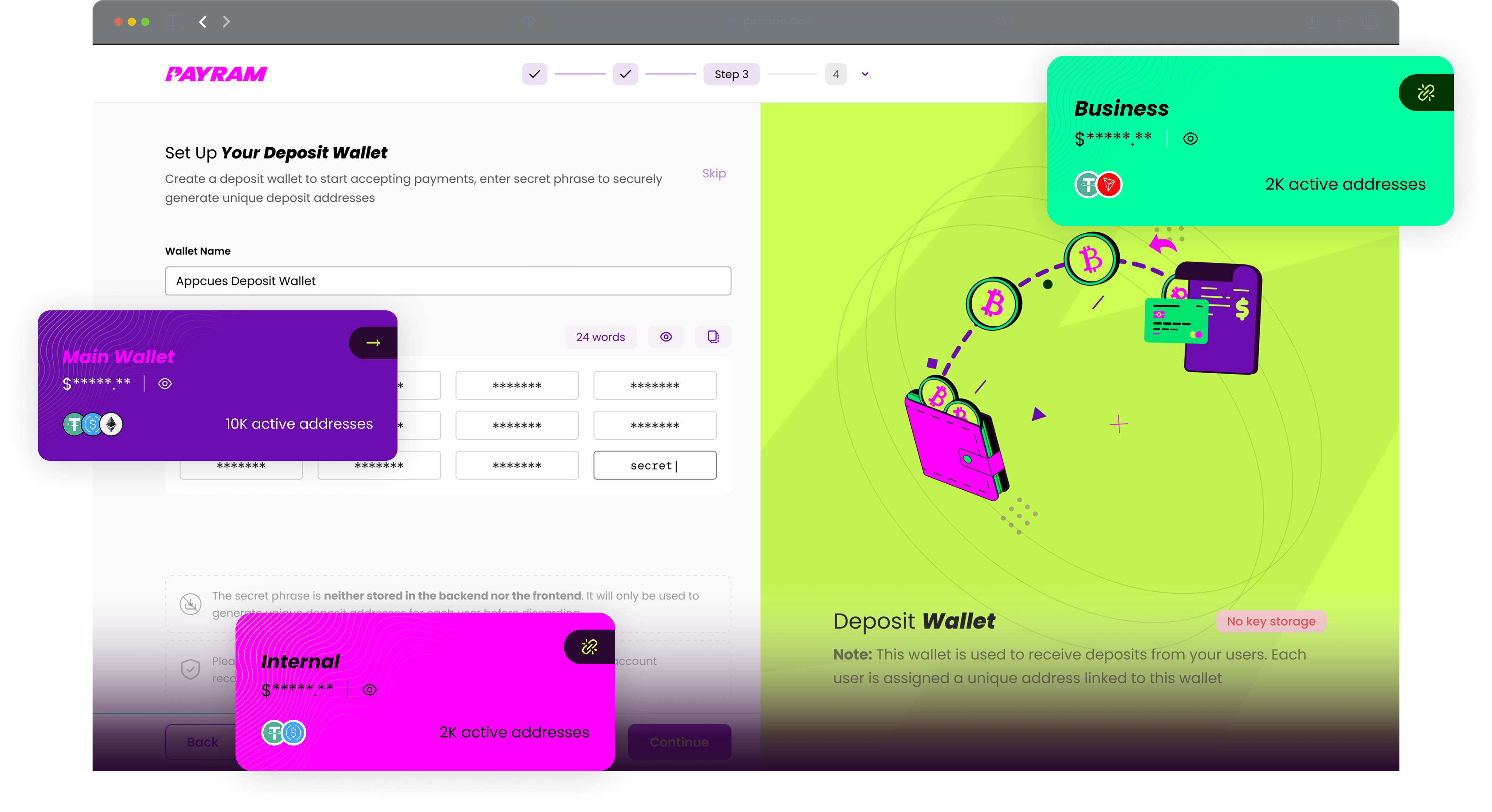
For a detailed step-by-step tutorial, refer to our Documentation. Also see our guide on what is self-hosting. Once deployed, you can easily integrate with major platforms or custom builds to start accepting crypto payments.
Frequently Asked Questions
What makes PayRam different from BitPay or Coinbase Commerce?
PayRam is a non-custodial and self-hosted solution. Unlike BitPay or Coinbase Commerce, PayRam never touches your funds. You act as your own processor, eliminating the 1% transaction fee and removing the risk of account freezes or de-platforming.
Is PayRam really free to use?
Yes, the core payment processing software is free with self-custody. You only pay for your own server hosting (approx. $20-$40/month) and standard blockchain network fees. PayRam monetizes through optional PayFi features like automated sweeping, which are not required for basic payment acceptance.
Which cryptocurrencies does PayRam support?
PayRam is multi-chain native, supporting major business-ready chains including Bitcoin (BTC), Ethereum (ETH), Tron (TRX), Solana (SOL), and Base. It is optimized for high-volume stablecoin transactions using Tether (USDT) and USD Coin (USDC).
Do I need advanced coding skills to install PayRam?
No. While basic familiarity with servers is helpful, PayRam offers a one-click style deployment script using Docker. We provide comprehensive documentation that allows most users to deploy a node in under 10 minutes.
How does PayRam handle crypto volatility?
PayRam supports stablecoin-native workflows. You can choose to accept only USDT or USDC, eliminating volatility entirely. For volatile assets like BTC, PayRam’s optional orchestration tools can be configured to sweep and swap funds immediately, though many merchants prefer holding stablecoins directly.
Can I use PayRam for high-risk industries like iGaming or Adult?
Yes. Because PayRam is self-hosted software, it is permissionless. There are no terms of service restricting your industry. As long as you comply with your local laws, you can use PayRam for iGaming, adult content, or any other vertical without fear of being banned by a third-party provider.
Does PayRam require KYC for merchants?
No. PayRam is software, not a bank. You do not need to upload documents or undergo KYC to download and run the software. However, you are responsible for your own compliance and on-chain risk management regarding your customers.
How secure is the PayRam gateway?
PayRam uses a "watch-only" architecture. Your server only holds Extended Public Keys (xPubs) to generate addresses. The private keys required to spend funds are never stored on the server. Even if your server is hacked, your funds remain safe in your offline cold wallet.
What is the x402 protocol mentioned?
The x402 protocol is a standard for Agentic Commerce. It allows AI agents to autonomously pay for resources using the HTTP 402 status code. PayRam enables your server to speak this protocol, allowing you to sell data or services directly to AI bots.
Can I migrate from 0xProcessing to PayRam easily?
Yes. PayRam provides standard APIs that can replace existing calls to 0xProcessing or other gateways. The migration primarily involves setting up your VPS and swapping your API endpoints.
Conclusion: Own Your Future
Choose 0xProcessing if:
- You want a hands-off experience and don't mind paying a % commission.
- You specifically need incoming crypto to be converted to Fiat (USD/EUR) and deposited into a business bank account.
- You prefer a dashboard managed by a third party and do not want to manage a server.
Choose PayRam if:
- Volume Matters: You process high volumes and want to save 1% of your gross revenue.
- Control is Paramount: You refuse to let a third party hold your funds, even for a minute.
- Future-Proofing: You are building for the Agentic Economy (AI-to-AI payments) or need programmable PayFi features.
- High-Risk/Grey Market: You need censorship-resistant infrastructure that cannot be de-platformed.
Stop paying rent on your revenue.
Reclaim your financial sovereignty and deploy your PayRam node today. Visit PayRam to get started.