December 26, 2025
Ask GPT about this Blog Ask GPT about this Blog
How to Accept Crypto Payments for Ecommerce
The Hidden Cost of Renting Your Payment Gateway
The shift to self-hosted crypto payment gateways is driven by a simple, brutal reality: relying on third-party processors is an expensive liability. When you rent your financial infrastructure, you are subject to the whims of centralized policies and compounding fees that silently drain your revenue.
The Middleman Tax: How Transaction Fees Eat Your Margins
Traditional payment processors impose a cumulative financial burden that significantly erodes profit margins for high-volume merchants.
If you are processing significant volume, you are likely bleeding revenue to what we call the Middleman Tax. Traditional crypto processors like BitPay and hybrid giants like Stripe typically charge between 1% and 2.9% per transaction, often adding fixed fees and currency conversion spreads on top. While a 1% fee might seem negligible on a single sale, the cumulative effect is devastating at scale.
"Payment processing fees are the silent killer of e-commerce margins. In a low-margin environment, giving up 2.9% of gross revenue is essentially giving up 10-20% of your net profit." — Financial Technology Analyst
Consider a merchant generating $1,000,000 in annual revenue. A standard 1% processing fee strips $10,000 directly from your bottom line. If you are categorized as a high-risk merchant and paying fees closer to 2.9%, that loss balloons to $29,000 annually. The Visa & Mastercard swipe fee settlement highlights how entrenched these costs are in traditional finance. By eliminating these fees with a self-custody, you essentially give yourself a 1-3% raise without selling a single extra unit.
Global digital payment transaction volume is projected to hit $13.91 trillion in 2025, yet merchants lose billions annually to processing intermediaries.
Platform Risk: Why Custodial Accounts Get Frozen
Custodial payment gateways operate with banking-like authority, creating a single point of failure where merchants can be de-platformed or have funds seized without warning.
Beyond the financial cost, there is the existential threat of platform risk. Custodial gateways—such as PayPal, Stripe, and even some crypto processors—operate under strict banking charters and risk parameters. Because they hold the private keys to your funds, they possess the absolute authority to freeze your account. Common triggers for these freezes include sudden spikes in sales volume, irregular transaction patterns, or operating in industries deemed high risk by their banking partners.
For a merchant, receiving a funds on hold notification is a nightmare scenario. It is not uncommon for funds to be locked for 180 days while the processor conducts a risk review. For a healthy business with ongoing inventory and payroll obligations, a six-month cash flow freeze is often fatal. This risk highlights the critical flaw of custodial systems: you are renting access to your own revenue.
Stripe Business account frozen, payouts with my + clients money disabled.
byu/Opposite-Jury570 instripe
Custodial vs. Non-Custodial: Why Ownership Matters for Merchants
To choose the right infrastructure, you must understand who holds the keys to the vault. The distinction between custodial vs. non-custodial crypto payment gateways is the difference between asking for permission and having absolute control.
What is the Difference Between Custodial and Non-Custodial Gateways?
A clear distinction exists between gateways that act as digital banks holding your funds and software that simply facilitates direct, peer-to-peer payments.
- Custodial (The Bank Model): Providers like CoinPayments or BitPay act as intermediaries. When a customer pays, the funds go into the provider's wallet first. You effectively have an IOU from the company and must request a withdrawal to access your money. While they handle security, they introduce significant counterparty risk—if they go bankrupt or decide to freeze your account, your funds are trapped.
- Non-Custodial (The Sovereign Model): In this model, you are the bank. The gateway is simply software that generates payment addresses derived from your own wallet. When a customer pays, the funds settle directly into your wallet on the blockchain. No middleman ever touches the assets, meaning no middleman can ever freeze or seize them. This is the only true unbannable gateway architecture.
The Security Advantage of Self-Hosted Infrastructure
Running payment software on your own private server ensures data sovereignty, 100% uptime control, and immunity from third-party de-platforming.
SelfHosting your payment gateway on a Virtual Private Server (VPS) offers security advantages that SaaS platforms cannot match. First, it guarantees Data Sovereignty. By keeping customer transaction data on your own server, you minimize leaks to third-party data brokers and maintain tighter control for privacy compliance.
Second, self-hosting eliminates single points of failure. If a centralized SaaS provider suffers an outage, your checkout goes down with them. With a self-hosted node, you control your uptime. Most importantly, self-hosting ensures censorship resistance. In the world of non-custodial software, Code is Law. Software running on your own server cannot fire you as a client or change its terms of service to exclude your business category.
Why Stablecoins (USDT & USDC) Are the Engine of Crypto Commerce
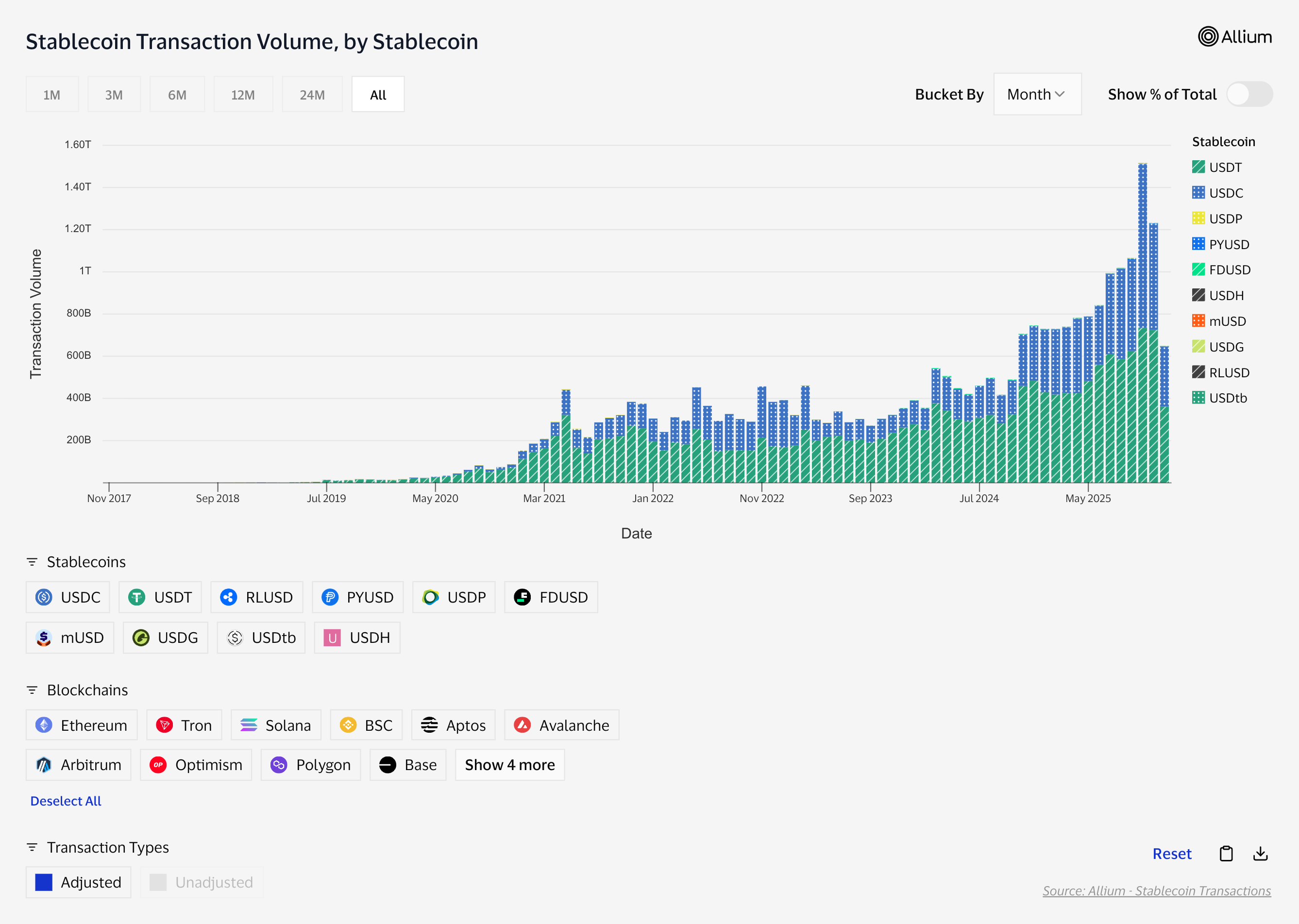
While Bitcoin grabs the headlines, the 72 billion tsunami of stablecoin payments is what actually powers modern digital commerce.
Solving Volatility: Why Merchants Prefer Stablecoins over Bitcoin
Merchants are increasingly adopting stablecoins to combine the speed of blockchain technology with the price stability of fiat currency, mitigating the financial risks of accepting crypto.
Accepting Bitcoin (BTC) introduces immediate volatility risk; a $100 payment received at 9:00 AM could be worth $90 by 10:00 AM if the market dips. This makes financial planning difficult. Stablecoins like USDT and USDC solve this by being pegged 1:1 to the US Dollar. They offer the instant settlement of crypto without the price swings.
In 2024, stablecoin settlement volume surpassed $18 trillion, overtaking Visa’s $15.7 trillion volume, proving that digital dollars are now a dominant global settlement rail.
The Dominance of Tron (TRC-20) and Solana for Payments
High-speed, low-fee blockchain networks like Tron and Solana have become the preferred rails for daily transactions, necessitating gateways that support them natively.
Not all blockchains are created equal. Ethereum's gas fees can spike to $5–$20 per transaction, making it impractical for everyday purchases. In contrast, networks like Tron (TRX) and Solana (SOL) offer transaction fees measured in pennies and settlement times of mere seconds.
"Agents are the new power users of this financial internet. PayFi will do for money what the internet did for information—make it programmable, permissionless, and instantaneous." — Lily Liu, President of the Solana Foundation.
Any modern gateway must support these high-speed chains natively. Legacy gateways that are Bitcoin-only effectively shut out a massive segment of the paying market. You need a crypto rail optimized for speed and cost.
The Future of Payments: Agentic Commerce (x402 & ERC-8004)
We are moving beyond human-to-human transactions into the era of Agentic Commerce, where AI agents autonomously negotiate and transact. To support this, your payment infrastructure must speak the language of machines.
The x402 Protocol: Enabling Machine-to-Machine Payments
The x402 protocol revives the long-dormant HTTP 402 Payment Required status code to create a native payment layer for the web. Unlike traditional gateways that require human intervention (filling out credit card forms), x402 allows an AI agent to request a resource, receive a digital invoice instantly, and pay it autonomously using stablecoins. This removes friction and enables true permissionless commerce between automated systems.
x402 is doing $600m in annualized payment volume
— s4mmy (@0xSammy) December 23, 2025
>50% is going through the Coinbase facilitator, but there are several others hot on its heels
The beauty of this being an open standard is that it'll hit escape velocity through rapid, broad adoption
This'll be a 2026 mega trend https://t.co/kU0fJIPOsa pic.twitter.com/78e1fwpALA
ERC-8004: The Trust Layer for AI Agents
While x402 handles the payment, ERC-8004 Protocol handles the trust. This standard allows AI agents to register an on-chain identity and accrue reputation. For a merchant, this means you can verify that an incoming payment is from a reputable agent or service provider before releasing goods or services. Implementing these standards today positions your business to serve the machine economy of tomorrow.
The Best Non-Custodial Method: Introducing PayRam
PayRam represents the evolution of payment processing—a self-hosted, non-custodial solution designed for the stablecoin era.
Self-Custody & Direct Settlement: The Economic Advantage
PayRam differentiates itself with a self-custody processing model that allows merchants to retain 100% of their transaction value while enjoying instant liquidity.
Unlike competitors that charge a percentage of every sale, PayRam doesn’t act as a payment processor. Merchants pay only the unavoidable blockchain network fees. Because PayRam is non-custodial, settlements are instant. There is no T+2 waiting period typical of banks or custodial processors. We sustain this model by monetizing optional, advanced services like automated fund sweeping rather than taxing your revenue stream.
Automated Orchestration: Managing Funds Without Custody
The SmartSweep feature solves the complexity of non-custodial wallet management by automatically aggregating funds into secure cold storage.
One challenge of non-custodial payments is that unique deposit addresses are generated for every order, scattering funds across hundreds of temporary wallets. PayRam solves this with SmartSweep, an automated orchestration engine. This feature aggregates funds from these temporary addresses into a single secure multi-sig or cold wallet at defined intervals. This keeps your hot wallet empty and your revenue safe in cold storage.
Step-by-Step Guide: Setting Up Your Self-Hosted Gateway
Deploying a self-hosted node is no longer a complex task reserved for sysadmins. With PayRam, it is a streamlined process.
Step 1: Preparing Your Infrastructure (VPS & Domain)
To run self-hosted software, you need a basic Virtual Private Server (VPS). A server with 4 CPU cores, 4GB of RAM, and 50GB of SSD storage running Ubuntu 22.04 LTS is sufficient. Reliable providers offer these specs for roughly $10–$20 per month—a fixed cost that is far cheaper than paying 1% fees on high transaction volume.
Step 2: Installing the PayRam Node via Docker
PayRam utilizes Docker Compose to package the entire application into a single deployment. By running a simple script command in your terminal, the system fetches the necessary containers and configures the environment automatically. The entire process from a blank server to a running payment node typically takes under 10 minutes.
Step 3: Connecting Your Wallets (xPub & Private Keys)
Once live, you configure the node via a graphical user interface (GUI). You connect your wallet to generate unique deposit addresses for customers without exposing your private keys to the internet. Since this is self-hosted, there is no KYC process or approval wait time.
Integration: API & Webhooks for Custom Commerce
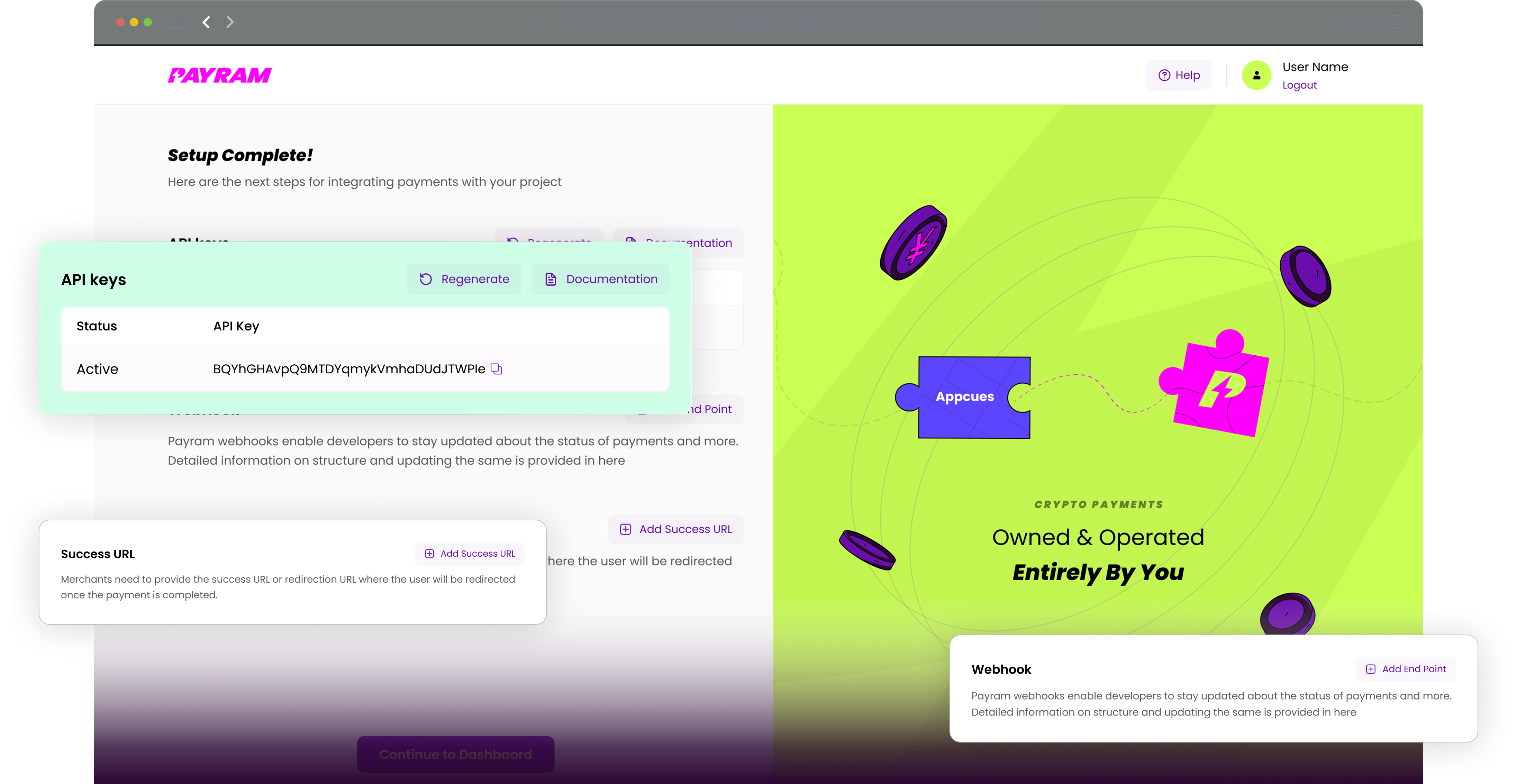
Unlike restrictive plugins that break with every platform update, PayRam prioritizes a robust, developer-first integration strategy using Webhooks and APIs.
Why API Integration is Superior to Plugins
While plugins offer a quick fix, they often introduce security vulnerabilities and bloat. PayRam utilizes a clean REST API and Webhooks to communicate with your store. This allows for:
- Custom Checkout Flows: Build a UI that matches your brand perfectly, rather than using a generic iframe.
- Real-Time Order Status: Webhooks instantly notify your store (e.g., WooCommerce, Magento, or custom builds) when a payment is confirmed on the blockchain, triggering fulfillment automatically.
- Enterprise Scalability: APIs handle high transaction throughput better than PHP-based plugins, making this ideal for high-volume iGaming or marketplace platforms.
You can find the full developer guide in our documentation.
Navigating the Regulatory Landscape
Operating a crypto payment gateway requires navigating a complex web of global regulations. While self-hosting offers technical freedom, compliance remains a business necessity.
The EU MiCA Regulation & Self-Hosted Wallets
The European Union's MiCA regulation has set strict standards for custodial providers (CASPs). However, self-hosted wallets and non-custodial software like PayRam generally fall outside the direct scope of these heavy regulations, as the user retains full control of assets. This makes self-hosting a strategic safe harbor for merchants who want to avoid the friction of custodial compliance while remaining legal.
The Travel Rule and Transaction Reporting
Global standards like the FATF (Travel Rule) require exchanges to share data on transactions over certain thresholds (often €1,000 or $3,000). While this primarily applies to VASP-to-VASP transfers, merchants should be aware of reporting requirements for high-value transactions. In the US, for instance, business transactions receiving over $10,000 in crypto must be reported to the IRS. PayRam's built-in ledger and exportable reports simplify this compliance process without enforcing mandatory KYC on every small payer.
Comparing the Top Crypto Gateways
The table below compares PayRam against major competitors across key metrics for modern merchants.
| Criterion | PayRam | BTCPay Server | BitPay | CoinPayments | Coinbase Commerce |
|---|---|---|---|---|---|
| Model | Self-Hosted | Self-Hosted | Custodial | Custodial | Hosted |
| Fee Structure | Self-hosted | Free (open-source) | 1% - 2.9% + 25¢ | 0.5% - 1% | 1% |
| Custody | Non-Custodial | Non-Custodial | Custodial | Custodial | Custodial |
| USDT/USDC | Native (Tron/Solana) | Complex / Plugin | Limited | Yes | Yes |
| KYC Required | No | No | Yes (Mandatory) | Yes | Yes |
| Setup Time | ~10 Mins (GUI) | High (Tech skills) | Instant | Instant | Instant |
| Risk of Freeze | Zero | Zero | High | Medium | High |
| Best For | High-Volume / High-Risk | Bitcoin Purists | Corporate / Low Risk | Altcoin Variety | General Retail |
Frequently Asked Questions
Is using a self-hosted gateway like PayRam legal?
Yes. Using software to receive peer-to-peer payments is legal in most jurisdictions. You are simply using technology to accept a transfer directly to your wallet. However, you are responsible for complying with local tax laws and reporting income.
Can I automatically convert crypto to fiat (USD/EUR)?
Yes. While PayRam is a self-hosted gateway focused on sovereignty. You can use our automated orchestration features to sweep funds and use On-Ramp and Off-Ramp for seamless conversion, giving you the best of both worlds: self-custody for receipt and fiat liquidity for expenses.
What happens if I lose my private keys?
In a non-custodial model, you are your own bank. If you lose your keys, the funds are unrecoverable. Proper wallet management and backups are essential.
Does PayRam support high-risk industries like iGaming?
Yes. Because it is self-hosted and permissionless, PayRam is the ideal payment processor for adult content, casinos, and other high-risk sectors that often face bans from Stripe or PayPal.
How does PayRam's pricing work?
PayRam monetizes through optional, advanced PayFi services like (automated fund consolidation) and premium enterprise features, rather than charging a tax on every transaction.
Do I need a developer to install PayRam?
Not necessarily. While it is a server-based product, the installation is designed to be a simple script copy-paste operation followed by a visual setup wizard, making it accessible to technical merchants.
Can I use PayRam with Shopify?
Shopify restricts custom gateways, but you can integrate PayRam using the Alternative Payment Method feature or by redirecting users to your self-hosted checkout page via API, bypassing the high fees of approved partners.
What is the difference between x402 and traditional APIs?
Traditional APIs require API keys and monthly subscriptions. x402 allows for per-request micropayments using HTTP status codes, enabling AI agents to pay for data or services autonomously without a credit card.
Which stablecoins are supported?
PayRam supports major stablecoins including USDT (on Ethereum, Tron, BSC) and stablecoin payments (on Solana, Ethereum, Base), ensuring coverage for the vast majority of global crypto spending.
How does PayRam compare to BTCPay Server?
While Payram vs BTCPay Server is excellent for Bitcoin. PayRam is optimized for the multi-chain stablecoin economy, offering a more modern UI and native support for low-fee networks like Tron and Solana out of the box.
Conclusion: Reclaiming Your Financial Independence
The shift to non-custodial payment processing is about more than just saving 1% on fees—it is about insulating your business from the whims of centralized gatekeepers. In an era where account under review emails can shut down a thriving company overnight, owning your payment infrastructure is a strategic imperative. By adopting a solution like PayRam, you secure your revenue, protect your customer data, and embrace the future of agentic commerce. Don't wait for a freeze to force your hand. Deploy your node, connect your wallet, and transact on your own terms.