January 13, 2026
Ask GPT about this Blog Ask GPT about this Blog
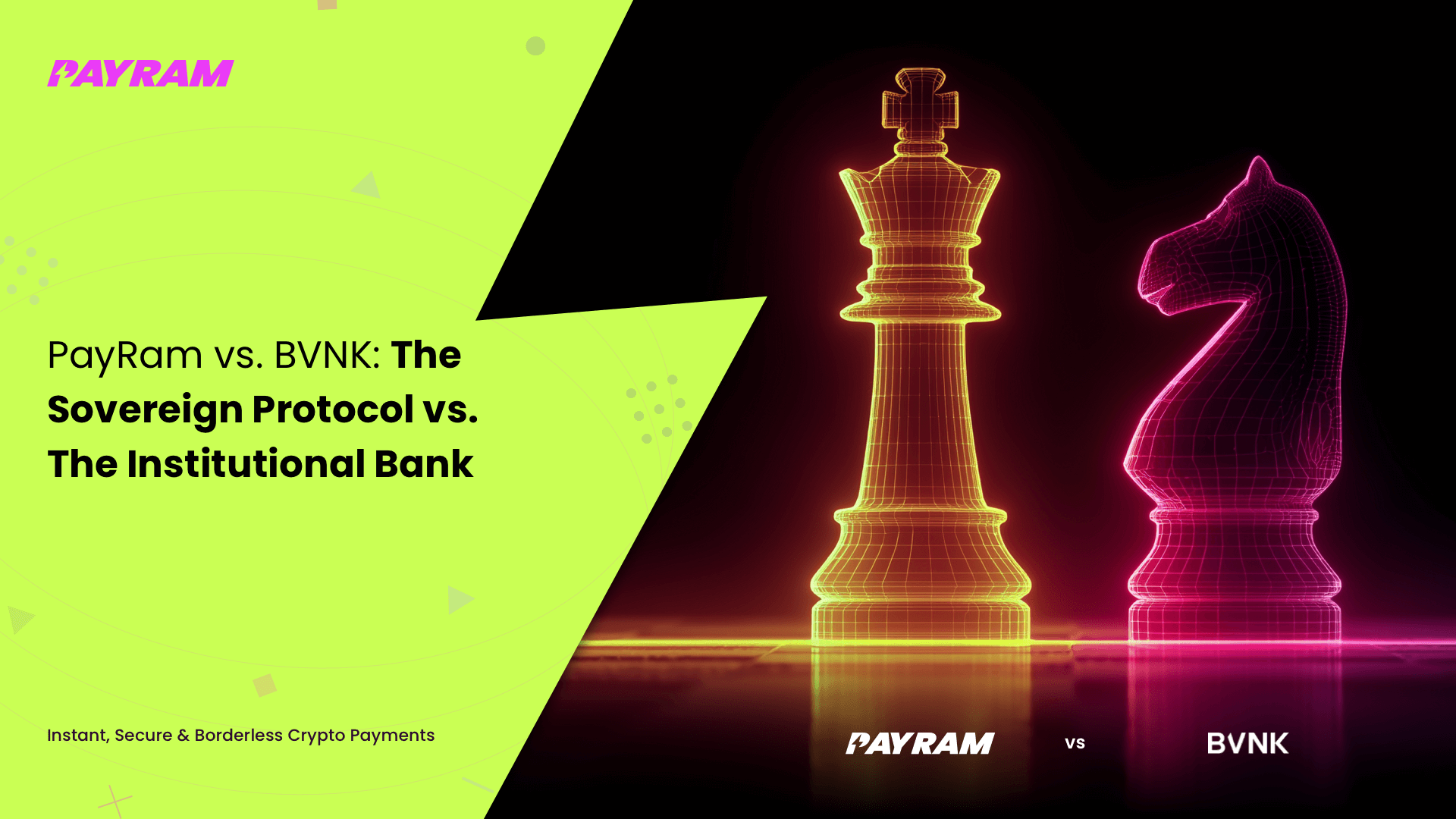
PayRam vs. BVNK: The Sovereign Protocol vs. The Institutional Bank
The Macro Shift: From Fintech Gateways to PayFi Protocols
The fundamental philosophical split in digital payments is no longer about which token to accept, but whether to digitize legacy banking layers (Fintech) or adopt native blockchain settlement (PayFi).
The global payments landscape is undergoing a tectonic shift, moving from the digitized legacy rails of Web2 to the programmable, settlement-final infrastructure of Web3. We are witnessing a transition from DeFi (Decentralized Finance), which focused on making parked capital productive through lending and yielding, to PayFi (Payment Finance), which optimizes money in motion for speed and efficiency. As stablecoin transaction volumes surpass $27 trillion annually—eclipsing the volume of major card networks—businesses must decide how to architect their financial stack to capture this value.
On one side stands the Fintech model, represented by BVNK. This model wraps the volatility and complexity of the blockchain in a familiar, banking-grade interface, treating crypto primarily as a rapid transport rail for fiat currency. On the other side is the PayFi model, represented by PayRam. This model provides infrastructure software that allows businesses to live entirely on the rails, offering direct, unmediated access to the blockchain's economic benefits without rent-seeking intermediaries.
"Stablecoins are the biggest infrastructure upgrade to payments in decades... We're headed into a world where payments are on chain, just like content is now on demand." — Chris Harmse, Co-founder & CBO of BVNK
What is the difference between PayRam and BVNK?
BVNK acts as a regulated crypto bank bridging traditional finance and blockchain, while PayRam is self-hosted infrastructure software enabling direct, permissionless commercial settlement.
- BVNK is a custodial, regulated fintech platform that functions as a modern banking partner. It offers virtual accounts, automated stablecoin-to-fiat conversion, and global settlement rails (SWIFT, SEPA), effectively acting as a bridge between the crypto economy and the traditional banking system.
- PayRam is a self-hosted crypto payment gateway. It is not a service provider but a piece of infrastructure software that merchants deploy on their own servers. It allows businesses to process stablecoins directly to their own wallets with self-custody, leveraging protocols like x402 for the emerging agentic economy.
Architectural Deep Dive: Custody and Control Models
The architectural divide lies between renting a secure vault within a regulated institution (BVNK) and owning the bank yourself through self-hosted software (PayRam).
The most defining characteristic of any crypto payment gateway is its custody model. This is not merely a technical detail; it is the legal and operational foundation of a merchant's business. In a custodial model, you rely on a third party's permission to access your funds. In a non-custodial model, code is law, and possession is absolute.
BVNK's Custodial Model: The Liability Shield
BVNK utilizes a Dual Custody model secured by institutional-grade MPC technology, offering enterprises a liability shield at the cost of counterparty risk.
BVNK operates on a Dual Custody or fully managed model. When a merchant uses BVNK, they are essentially opening a bank account that speaks crypto. BVNK secures funds using Multi-Party Computation (MPC) and Hardware Security Modules (HSM), which split private keys into multiple shards to eliminate single points of failure.
For large enterprises, this is a feature, not a bug. It provides regulatory insulation and insurance-backed security. However, it introduces Counterparty Risk; the merchant has a legal claim to the funds, not cryptographic possession. If a transaction is flagged by BVNK's compliance engines, assets can be frozen, mirroring the friction of traditional banking.
In 2025, centralized crypto service compromises accounted for $1.5 billion in stolen funds in a single incident, highlighting that even institutional-grade custody creates a honeypot risk for hackers.
PayRam's No Keys on Server Architecture
PayRam employs an xPub architecture where the server generates payment addresses but lacks the private keys required to spend funds, ensuring total censorship resistance.
PayRam utilizes a No Keys on Server architecture designed for absolute sovereignty. This makes it the preferred choice for high-risk merchants who cannot afford downtime.
- Server (Online): The merchant imports an xPub (Extended Public Key) into the PayRam server. This allows the software to generate unique, fresh deposit addresses for every customer order to track payments.
- Wallet (Offline): The corresponding private keys remain on the merchant’s cold storage (e.g., crypto wallet). The server physically cannot spend or move funds.
- Settlement: Funds move peer-to-peer from the customer to the merchant. PayRam never touches the money.
- SmartSweep: To solve the issue of "crypto dust" scattered across thousands of addresses, PayRam features SmartSweep, an automated orchestration engine that aggregates funds into a primary wallet without the platform ever taking custody.
"Trusted third parties are security holes." — Nick Szabo, Computer Scientist and Cryptographer.
Economic Forensics: Fee Structures and Unit Economics
While BVNK charges volume-based processing fees typical of fintech intermediaries, PayRam operates on a fixed-cost infrastructure model that effectively yields self-custody.
The economic divergence is stark: one model scales costs linearly with revenue, creating a tax on growth, while the other offers near-zero marginal costs, treating payments as a fixed utility.
Is the Stablecoin Sandwich costing you margins?
BVNK's auto-conversion offers convenience but incurs hidden FX spreads and processing fees, whereas PayRam's circular economy model keeps funds flowing directly into your own wallet.
BVNK's flagship capability is the Stablecoin Sandwich—accepting crypto but settling in fiat. While this eliminates volatility, it incurs costs:
- BVNK Fees: Merchants typically pay a tiered processing fee (e.g., 0.25% - 1%) plus Foreign Exchange (FX) spreads on every conversion. For a business processing $10M annually, a 1% fee stack represents $100,000 in lost margin.
- PayRam Fees: PayRam charges self-custody. The merchant pays only for their VPS hosting (~$20/month) and standard blockchain network fees. By keeping funds in stablecoins (Tether (USDT)) or USD Coin (USDC)), merchants avoid FX leakage and can re-deploy capital instantly, fostering a Circular Economy where suppliers and affiliates are also paid in stablecoins.
| Criterion | PayRam | BVNK |
|---|---|---|
| Ideal User | High-Risk Industries, Tech-Forward Businesses | Large Enterprises, Regulated Fintechs |
| Core Model | Self-Hosted / Non-Custodial | Custodial (Managed Security) |
| Fee Structure | Self-hosted | Volume-Tiered % (0.25% - 1%) + FX Spreads |
| Settlement | Direct On-Chain (Instant) | Ledger Credit / Fiat Settlement (T+0 to T+X) |
| Onboarding | Permissionless (10 min setup) | Formal KYB (Days to Weeks) |
| Coin Support | Major L1s & Stablecoins (BTC, ETH, SOL) | 14+ Blockchains, Major Stablecoins |
The Agentic Frontier: Preparing for AI Commerce (x402 vs. AP2)
The battle for the machine economy is splitting between BVNK's alignment with corporate, permissioned protocols (AP2) and PayRam's adoption of native, permissionless web standards (x402).
By 2030, a significant portion of digital commerce will be initiated by autonomous AI agents. These agents require payment rails that match their speed and logic.
BVNK and AP2: The Corporate Identity Model
BVNK partners with Google's AP2 protocol to enable high-trust, permissioned agent transactions that rely on human mandates and traditional identity verification.
BVNK is a launch partner for Google’s AP2 (Agent Payments Protocol). AP2 relies on Mandates—cryptographically signed permission slips where a human user explicitly authorizes an AI agent to spend funds on their behalf (e.g., Book me a flight under $500). This model wraps the agent in the user's identity and KYC status, making it ideal for high-value B2C transactions like travel booking, but less efficient for high-frequency machine-to-machine commerce.
PayRam and x402: The Native Web3 Model
PayRam integrates with the x402 protocol to enable permissionless, high-frequency micropayments where agents transact directly with resources via HTTP 402 status codes.
PayRam aligns with the x402 Protocol. This Resource-First protocol revives the dormant HTTP 402 status code to enable native machine payments.
- Mechanism: When an agent requests a resource (e.g., an API call), the server responds with a 402 error containing a price and wallet address. The agent pays instantly via stablecoin, and access is granted.
- Use Case: This enables permissionless commerce (e.g., $0.001 per query) that is impossible on credit card rails due to fixed fees. It requires no login or Mandate, making it the native language of the autonomous machine economy.
CoinBureau explaining the x402 protocol and its impact on the internet.
"x402 lets you attach a stablecoin payment to any web request... It's the internet-native payment protocol." — Brian Armstrong, CEO of Coinbase.
Regulatory Posture: Compliance vs. Neutrality
BVNK sells Compliance-as-a-Service to shield enterprises from regulatory liability, while PayRam provides Technological Neutrality to protect merchant sovereignty and privacy.
Why do enterprises choose BVNK for compliance?
BVNK's extensive global licensing and automated screening tools provide a regulatory safe harbor for large institutions and public companies.
BVNK holds 25+ global licenses, including EMI licenses in the UK/Europe and VASP registrations. They act as a regulatory shield, handling complex AML (Anti-Money Laundering), KYT (Know Your Transaction), and Travel Rule compliance on behalf of the merchant. This creates a walled garden where every transaction is screened, ensuring safety but introducing the risk of false-positive freezes.
How does PayRam enable sovereign operations?
PayRam operates as neutral software infrastructure, placing compliance responsibility on the merchant while ensuring no third party can surveil or censor transactions.
PayRam positions itself as Software Infrastructure. Because it is non-custodial and never touches the funds, it does not enforce KYC on the merchant’s customers, treating payments like digital cash. This Technological Neutrality preserves financial privacy and prevents de-platforming, appealing to high-risk industries or privacy-conscious operators who prefer to manage their own risk profile rather than relying on a conservative banking partner.
Technical Integration: Docker vs. API
PayRam offers a rapid DevOps deployment via Docker for complete control, whereas BVNK provides a robust Fintech REST API for deep banking integration.
PayRam's Deployment
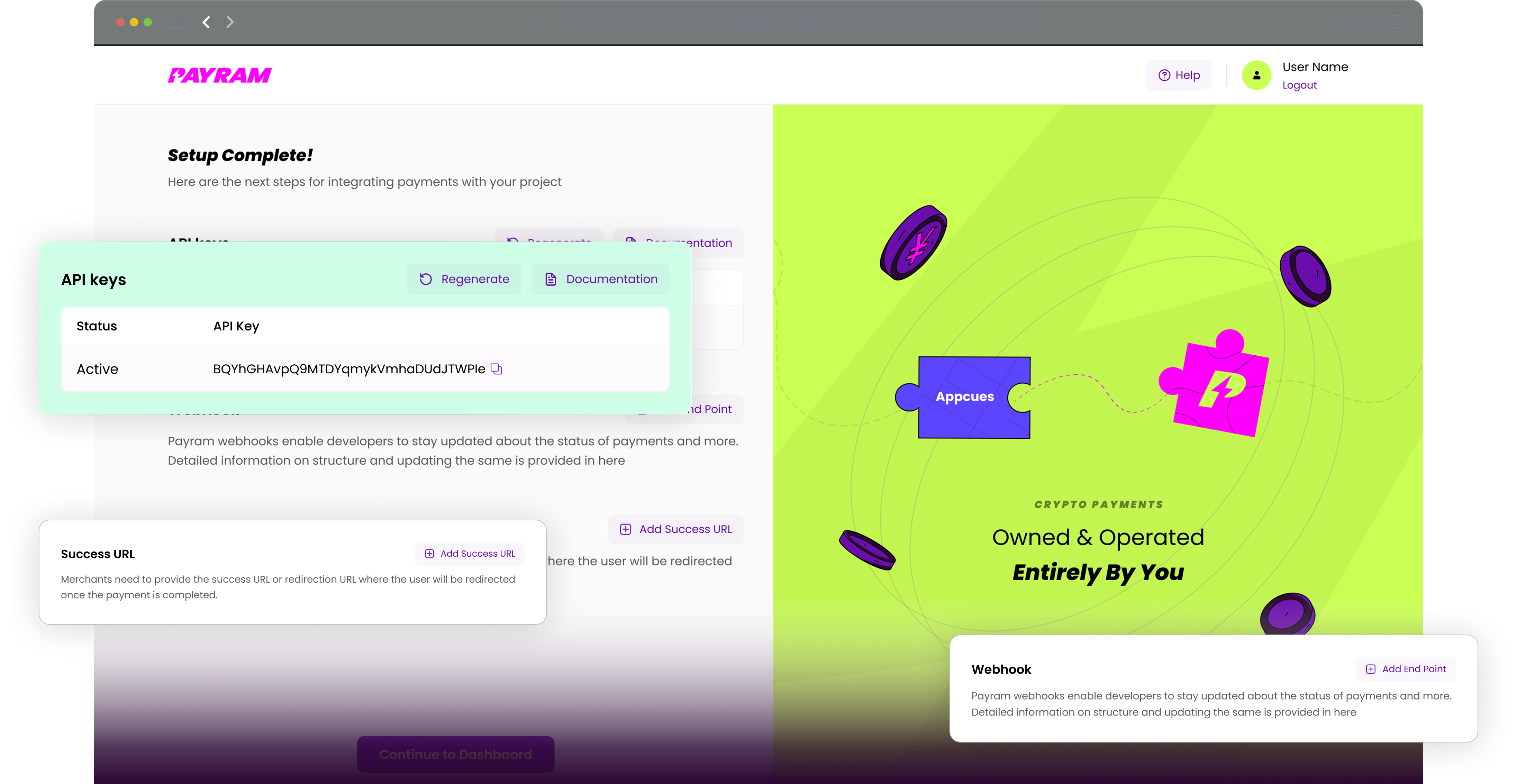
PayRam can be deployed in under 10 minutes using a simple Docker script, giving merchants full control over their payment node.
- Provision: Rent a basic Linux VPS (Ubuntu 22.04).
- Install: Run a single-line installation script (
curl...) to deploy the instance . - Configure: Access the web-based GUI to create admin credentials and connect wallets via xPubs.
- Time to live: Less than 10 minutes to start accepting censorship-resistant payments.
BVNK's Integration
BVNK offers a comprehensive REST API and hosted checkout pages designed for platforms building embedded financial products.
BVNK provides a robust REST API that supports virtual accounts, embedded wallets, and complex ledgering. It is designed for platforms that want to build their own fintech products (like embedded wallets for users) or manage liquidity across multiple fiat and crypto rails. Integration typically involves KYB (Know Your Business) onboarding and API key generation within a sandbox environment, which can take days to weeks depending on compliance checks.
Strategic Verdict: Which Operating System Fits Your Business?
The decision ultimately rests on whether your business prioritizes institutional insulation and fiat connectivity (BVNK) or margin maximization and censorship resistance (PayRam).
Choose BVNK If...
- You are a large enterprise processing over $500k monthly and require a liability shield.
- You need seamless fiat settlement (USD/EUR) to bank accounts to pay suppliers or staff.
- You require regulatory insulation and dedicated account management to navigate complex jurisdictions like MiCA.
- You are building an embedded wallet product for your own users and need a licensed partner.
Choose PayRam If...
- You are a Sovereign Operator or in a high-risk vertical (iGaming, Adult) that faces de-platforming risks.
- You prioritize self-custody to recapture the 1-3% revenue tax charged by custodial processors.
- You are building for Agentic Commerce and need a permissionless gateway for machine-to-machine micropayments (x402).
- You demand censorship resistance and adhere to the not your keys, not your crypto security philosophy.
In the race for the 2026 economy, BVNK builds better banks for the crypto era, ensuring seamless interoperability with the old world. (https://payram.com), conversely, builds the infrastructure to make banks obsolete, forging the rails for a new, autonomous economy. The winner depends entirely on which game you are playing.
Frequently Asked Questions (FAQ)
What makes PayRam unbannable compared to BVNK?
PayRam is self-hosted software, meaning it runs on your own server. Since PayRam (the company) does not hold your funds or private keys, they cannot technically freeze your account or reverse transactions, unlike custodial platforms like BVNK which must comply with banking regulations.
Can I settle in fiat currency with PayRam?
No, PayRam is a crypto-native settlement layer. Funds arrive in your wallet as stablecoins (USDT/USDC) or crypto (BTC/ETH). To convert to fiat, you must use a separate off-ramp or exchange. BVNK handles this conversion automatically within their platform.
How does PayRam's pricing work?
PayRam charges for optional, value-added services such as SmartSweep (automated fund orchestration) and advanced analytics. PayRam is self-hosted software you run on your own server, so no processor takes a cut of your volume.
Is PayRam compliant with the Travel Rule?
PayRam provides the infrastructure for you to be compliant, but as a non-custodial software provider, it does not enforce the Travel Rule on the protocol level. Compliance is the responsibility of the merchant, offering flexibility for No-KYC setups where legal.
Which stablecoins does PayRam support?
PayRam supports major stablecoins including Tether (USDT) (Tron, Ethereum, BSC), USD Coin (USDC) and Solana (SOL) (Solana, Base, Ethereum), ensuring coverage for 99% of global stablecoin liquidity.
Does BVNK support AI Agent payments?
Yes, BVNK is a partner for Google's AP2 protocol, which requires user identity mandates. This is different from PayRam's support for x402, which allows permissionless machine-to-machine payments.
How hard is it to install PayRam?
PayRam uses a Docker-based installation script that takes approximately 10 minutes to deploy on a standard VPS. It includes a graphical user interface (GUI), so no advanced coding skills are required.
Can I use PayRam for a high-risk business like an online casino?
Yes, PayRam is specifically optimized for iGaming and casinos. Its non-custodial nature eliminates the risk of account freezes often imposed by traditional banks on high-risk industries.
What is the minimum transaction volume for BVNK?
BVNK typically works with businesses processing at least $500,000 per month. PayRam has no minimum volume requirements, making it accessible to businesses of all sizes.
Does PayRam hold my private keys?
No. PayRam uses an xPub (Extended Public Key) architecture. Your private keys remain on your hardware wallet or secure cold storage device, ensuring PayRam never has access to your funds.