January 06, 2026
Ask GPT about this Blog Ask GPT about this Blog
What is PayRam? The Sovereign Payment Stack for the AI Economy
The digital economy is undergoing a structural phase shift. We are moving from the era of Digitized Commerce—characterized by centralized intermediaries, static systems of record, and human-gated transactions—to the era of Permissionless Commerce. This transition is driven by the convergence of two destabilizing forces: the maturation of Agentic Artificial Intelligence (AI), which demands high-velocity, machine-native settlement rails, and the widespread adoption of Stablecoins, which provide the liquidity layer necessary for a global, borderless economy.
For the past two decades, digital commerce has been constrained by the Financial Air Gap—the structural incompatibility between the millisecond decision loops of modern software and the T+2 settlement cycles of legacy banking. PayRam bridges this gap, not by building a faster bank, but by removing the bank from the transaction loop entirely.
The Merchant's Dilemma: The Silent Crisis of Centralized Payments
Before understanding the solution, we must confront the fragility of the current system. For thousands of digital merchants, the merchant account has transformed from a utility into a single point of failure.
The Algorithmic Executioner (The 180-Day Nightmare)
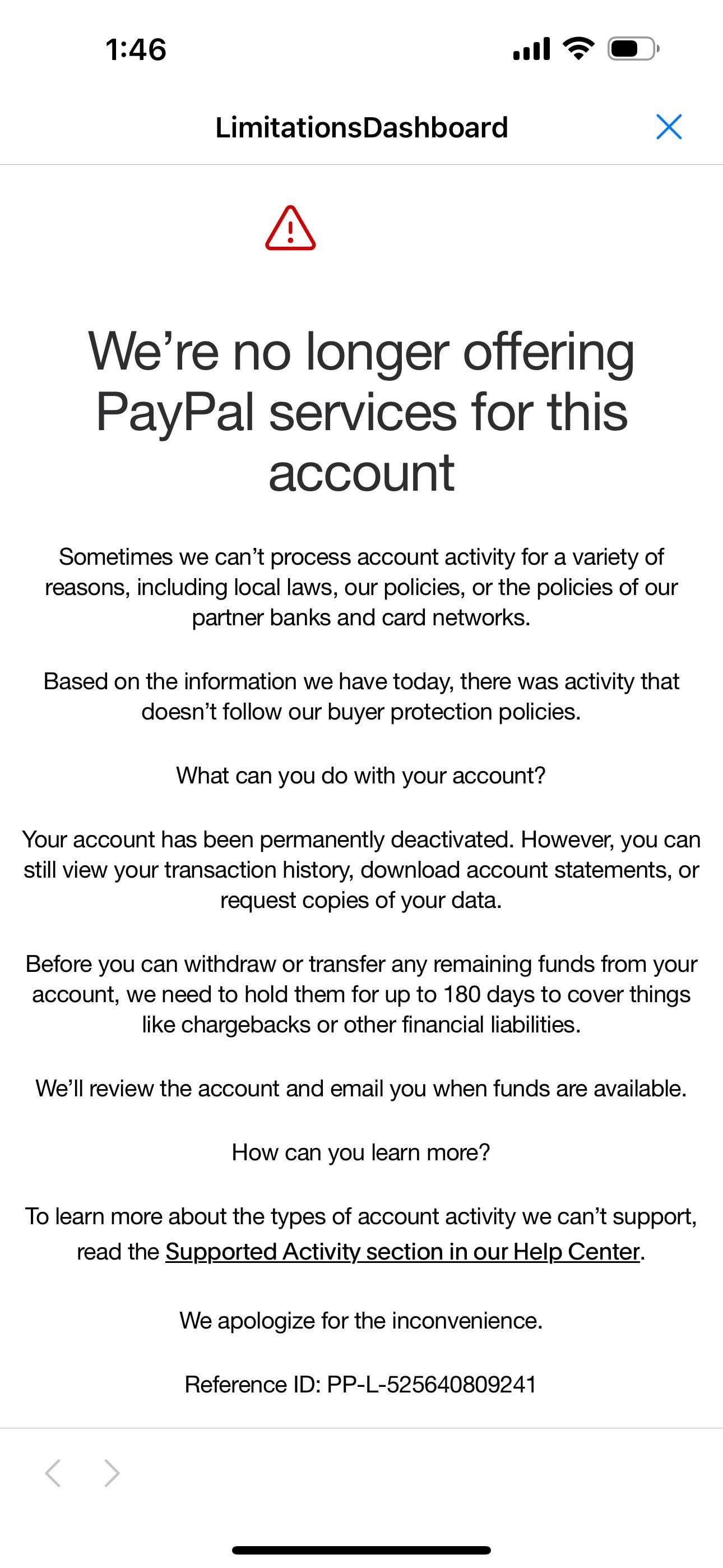
Modern payment processors (PSPs) like Stripe and PayPal utilize opaque black box risk algorithms to police their networks. These systems often flag legitimate growth—such as a sudden spike in sales or a viral product launch—as anomalous behavior. The result is immediate account suspension, often without human review.
The industry standard penalty is the 180-Day Hold. Processors freeze a merchant's funds for six months to cover potential future chargebacks. For a bootstrapped startup or a high-velocity e-commerce brand, having 3-6 months of revenue locked overnight is a death sentence. Research indicates that these freezes are rarely personal; they are systemic failures of a centralized risk model applied to a decentralized, global market.
The Friendly Fraud Epidemic
The legacy credit card system is weaponized against merchants through Friendly Fraud (First-Party Misuse)—where a customer makes a legitimate purchase and later disputes it to get their money back while keeping the goods.
- The Cost: Industry data suggests that up to 75% of all chargebacks are actually friendly fraud.
- The Multiplier: The damage isn't just the lost sale. Between chargeback fees, lost inventory, and operational overhead, merchants lose an estimated $3.75 for every $1 lost to fraud.
- The Reality: In the custodial model, the merchant is guilty until proven innocent. In the PayRam model, blockchain transactions are irreversible, structurally eliminating chargeback fraud.
The High-Risk Trap
Legitimate industries—including iGaming, adult entertainment, dropshipping, and digital goods—are frequently categorized as High Risk by banking partners. This results in predatory rolling reserves (where the processor holds 10-30% of your revenue) or outright de-platforming. By shifting to a self-hosted payment gateway, merchants in these verticals can bypass these restrictive policies entirely.
The Shift to Permissionless Commerce
PayRam is the infrastructure response to the Financial Air Gap, enabling a transition from renting centralized payment rails to owning sovereign, cryptographic infrastructure.
The prevailing model of online payments is fundamentally broken for a growing segment of the global economy. Centralized processors have established a tenancy model for commerce, where merchants effectively rent the ability to transact. This creates existential risks: arbitrary de-platforming, variable taxes on revenue in the form of processing fees, and invasive surveillance.
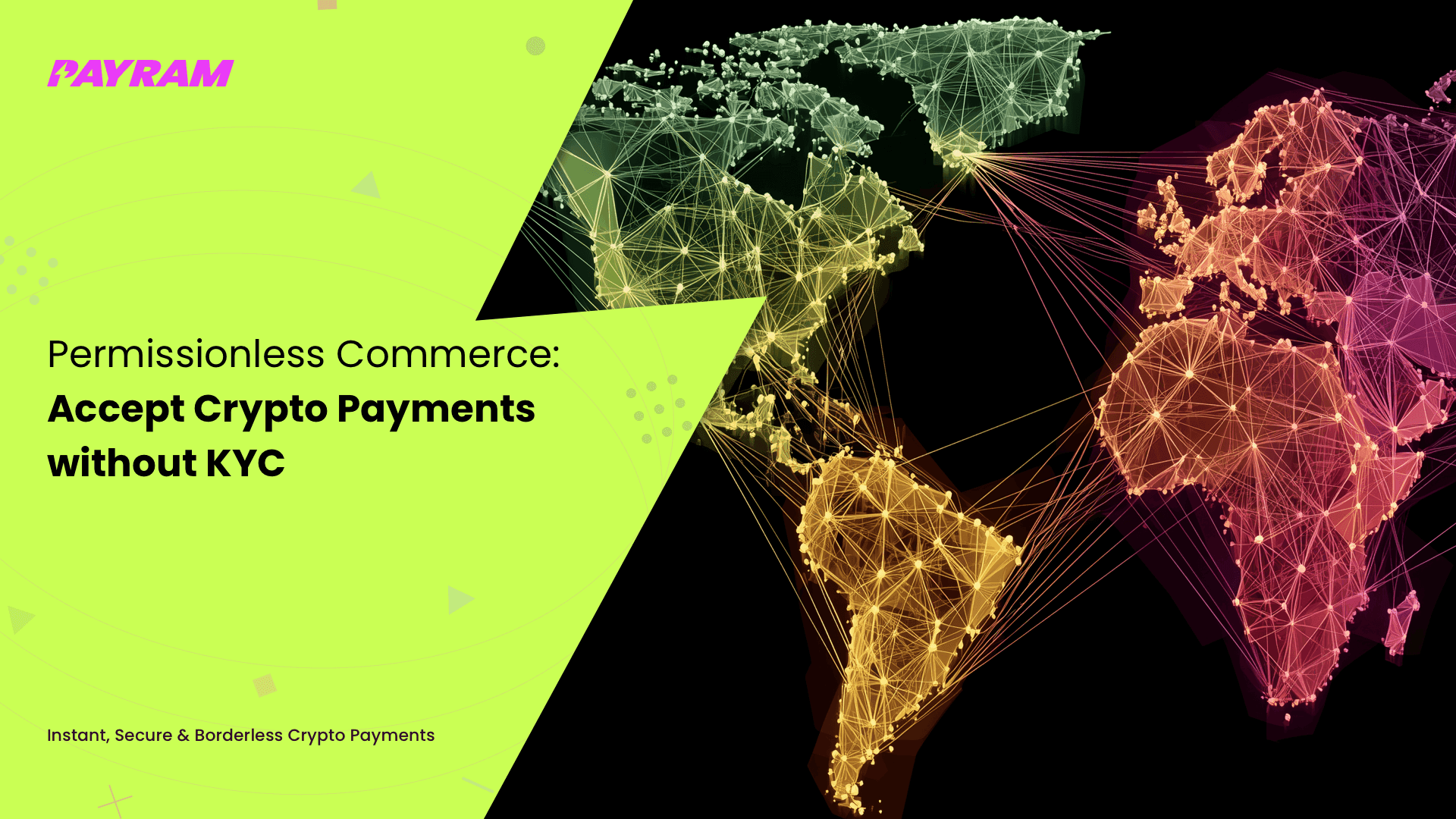
Permissionless Commerce represents the antithesis of this model. It is a market structure defined not by a lack of rules, but by a shift in the locus of control: from trusted third parties to cryptographic verification. In this paradigm, economic actors transact based on what they can prove (cryptographic signatures, proof of funds) rather than who they know (credit scores, bank relationships). This shift enables Infrastructure Inversion, where merchants move from renting access to financial rails to owning the rails themselves via self-hosted, non-custodial software.
"The future of payments is decentralized stablecoin payments. As the world moves beyond custodial systems, PayRam is building the foundation for permissionless commerce, where every merchant, creator, or platform can host and own their own payment infrastructure." — Siddharth Menon, Founder of PayRam.
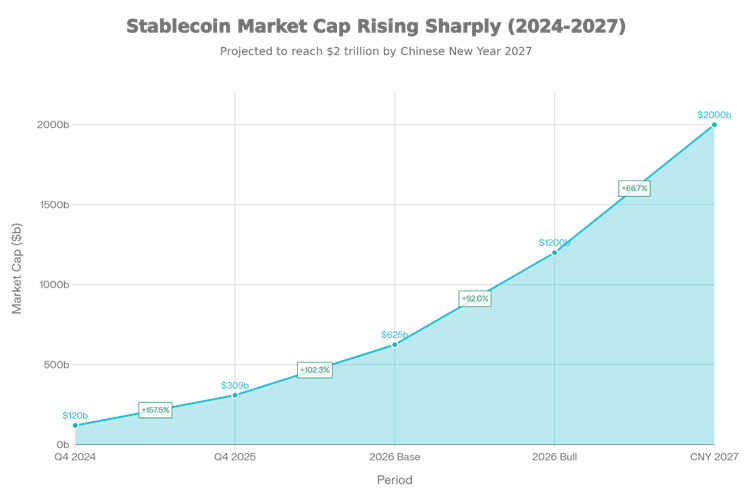
This shift is backed by undeniable market data. In 2024, stablecoin settlement volume reached an estimated $15.6 trillion, surpassing Visa's total payment volume. This proves that the market is already voting for settlement rails that are faster, cheaper, and more sovereign than traditional finance.
What is PayRam?
PayRam is a self-hosted, non-custodial cryptocurrency payment gateway designed to function as the sovereign execution layer for modern commerce, enabling direct wallet-to-wallet settlement with self-custody.
PayRam is not a service provider; it is a piece of software. It functions as the operating system for the sovereign, agentic economy. When a merchant deploys PayRam on their own Virtual Private Server (VPS), they effectively become their own payment processor. Unlike custodial gateways that hold your funds and act as gatekeepers, PayRam facilitates a direct peer-to-peer connection between the customer and the merchant.
This architectural distinction ensures three critical outcomes:
- Zero Counterparty Risk: PayRam never touches your funds.
- Censorship Resistance: Because you control the private keys, no third party can freeze your account.
- Fixed Costs: You pay for server hosting, not a percentage of your revenue.
Core Architecture: How PayRam Works
PayRam utilizes a split-key security architecture and automated orchestration to combine the security of cold storage with the convenience of automated processing.
The No Keys on Server Security Model
PayRam employs a security architecture that decouples transaction observation from fund management, ensuring that even a compromised server cannot result in stolen funds.
Merchants often ask, "If I am the bank, am I not also the target?" PayRam answers this with the no keys on server model. This architecture relies on the mathematical properties of Hierarchical Deterministic (HD) wallets to separate the Observation Layer from the Management Layer.
- The Watcher (Public Server): The server running PayRam holds only your Extended Public Key (xPub). This allows it to generate a unique, fresh deposit address for every new order and monitor the blockchain to confirm payments. Crucially, an xPub is a read-only credential—it cannot be used to sign transactions or move funds.
- The Signer (Private Vault): Your Private Key (seed phrase) remains completely air-gapped on a hardware wallet (like a Ledger or Trezor). It is never exposed to the internet.
This creates an Unbannable Gateway. Even if a sophisticated attacker gained root access to your PayRam server, they would find no money to steal—only a list of public addresses. This model directly addresses the honeypot risk that plagues centralized exchanges. According to industry analysis, first-party fraud (friendly fraud) accounts for 40-80% of all eCommerce fraud losses—a risk that is structurally eliminated by the irreversibility of PayRam's self-hosted crypto payments.
SmartSweep and Fund Orchestration
PayRam’s SmartSweep technology solves the crypto dust problem by automatically aggregating funds from scattered deposit addresses into a primary secure wallet.
A challenge with non-custodial payments is that unique deposit addresses are generated for every order to preserve privacy. This results in funds being scattered across thousands of addresses—a phenomenon known as dust. PayRam solves this with SmartSweep, an automated orchestration engine.
SmartSweep monitors these addresses and, once they reach a defined threshold, automatically aggregates (sweeps) the funds into your primary cold wallet. This ensures your liquidity is consolidated and ready for use without manual intervention, solving the operational complexity of HD wallets while maintaining non-custodial security.
Why Merchants Are Switching to PayRam
Merchants are adopting PayRam to eliminate the variable tax on revenue, access multi-chain stablecoin liquidity, and secure their business against censorship.
Self-Custody and Unit Economics
PayRam replaces the variable percentage fees of custodial processors with a fixed infrastructure cost, dramatically improving profit margins for high-volume merchants.
The custodial model is predicated on extracting a percentage of Gross Merchandise Value (GMV). A merchant processing $10 million annually at a typical 1% crypto processing fee pays $100,000 per year in fees. This is a tax that scales linearly with your success.
With PayRam, that same merchant self-hosts and self-custodies — no processor takes a cut of the transaction. The cost structure shifts to a fixed operational expense: roughly $20–$50/month for VPS hosting and standard network gas fees. Merchants can save an average of 80-90% on payment processing costs by switching from a traditional fee model to a self-hosted crypto model.3 PayRam monetizes only through optional value-add services, such as advanced fund orchestration, rather than taxing your revenue flow.
Multi-Chain and Stablecoin Native
PayRam provides unified, seamless support for high-velocity stablecoins like USDT and USDC across low-cost networks such as Tron, Solana, and Base.
The modern digital economy runs on stablecoins. Data indicates that stablecoin settlement volume has surpassed Visa's total volume, driven by the need for volatility-free, instant value transfer. Merchants require infrastructure that is Stablecoin Native and Multi-Chain Agnostic.
PayRam creates a unified abstraction layer over diverse blockchains. You can accept USDT on Tron for low fees, Solana (SOL) for speed, and Ethereum (ETH) on Base for L2 scalability—all settling into the same merchant dashboard. This overcomes the fragmentation of the crypto ecosystem, allowing you to service customers regardless of their preferred network.
📊 BIG: Total stablecoin supply is up 33% this year to over $304B, with monthly adjusted volumes now exceeding Visa and PayPal, per Delphi Digital. pic.twitter.com/Zfusjq9lCd
— Cointelegraph (@Cointelegraph) December 18, 2025
True Financial Sovereignty (No KYC for Software)
PayRam’s architectural neutrality means it cannot enforce KYC on a merchant's customers, restoring privacy and protecting businesses from financial censorship.
No KYC in the context of PayRam does not imply illegality, it implies architectural neutrality. Because PayRam is software (like a web server or email client) and not a financial custodian, it physically does not possess the user's funds. Therefore, it lacks the technical capacity—and the legal mandate—to enforce Know Your Customer (KYC) surveillance on the merchant's customers.
"Trusted third parties are security holes." — Nick Szabo, Computer Scientist and Cryptographer.
This creates a Pluggable Compliance model. The software is neutral. You, the merchant, retain the autonomy—and the responsibility—to implement whatever compliance measures are required by your specific jurisdiction. For high-risk industries or merchants in regions excluded by Western banking standards, this neutrality is existential.
PayRam and the Future of Agentic Commerce
PayRam is building the Mullet Economy infrastructure, providing the permissionless execution layer required for AI agents to transact autonomously via the x402 protocol.
We are witnessing the transition to the Kinetic Enterprise, where software agents actively make and execute decisions. A critical barrier to this vision is the Financial Air Gap—legacy banking is too slow (T+2 settlement) and too manual for AI agents that operate in milliseconds.
PayRam positions itself as the Sovereign Execution Layer for this new machine economy by supporting:
- The x402 Protocol: PayRam enables the HTTP 402 Payment Required status code. When an AI agent requests a resource (like an API call), the server responds with a crypto invoice. The agent pays instantly via stablecoin, and the resource is unlocked. This enables Machine-to-Machine (M2M) micropayments (e.g., $0.05 for a data packet) that are impossible on credit card rails due to fixed fees.
- ERC-8004 Protocol: PayRam integrates with emerging standards to verify agent reputation on-chain, solving the trust gap in automated commerce.
"The future of the internet is agents paying agents. If you're building payment rails that require a human to click a button, you're building for the past." — Balaji Srinivasan, Author of The Network State.
By 2030, McKinsey projects that $3 trillion to $5 trillion in global revenue will be orchestrated by Agentic Commerce. PayRam is the infrastructure ready to capture this volume today.
PayRam vs. Traditional Crypto Gateways
PayRam offers a superior alternative to custodial gateways by combining self-custody and sovereignty of open-source solutions with the usability of a SaaS product.
| Feature | PayRam (Sovereign) | B2BinPay (Custodial) |
|---|---|---|
| Custody Model | Self-Hosted / Non-Custodial (You hold the keys) |
Custodial (They hold funds) |
| Transaction Fees | 0% Core Processing (Optional service fees only) |
0.4% - 0.5% + Setup Fees ($1,000+) |
| KYC Requirements | None (Architecturally impossible) |
Strict (Mandatory for all merchants) |
| Censorship Risk | Unbannable (Code is Law) |
Medium (Subject to policy changes) |
| Ideal User | High-Risk, Privacy-First, High-Volume Merchants |
Regulated Forex Brokers, Large Enterprises |
| Settlement Speed | Instant (Direct to your wallet) |
Flexible (Crypto or Fiat Settlement) |
| Stablecoin Support | Native USDT (TRC20/ERC20) & USDC (Solana/Base) |
Excellent Deep liquidity focus |
vs. BitPay/CoinGate: These platforms replicate the banking model on blockchain rails. They charge high fees, require invasive KYC, and can freeze your funds. For a deeper comparison, read our Payram vs BitPay or our analysis of Payram vs Coingate.
vs. BTCPay Server: BTCPay is the gold standard for Bitcoin sovereignty but can be technically complex and lacks native, easy support for multi-chain stablecoins (like USDT on Tron) which are essential for modern commerce. PayRam bridges this gap, offering the sovereignty of BTCPay with the usability and stablecoin focus of a SaaS product. See our full guide on Payram vs BTCPay Server.
How to Get Started with PayRam
Deploying PayRam is a streamlined process that takes less than 10 minutes, utilizing Docker to package complex infrastructure into a single install command.
Installation and Setup
Getting PayRam up and running is designed to be accessible even for non-developers.
- Provision Server: Rent a basic Linux VPS (e.g., Ubuntu 22.04) from a provider like DigitalOcean or AWS (~$20/mo).
- Install: Connect to your server via terminal and run the one-line Docker command:
bash <(curl -fsSL https://payram.com/setup_payram.sh)
- Connect Wallets: Access the graphical user interface (GUI) in your browser. Follow the wizard to input your xPubs (Extended Public Keys). Remember, your private keys stay offline.
- Integrate: Use the API to connect your ecommerce store to PayRam.
Frequently Asked Questions (FAQ)
Is PayRam safe to use?
Yes. PayRam utilizes a No Keys on Server architecture. Your private keys (which are needed to spend funds) are never stored on the PayRam server. They remain safe in your cold storage (hardware wallet). Even if the server is compromised, hackers cannot steal your funds. Read more about our security model here.
Does PayRam require KYC?
No. PayRam is self-hosted software, not a financial intermediary. It does not possess your funds and therefore cannot enforce KYC checks on you or your customers. Compliance is fully under your control. Learn more about privacy and self-custody.
How does PayRam handle high-risk industries like iGaming?
PayRam is purpose-built for high-risk verticals. Because it is non-custodial, it cannot ban you or freeze your funds. This makes it the ideal payment gateway for casinos and iGaming.
What cryptocurrencies does PayRam support?
PayRam supports over 20 tokens, with a strong focus on stablecoins and high-liquidity assets. This includes USDT (Tether) and USDC across multiple networks (Ethereum, Tron, Solana, Base, BSC), as well as native assets like Bitcoin (BTC) and Ethereum (ETH).
Can I integrate PayRam with Shopify?
Yes. While Shopify restricts custodial crypto gateways, PayRam can be integrated via the Manual Payment Methods feature or through custom API integration. This allows you to present a Pay with Crypto option at checkout that redirects to your PayRam invoice.
What is the cost of using PayRam?
The core payment processing software is free to use (self-custody). Your only costs are your own server hosting (approx. $20/month) and standard blockchain network fees. PayRam charges service fees only if you choose to use optional advanced features like automated fund sweeping.
Does PayRam comply with regulations like the GENIUS Act?
Yes. The GENIUS Act explicitly exempts self-hosted wallets and peer-to-peer transactions from issuer regulations. PayRam's architecture ensures you fall under this Safe Harbor by keeping custody in your hands.
Can PayRam handle payouts to affiliates?
Absolutely. PayRam's infrastructure supports mass payouts, making it ideal for affiliate networks or adult content platforms that need to pay thousands of creators instantly in stablecoins.
How does PayRam compare to Stripe?
Stripe is a custodial processor that charges ~2.9% + 30¢ and frequently freezes high-risk accounts. PayRam is self-hosted, so no processor takes a cut, and it cannot freeze your account. For a detailed comparison, see our Payram vs Stripe.
What is Agentic Commerce support?
PayRam is future-proofed for the AI economy. It supports the x402 protocol, allowing autonomous AI agents to pay for your services instantly using stablecoins, opening up new B2B revenue streams.
Conclusion: The Path to Financial Sovereignty
The transition to Permissionless Commerce is not just a technical upgrade; it is a fundamental restructuring of how value moves in the digital age. As Agentic AI accelerates the velocity of trade and Stablecoins become the preferred medium of exchange, legacy financial rails are becoming obsolete bottlenecks.
PayRam offers more than just a payment gateway; it offers a declaration of independence. By choosing a self-hosted, non-custodial architecture, you are future-proofing your business against censorship, eliminating the tax on your revenue, and positioning yourself to serve the emerging machine economy.
Ready to reclaim control of your payments?
Explore the documentation and join the future of sovereign commerce.