March 17, 2026
Ask GPT about this Blog Ask GPT about this Blog
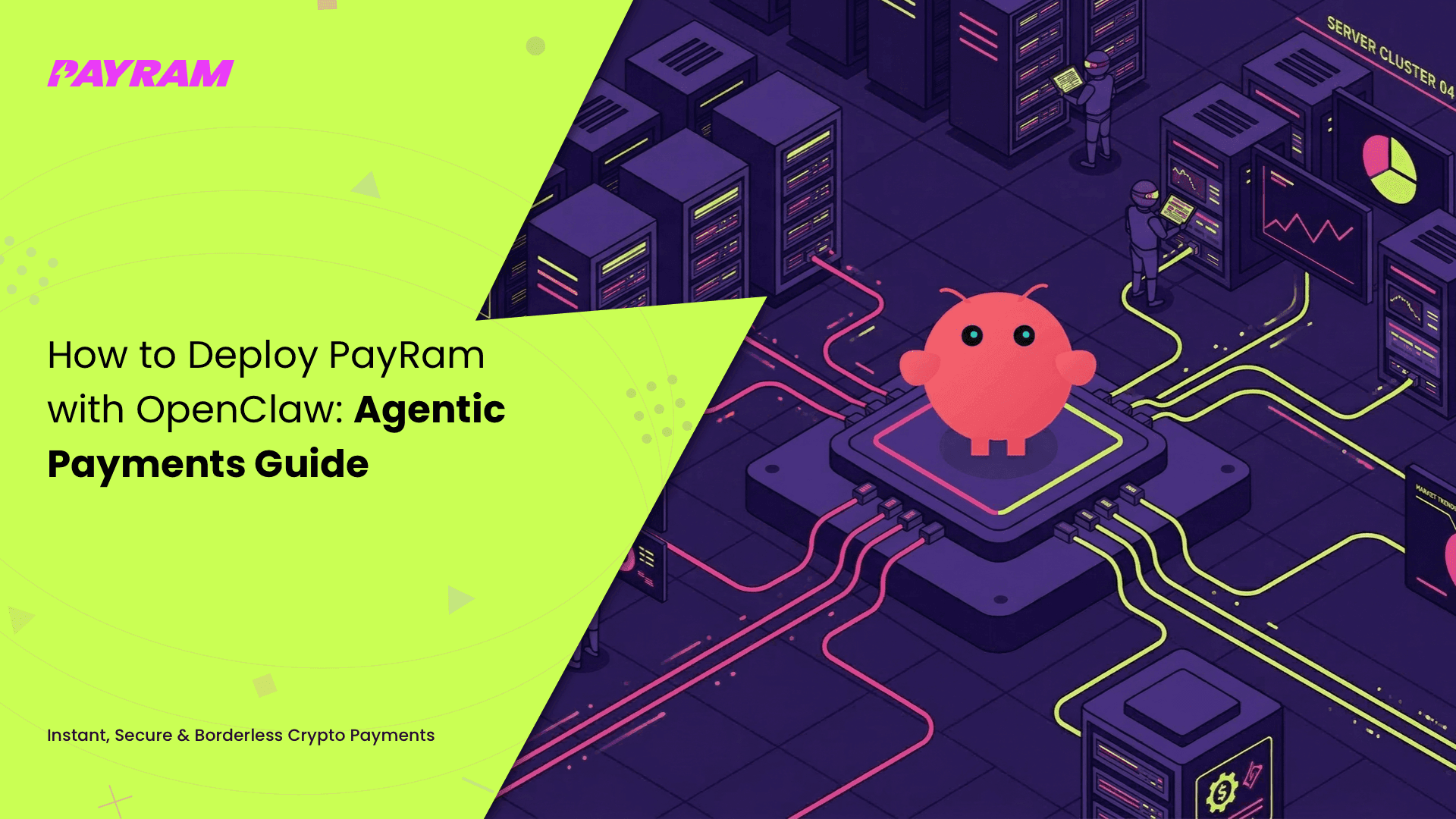
How to Deploy PayRam with OpenClaw
As we move deeper into 2026, the primary bottleneck for artificial intelligence is no longer cognitive intelligence—it is financial agency. We have entered the era of Web 4.0, a transition from the decentralized ownership of Web 3.0 to a paradigm defined by intelligent delegation. In this new landscape, Large Language Models have achieved the threshold required to reason and orchestrate complex tasks, yet they remain functionally paralyzed by the limitations of legacy banking. An autonomous agent can write sophisticated code or identify market inefficiencies, but it remains an economic ghost if it cannot settle its own API credits or provision its own infrastructure.
PayRam serves as the solution, not by acting as a third-party processor, but by providing the infrastructure that an AI agent can independently deploy to manage commerce. This guide bridges the OpenClaw orchestration gateway with PayRam's specialized execution layer so technical founders can build self-hosted crypto payment gateways where the agent acts as the primary DevOps and FinOps operator.
The Bottleneck of Intelligence: Why AI Agents Require Financial Agency
Intelligence without the ability to manage capital is the primary obstacle preventing AI agents from achieving true operational autonomy.
In the previous decade, the web moved from Read-Write-Own to Intelligent Delegation. This shift represents the final closure of the loop between human intent and machine execution. However, legacy payment rails were designed for human interaction, relying on manual forms and redirects that require a human in the loop. For an agent like OpenClaw, these friction points are absolute barriers. Furthermore, centralized gatekeepers introduce de-platforming risks; they can freeze accounts based on subjective assessments, a common occurrence for those exploring permissionless commerce. True autonomy requires an architecture where the agent can provision its own agentic commerce environment without waiting for third-party approval
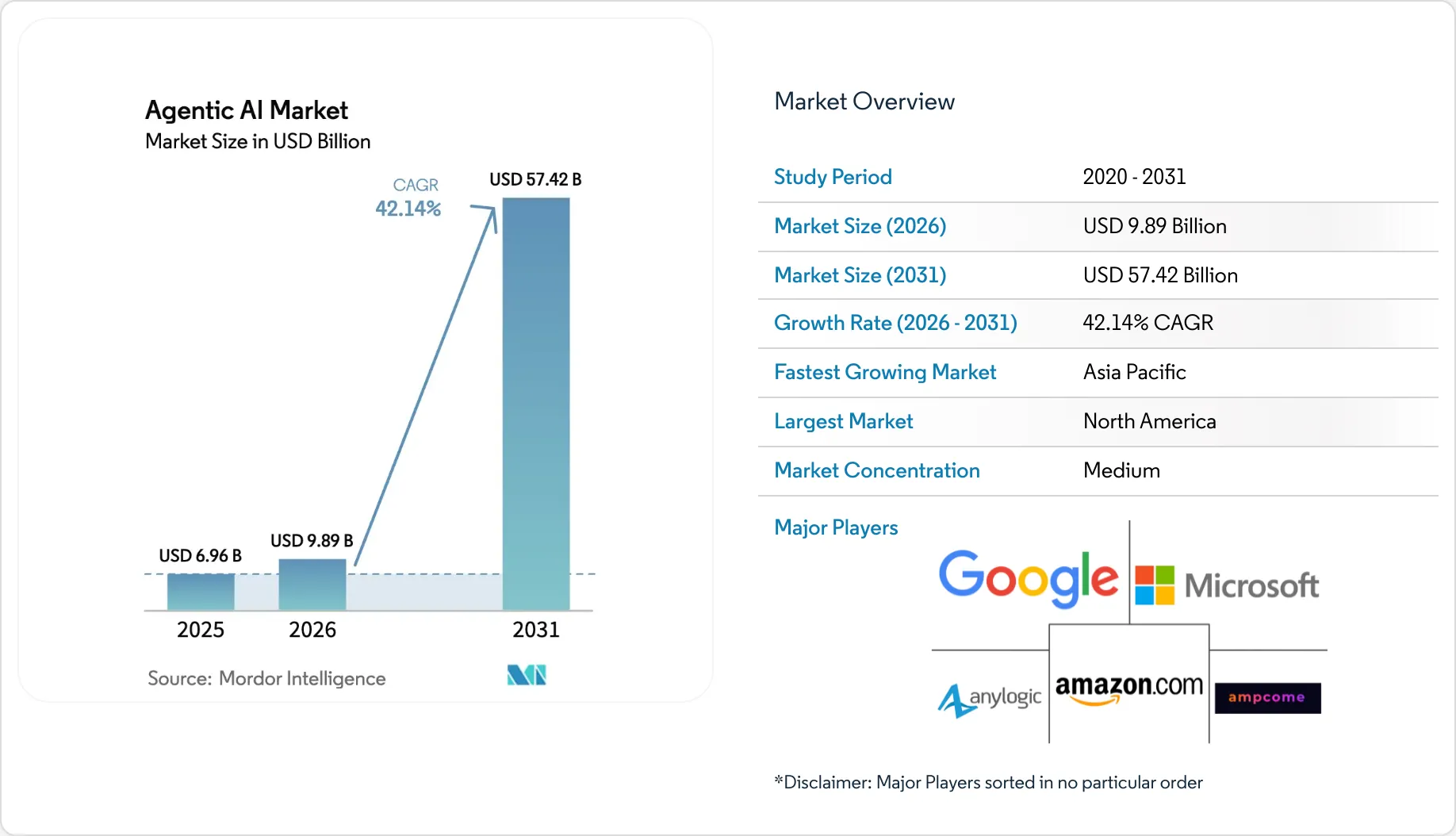
Mordor Intelligence valued the agentic AI market at USD 6.96 billion in 2025, proving that the demand for autonomous action is scaling faster than current financial infrastructure.
“The future of the internet is agents paying agents. If you're building payment rails that require a human to click a button, you're building for the past,” notes Balaji Srinivasan, author of The Network State.
To succeed, businesses must follow a comprehensive guide to cryptocurrency payments that prioritizes machine-to-machine efficiency.
Understanding the OpenClaw Architecture
OpenClaw is an orchestration gateway that transforms messaging apps into control planes for autonomous task execution and system-level automation.
OpenClaw, created by Peter Steinberger, achieved viral momentum through its evolution from project names like Clawdbot and Moltbot. Its trajectory has been described by industry leaders as resembling science fiction, largely because it connects AI models to tools like GitHub, Notion, and smart home devices. Unlike traditional chatbots, OpenClaw functions as a local-first Gateway, serving as a single control plane for your digital workflows. It represents an unbannable gateway architecture that founders use to maintain digital sovereignty.
What is OpenClaw AI?
OpenClaw is a local-first gateway process that allows users to interact with autonomous agents through standard messaging platforms.
OpenClaw reached a massive milestone in early 2026, gaining over 10,000 GitHub stars per day as developers rushed to deploy personal assistants.
“OpenClaw serves as a gateway that connects AI models to your tools and data, accessible via conversational commands,” - Industry Analyst
By utilizing programmatic payments, these agents can now move beyond simple chat.
Architecturally, OpenClaw operates via Channel Adapters for WhatsApp and Telegram, a Session Manager for context, and an Agent Runtime that reads your secure multi-crypto management rules from local Markdown files.
PayRam: The Sovereign Execution Layer for Agentic Commerce
PayRam provides a non-custodial financial infrastructure that allows merchants and AI agents to process crypto payments with full self-custody.
PayRam is the Linux of Payments—a self-hosted solution that runs on your own infrastructure. While custodial providers act as digital middlemen that take possession of your funds, PayRam is software that facilitates a direct peer-to-peer connection. This is the unbannable guide for businesses that have faced arbitrary account closures.
Merchants using legacy processors can lose between $1,500 and $3,000 annually just to basic processing and conversion fees.
“PayRam is building the foundation for permissionless commerce, where every merchant, creator, or platform can host and own their own payment infrastructure,” says Siddharth Menon, Founder of PayRam.
For high-volume users, the Payram vs Coinbase Commerce comparison highlights the massive ROI of the self-hosted model.
Is PayRam a custodial gateway?
PayRam is a strictly non-custodial software solution that facilitates direct settlements without ever holding or controlling user funds.
Accepting crypto payments without KYC does not imply a lack of compliance but rather architectural neutrality. Because PayRam is software, it physically does not possess the user's funds. This allows it to function as a non-custodial cryptocurrency payment gateway where the merchant retains 100% control of their private keys.
The Technical Bridge: Bridging LLMs to Money via MCP and x402
The integration of Model Context Protocol and the x402 standard creates a standardized environment where AI agents can autonomously discover tools and settle micro-transactions.
The bridge between OpenClaw’s brain and PayRam’s hand is built on emerging protocols. The Model Context Protocol (MCP) acts as the USB-C for AI, providing a standardized way for agents to interact with external tools. To solve the trust gap, ERC-8004 Protocol provides an on-chain identity layer, acting as a cryptographic passport for autonomous agents.
Global stablecoin volume now exceeds $8 trillion, making the x402 protocol implementation the essential standard for machine-to-machine scaling. x402 protocol transforms how AI agents can transact by embedding payment capabilities directly into HTTP interactions. See our latest technical standards documentation. This enables agents to transact and settle instantly without human intervention.
How does agentic commerce work?
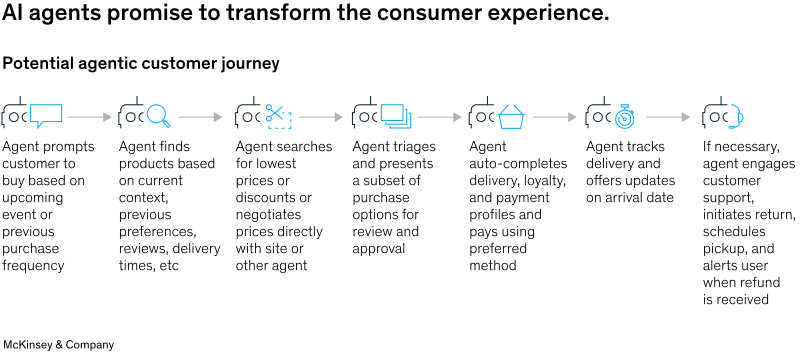
Agentic commerce is a four-stage autonomous cycle involving goal setting, research, negotiation, and automated payment execution.
According to a field manual for innovators, agentic transactions follow a precise lifecycle:
- Goal Definition: Setting constraints for the agent.
- Autonomous Research: Multimodal scanning of providers.
- Negotiation: Agents communicating with APIs to secure deals.
- Execution: Finalizing the purchase via on-chain payments.
Deployment Roadmap Phase I: Provisioning a Hardened PayRam Node
Launching a sovereign payment node requires a basic Linux environment and a "No Keys on Server" configuration to ensure maximum fund security.
To build an unbannable payment infrastructure, you must host your own node. This requires a Linux VPS—typically from one of the (https://payram.com/blog/top-5-vps-providers-for-self-hosted-stablecoin-nodes-2026) switch for their stablecoin backend.
A recent study by Deluxe found that automated accounts receivable can save small businesses 10 to 14 hours each month. For agents, the PayRam Agent Onboarding skill enables fully automated, CLI-driven deployment without a web UI. “PayRam's core philosophy is no keys on the server, ensuring funds are swept to cold storage based on immutable policies,” notes the developer documentation. By using an Extended Public Key, the server remains a read-only Watcher that cannot be drained by hackers.
Headless Deployment Command (for Agents):
Agents can initiate a one-step installation using the setup script:
bash <(curl -fsSL https://payram.com/setup_payram.sh)
Deployment Roadmap Phase II: Installing OpenClaw for Multi-Channel Autonomy
Deploying OpenClaw involves setting up a dedicated server environment, pairing messaging channels, and selecting high-context models optimized for reasoning.
Following security best practices, you should create a dedicated non-root user. This is a vital step in eliminating transaction risk for your agentic business.
While 83% of organizations plan to deploy agentic AI, Cisco reports that only 29% feel truly ready to do so securely.
“OpenClaw is a personal assistant that executes tasks like managing calendars and browsing the web,” DigitalOcean.
To ensure security, founders should consult a crypto fortress guide before connecting high-value wallets to an internet-facing node.
Strategic Integration: Configuring the PayRam Helper MCP Server
Registering PayRam as an MCP server enables OpenClaw agents to dynamically access financial tools like payee creation and payment flow explanations.
The integration is finalized by registering the PayRam Helper MCP Server in your configuration. This gives your agent a catalog of tools it can use dynamically. You can ask your AI to accept crypto payments on ecommerce sites or generate a webhook handler.
Available Headless Management Tools
Once the MCP server is registered, an AI agent can execute the following functions headlessly:
create_payee: Register new recipient details for payouts.generate_invoice: Create a crypto invoice for a specific customer or transaction.monitor_deposits: Automatically check the blockchain for confirmed payment events.sweep_funds: Trigger policy-driven movement of funds from deposit addresses to a secure cold wallet.get_balance: Retrieve current treasury balances across multiple chains.test_connection: Validate that the agent's backend can reach the self-hosted PayRam server.
Use Cases: Realizing Value in the Agentic Frontier
The OpenClaw-PayRam stack enables immediate commercial value through high-velocity micro-arbitrage, automated lead generation, and accelerated asset tokenization.
The potential for the OpenClaw-PayRam stack is proven by igaming operators achieving growth through automation.
- Micro-Arbitrage: Agents on Polymarket exploit timing inefficiencies in price data.
- Autonomous Lead Gen: Agents research and issue stablecoin payments for creators.
- Headless Treasury: Agents use PayRam headlessly to manage fund distribution and payouts for global teams without human accounting delays.
“The advantage of agentic AI was technical and time-sensitive, often exploiting small timing inefficiencies,” report market researchers in 2026.
This allows businesses to bypass banking bans and maintain absolute operational continuity.
How are payments handled between autonomous agents?
Inter-agent payments utilize capability-based security and the x402 protocol to enable per-request billing and machine-verifiable receipts.
By using stablecoin business use cases, agents can settle debts in milliseconds. This is the future of digital entertainment, where agents handle the value transfer while humans focus on the creative output.
Security & Governance: Mitigating the Security Nightmare
Protecting an autonomous commerce system requires addressing plaintext credential storage and implementing strict guardrails for spending.
Security in OpenClaw is an option, not a default. Cisco research found that 26% of community-contributed skills contained vulnerabilities like command injection.
“Security for OpenClaw is not built in, making zero-trust principles and continuous monitoring essential,” warn cybersecurity experts.
Strategic founders must implement on-chain risk management to protect against tainted funds.
To protect your business, follow the iGaming operator's guide to compliance:
- Enforce Hard Spending Limits at the API provider level.
- Gate Irreversible Actions behind human approval.
- Maintain Auditable Trails by logging every transaction to a secure vault.
Conclusion: ROI and the Path to Zero-Fee Scaling
Adopting a self-hosted, sovereign stack for AI payments eliminates volume-based taxes and provides the unbannable infrastructure necessary for sustainable growth.
We are entering a world where the internet is defined by agents paying agents. By moving away from custodial providers that charge percentage-based taxes, businesses can achieve immediate ROI. For a high-volume business, the savings are transformative, and the immunity to shadow bans ensures long-term survival. Whether you are comparing Payram vs NOWPayments or looking to eliminate fraudulent chargebacks, the sovereign path is the only one that guarantees you remain the owner of your infrastructure.
Gartner predicts that by 2028, 60% of brands will use agentic AI for one-to-one interactions. By using a non-custodial crypto payment gateway, you ensure that your funds are never subject to the whims of a centralized entity.
Ready to give your agents financial agency? Get the scripts here.
FAQ: Autonomous AI Payments
What is an autonomous AI payment?
It is a transaction initiated and settled by an AI agent using programmable protocols like x402 without requiring manual human input.
How does OpenClaw handle financial transactions?
OpenClaw uses specialized skills and the PayRam MCP server to discover payment tools, sign payloads, and monitor blockchain confirmations.
Is it safe to give an AI agent access to a crypto wallet?
It is safe only if you use a No Keys on Server architecture where the agent only holds read-only credentials, and all spending is gated by human approval.
Why should I use PayRam instead of Stripe for AI agents?
PayRam offers self-custody and is unbannable, whereas Stripe can freeze accounts and charges a percentage of every transaction.
What are the hardware requirements for running an AI payment node?
A basic Linux VPS with 4 CPU cores and 4GB of RAM is sufficient for running both a PayRam node and an OpenClaw gateway.
Does PayRam require KYC for autonomous payments?
As a self-hosted software provider, PayRam does not collect KYC data, putting the compliance responsibility directly in the hands of the sovereign merchant.
What is the x402 protocol and why does it matter?
x402 is an HTTP-based standard that allows servers to request payments and agents to settle them instantly using stablecoins.
Can OpenClaw agents interact with legacy bank accounts?
No, OpenClaw is designed for the speed of the blockchain, but users can use card-to-crypto on-ramps to bridge fiat into the agentic economy.
How do I prevent my AI agent from overspending?
You must enforce hard spending limits at the API provider level and include mandatory human confirmation rules in your agent’s SOUL.md file.
Which blockchains are best for machine-to-machine payments?
Low-fee networks like Base, Solana, and Tron are ideal due to their near-instant finality and sub-cent transaction costs.